
Buying car insurance is easier when you compare quotes with the same coverage structure, the same deductible approach, and the same general policy goals. A lower number is not always the better option if the coverage behind that quote is weaker than you expected.
This page is designed as a practical car insurance shopping checklist. Before choosing a policy, review coverage limits, deductibles, discounts, payment terms, vehicle details, driver information, and the provider’s service style. That gives you a better chance of comparing real value instead of only comparing the lowest monthly price.
If you want to continue your research, you can also visit Instant Quotes, Type of Coverage, Rate Comparison, Discounts and Offers, and Compare Providers.
Match the quote structure
Compare similar liability limits, deductibles, and optional protections so the price difference actually means something.
Review discounts carefully
A discount sounds good, but it only matters if the final policy still fits your budget and protection goals.
Check before buying
Use the final checklist to confirm policy type, listed drivers, vehicle details, discounts, total cost, and provider fit.
What to Review Before Choosing a Policy
| What to Review | Why It Matters |
|---|---|
| Coverage limits | Two prices are not really comparable if one policy gives you much less protection than the other. |
| Deductible amount | A higher deductible can lower the premium, but it also changes what you may need to pay out of pocket later. |
| Discount eligibility | Some discounts apply only in certain situations, so the headline savings may not reflect your real final premium. |
| Provider fit | Some shoppers want a more digital process, while others prefer stronger support or more traditional guidance. |
| Policy changes over time | A quote that looked strong before may deserve a second look when your vehicle, location, or coverage needs change. |
What Information Should You Have Before Comparing Quotes?
A car insurance quote is only as useful as the information behind it. If you enter different details from one quote form to another, the results may not be comparable. Before starting a serious comparison, gather the same driver, vehicle, coverage, and payment information so each quote is built from the same starting point.
Useful information includes your ZIP code, vehicle year, make and model, estimated annual mileage, main vehicle use, driver history, current coverage status, desired liability limits, deductible preference, and whether you want collision, comprehensive, rental reimbursement, roadside assistance, or uninsured motorist coverage. These details matter because insurers may rate risk differently, and even small changes can affect the premium.
- Driver information: age range, licensed drivers in the household, driving history, and prior insurance status can affect the quote process.
- Vehicle information: year, make, model, trim, ownership status, safety features, and repair cost can influence the rate.
- Coverage choices: liability limits, deductibles, collision, comprehensive, uninsured motorist, rental, and roadside options should stay consistent across quotes.
- Payment preference: monthly payments, paid-in-full options, installment fees, and autopay discounts can change the final cost.
Why Similar Quotes Can Still Have Different Prices
Even when two quotes look similar, the final price can vary because insurers do not rate every driver the same way. One company may weigh driving history more heavily, while another may price the vehicle type, ZIP code, mileage, or prior insurance history differently. That is why one insurer can be competitive for one driver but expensive for another.
NAIC explains that auto insurance premiums can be affected by factors related to the driver, the vehicle, the amount of coverage purchased, and available discounts. It also notes that not every insurer uses the same factors in the same way. This is the main reason comparison shopping matters: you are not only comparing prices, you are comparing how different companies evaluate the same risk profile.
Factors That Can Change a Quote
| Factor | Why It Matters |
|---|---|
| Driving record | Accidents, tickets, and claims can affect how risky a driver appears to an insurer. |
| Vehicle type | Repair costs, theft risk, safety features, and vehicle value can influence pricing. |
| Location | Rates can vary by ZIP code because of traffic patterns, accident frequency, theft risk, and state insurance rules. |
| Coverage amount | Higher limits and broader protection usually cost more but may provide stronger financial protection. |
| Discounts | Safe-driver, multi-policy, multi-car, paperless, autopay, and paid-in-full discounts can affect the final premium. |
When Should You Compare Car Insurance Again?
You do not need to compare quotes every week, but there are specific moments when a fresh comparison can be useful. Rates and coverage needs can change when your personal situation changes, when your insurer adjusts pricing, or when your policy renewal arrives. A quote that was competitive last year may not be the strongest option today.
A practical habit is to review your options at renewal, especially if your premium increased without a clear reason. It also makes sense to compare again after moving, buying or selling a car, adding a driver, getting married, improving your driving record, paying off a vehicle loan, or changing how much you drive. These events can affect either the rate itself or the type of coverage that makes sense.
- At renewal: compare before automatically accepting a higher premium.
- After moving: ZIP code and garaging location can affect pricing.
- After buying a vehicle: a newer, financed, leased, or more expensive car may need different coverage.
- After a household change: adding or removing drivers can affect the policy structure.
- After driving habits change: lower mileage or remote work may change what quote options make sense.
Use This Infographic as a Quick Shopping Checklist
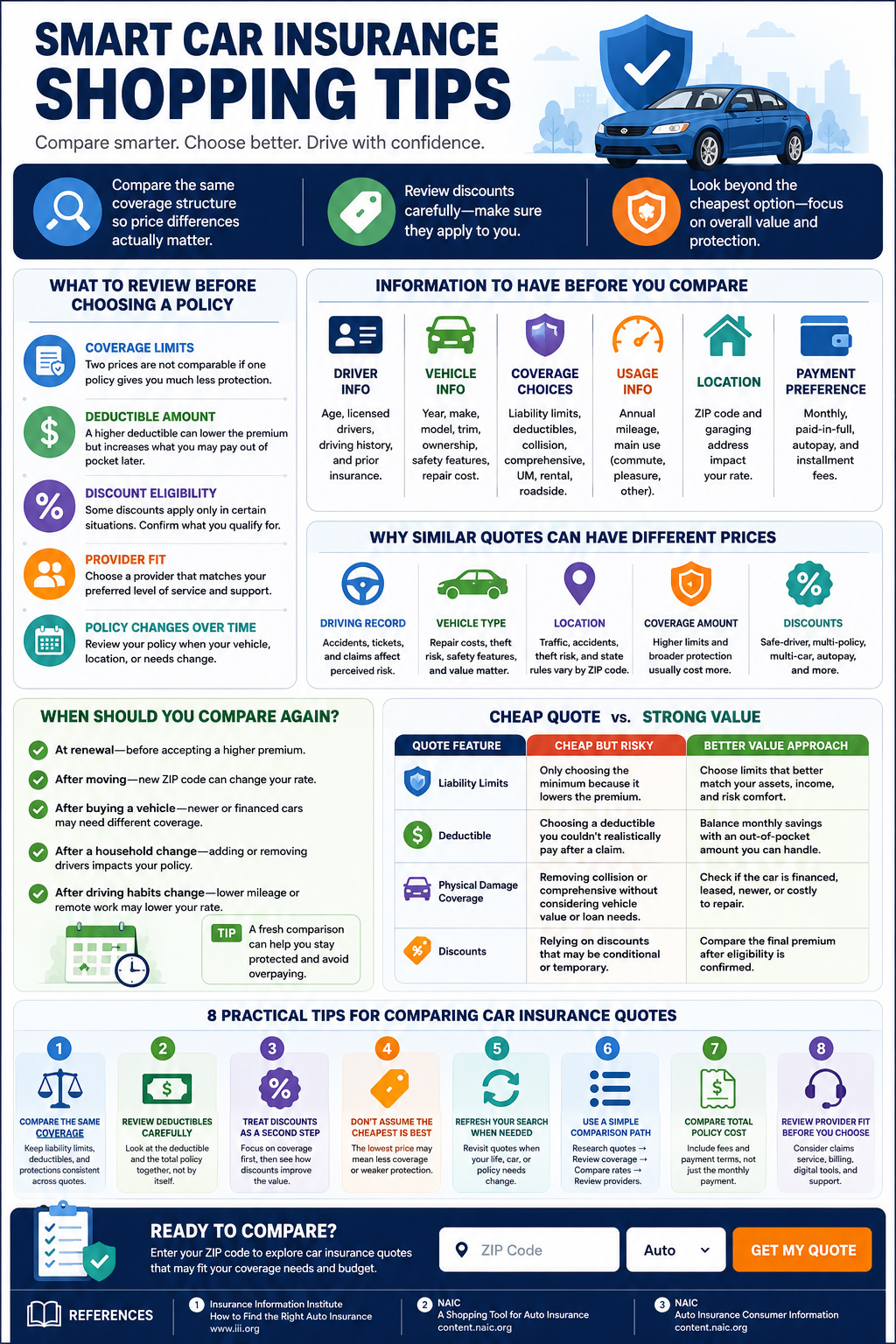
The infographic below summarizes the most important shopping checks before choosing a policy: what to review before buying, what information to gather before comparing quotes, why rates can differ, when to compare again, and how to avoid choosing a policy that looks cheap but is too thin.
How to Avoid Choosing a Policy That Is Too Thin
A thin policy is not always obvious from the price alone. It may meet state minimum requirements but leave you with low liability limits, no physical damage coverage for your own vehicle, a high deductible, or missing optional protections you assumed were included. This is why a cheap quote deserves a closer review before you treat it as the best option.
A policy can be a reasonable low-cost choice when the trade-off is intentional. For example, liability-only coverage may make sense for an older car with low market value. A higher deductible may make sense for a driver with enough emergency savings. But those choices should be made knowingly, not because the quote form quietly removed coverage to produce a lower premium.
Cheap Quote vs. Strong Value
| Quote Feature | Cheap But Risky | Better Value Approach |
|---|---|---|
| Liability limits | Only choosing the minimum because it lowers the premium. | Choosing limits that better match your assets, income, and risk comfort. |
| Deductible | Choosing a deductible you could not realistically pay after a claim. | Balancing monthly savings with an out-of-pocket amount you can handle. |
| Physical damage coverage | Removing collision or comprehensive without considering vehicle value or loan requirements. | Checking whether the car is financed, leased, newer, or costly to repair. |
| Discounts | Relying on discounts that may be conditional or temporary. | Comparing the final premium after eligibility is confirmed. |
Car Insurance Shopping Checklist Before You Buy
1. Compare the Same Coverage Before Comparing the Price
One of the most common shopping mistakes is comparing quotes that are built differently. If one company shows lower liability limits, a higher deductible, or fewer protections, the lower premium may not represent better value. It may only reflect a weaker policy design.
The better approach is to keep the main structure as consistent as possible across every quote. That makes it easier to judge whether a company is really more affordable or simply offering less. This is especially important before moving from research into active quote shopping.
2. Review the Deductible With the Rest of the Quote, Not by Itself
A deductible can change the monthly premium enough to make one quote look much more attractive than another. That is why it helps to review the deductible and the total policy structure together instead of focusing only on the premium shown on the screen.
A lower premium can feel appealing at first, but it may come with a deductible that changes how comfortable the policy feels later. A fair comparison should look at both the monthly cost and the policy setup behind it.
3. Treat Discounts as a Second Step, Not the Main Decision
Discounts can help, but they should not be the only reason you choose a policy. A quote can advertise multiple savings and still end up being less useful than another option that gives you a better balance of coverage and price.
The most useful way to review discounts is after you have already checked the main coverage structure. Once the policy basics make sense, then you can decide whether the discounts improve the overall value enough to matter.
4. Do Not Assume the Cheapest Quote Is the Best Quote
The lowest number on the page does not always tell the full story. A cheaper quote may reflect different coverage choices, fewer protections, or a policy structure that is not as strong as it first appears. That does not automatically make it a bad option, but it does mean it deserves a closer look.
A better shopping mindset is to ask whether the quote fits your actual needs, not just whether it is the smallest number available. This helps you avoid buying a policy that looks good at first but feels too thin once you review the details more carefully.
5. Refresh Your Quote Search When Your Situation Changes
Car insurance shopping is not something you do once and forget forever. Changes in your location, vehicle, driving profile, or coverage goals can all affect what makes sense for your next comparison. That is why revisiting the process can be useful even if you are not starting from zero.
A fresh comparison can also help when you move from early research into active shopping. The point is not to check constantly. The point is to revisit your options when the details behind your policy decision have changed in a meaningful way.
6. Use a Simple Comparison Path Instead of Jumping Around
Shopping gets easier when you follow a clear order. Start with basic quote research, review the type of coverage you want, compare rates more carefully, and then look at providers with the same policy structure in mind. That flow reduces confusion and helps you avoid judging one part of the process without enough context.
A simple structure often works best:
- Start with quote research so you can see realistic pricing paths.
- Review coverage choices before deciding what “cheap” really means for you.
- Compare rates with matched deductibles and policy structure.
- Review providers only after the basic quote setup is clear.
7. Compare Total Policy Cost, Not Just the Monthly Payment
Monthly payments are easy to understand, but they do not always show the full cost of the policy. Some policies include installment fees, processing fees, or different payment-plan terms. A quote that looks cheaper monthly may cost more over six months or twelve months once fees are included.
When possible, compare the total premium for the same policy term. If one quote is monthly and another is paid in full, convert both to the same time period before deciding. This gives you a cleaner view of the real cost.
8. Review Provider Fit Before Making the Final Choice
Price and coverage matter, but the provider also matters. Some drivers prefer a digital-first company with fast online tools. Others want local-agent support, more guidance, or a clearer claims process. A policy that saves a small amount each month may not feel like the best value if it is difficult to manage when you need help.
Before choosing, consider how you want to handle billing, policy changes, document access, claims, and customer support. The best quote is the one that fits both your budget and your service expectations.
Car Insurance Shopping Checklist Before You Buy
| Before You Buy | What to Confirm | Why It Matters |
|---|---|---|
| Policy type | Confirm whether the quote is liability-only or includes collision and comprehensive coverage. | A cheaper quote may simply include less protection for your own vehicle. |
| Liability limits | Check bodily injury and property damage limits side by side. | Minimum limits may satisfy state law but may not match your financial risk comfort. |
| Deductible | Confirm the deductible for collision and comprehensive coverage. | A high deductible can lower the premium but increase out-of-pocket cost after a claim. |
| Listed drivers | Make sure regular household drivers are handled correctly. | Missing driver information can cause quote changes or policy issues later. |
| Vehicle details | Review year, make, model, trim, VIN, vehicle use, and garaging address. | Incorrect vehicle or address details can change the final premium. |
| Discounts | Check whether discounts are confirmed, estimated, or conditional. | Some discounts may depend on proof, bundling, payment method, or eligibility review. |
| Total cost | Compare six-month or annual cost, not only the monthly payment. | Installment fees can make a monthly plan more expensive than it first appears. |
| Provider fit | Review support style, claims process, online tools, and policy management options. | The best quote is not only cheap; it should also be manageable when you need help. |
Continue Your Comparison
These pages can help you move to the next step without overlapping the purpose of this checklist. Use them when you want to go deeper into quotes, coverage, pricing, or provider comparison.
References
Explore Car Insurance Quotes With More Clarity
Enter your ZIP code to continue comparing car insurance options and review quote paths that may fit your coverage needs and budget.