Author: admin

  • Cost Analyzer

    Car Insurance Cost Analyzer

    Analyze the Real Cost Behind a Car Insurance Quote

    A car insurance quote can look affordable at first glance, but the monthly premium is only one part of the decision. A stronger cost review looks at the premium, deductible, coverage level, policy fees, discounts, and the amount you may need to pay out of pocket after a claim.

    This cost analyzer helps you compare the financial trade-offs behind two quote options before you move forward. It does not replace a final quote from an insurer, but it can help you understand whether a policy is truly affordable or only looks cheap on the surface.

    Created: April 26, 2026 Updated: May 9, 2026

    Monthly Premium

    The premium shows what you pay to keep the policy active, but it does not show the full financial exposure behind the policy.

    Deductible Risk

    A higher deductible may lower the monthly price, but it can increase what you would need to pay after a covered loss.

    Total Policy Fit

    The better question is whether the policy balances cost, coverage, deductible comfort, and real-world protection.

    Simple Car Insurance Cost Analyzer

    Enter two quote options to compare the estimated policy-term cost and the possible cost after one deductible event. This is a planning tool only. Final premiums, fees, and claim payments depend on the insurer and policy terms.

    Quote A

    Quote B

    Quote A annual premium + fees $0
    Quote B annual premium + fees $0
    Lower estimated annual cost
    Quote A with one deductible event $0
    Quote B with one deductible event $0
    Deductible comparison Quote A / Quote B
    Analyzer summary

    This tool uses simple math: monthly premium multiplied by 12, plus estimated fees, plus deductible when comparing a possible out-of-pocket event. It does not predict claims, underwriting decisions, coverage approval, or final insurer pricing.

    How to Read the Results From the Cost Analyzer

    The cost analyzer is not meant to tell you which insurance company is best. Its purpose is to show how the numbers behind two quotes can change once you include the annual premium, estimated fees, and deductible exposure. This is important because the lower monthly payment is not always the lower-risk choice.

    For example, Quote A may cost $145 per month with a $1,000 deductible, while Quote B may cost $170 per month with a $500 deductible. At first, Quote A looks cheaper because the monthly payment is lower. Over a full year, however, the difference may become less obvious once you add fees and think about what would happen after one covered claim.

    This is why the analyzer separates annual premium cost from deductible risk. The annual premium shows the predictable cost of keeping the policy active. The deductible event estimate shows what the policy may feel like if you actually need to use collision or comprehensive coverage. Both numbers matter, but they answer different questions.

    Result Shown What It Helps You Understand How to Use It
    Annual premium + fees The estimated predictable yearly cost before any claim happens. Use this to compare the basic cost of keeping each policy active.
    With one deductible event The estimated cost if you pay the annual premium, fees, and one deductible. Use this to judge whether the lower premium is still worth it after a possible covered loss.
    Lower estimated annual cost Which quote appears cheaper before considering claim risk. Do not choose based on this alone unless coverage and deductibles are also similar.
    Better deductible comfort Which quote may be easier to handle after a covered claim. Use this if your emergency savings are limited or you want less out-of-pocket risk.

    Example: When the Lower Monthly Premium Is Not the Better Deal

    Imagine two drivers comparing similar policies. Quote A is $132 per month with a $1,500 deductible and $40 in estimated fees. Quote B is $158 per month with a $500 deductible and $25 in estimated fees. Quote A looks cheaper because the monthly payment is $26 lower. Over twelve months, Quote A would cost about $1,624 before a claim, while Quote B would cost about $1,921 before a claim.

    Before a claim, Quote A saves about $297 for the year. But if the driver has one covered accident where the deductible applies, Quote A could require $1,000 more out of pocket than Quote B. In that situation, the lower premium may not feel like a better deal. The right answer depends on the driver’s savings, vehicle value, risk tolerance, and whether the deductible is realistic.
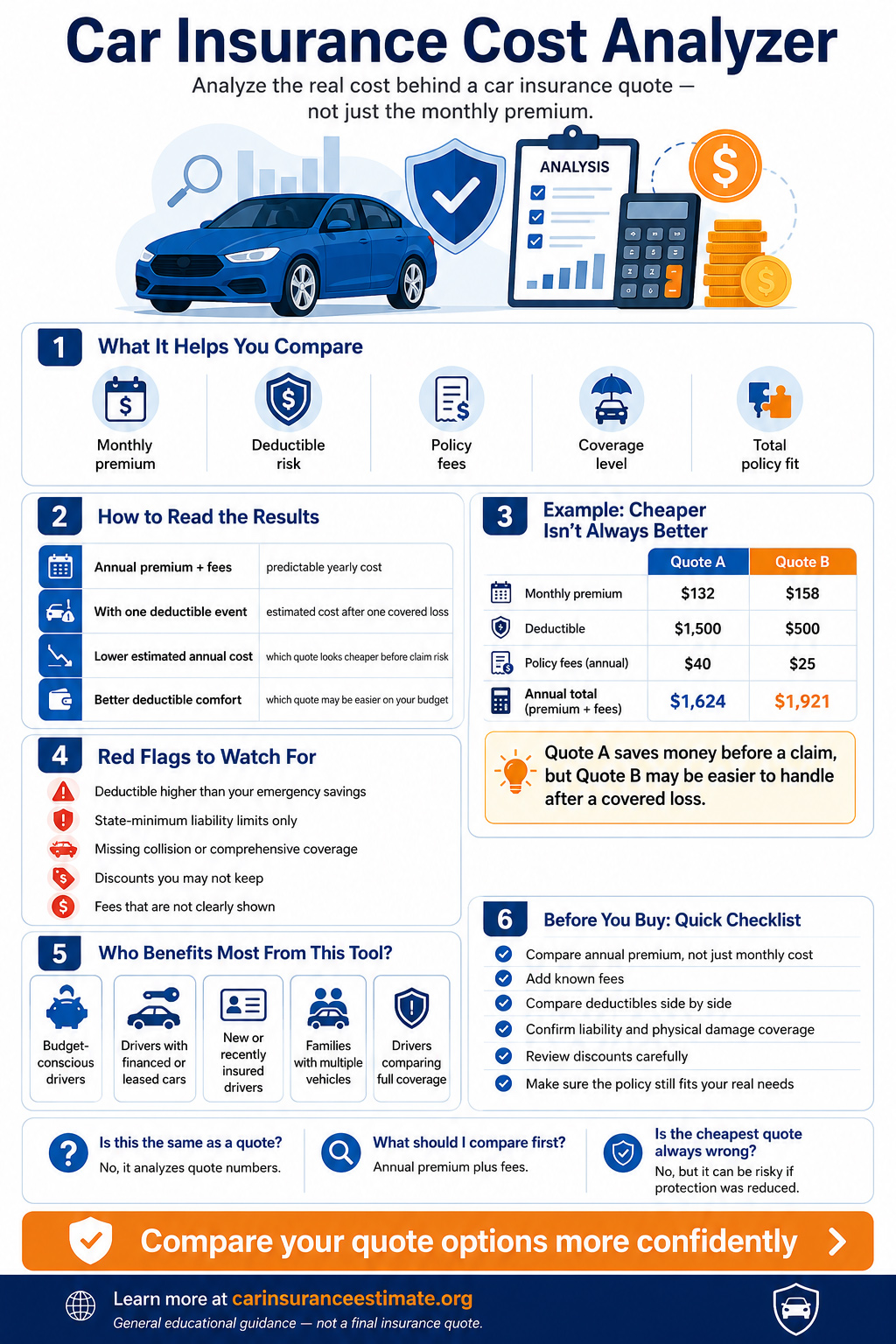
    Infographic explaining how to analyze the real cost of a car insurance quote, including monthly premium, deductible risk, policy fees, coverage level, red flags, quote comparison examples, and a pre-purchase checklist.

    This does not mean the higher-premium quote is always better. It simply means the decision should be based on more than the monthly payment. A driver with strong savings and a lower-value car may accept a higher deductible. A driver with a financed vehicle, tight monthly budget, or limited emergency fund may prefer a lower deductible even if the monthly premium is higher.

    Why a Cost Analyzer Is Different From a Quote Calculator

    A car insurance calculator usually helps you estimate a possible price range before you request a more specific quote. A cost analyzer works later in the shopping process. It helps you review the quote you already have and decide whether the price still makes sense after you include deductible risk, coverage quality, and possible fees.

    That difference matters because two quotes can look close on the monthly payment but feel very different when you compare the deductible, coverage limits, and out-of-pocket exposure. If you are still at the estimate stage, start with the car insurance calculator. If you already have numbers to compare, this cost analyzer can help you review them more carefully.

    What to Include When You Analyze Car Insurance Cost

    The monthly premium is the easiest number to notice, but it should not be the only number you compare. A stronger review looks at the full policy structure, including deductibles, liability limits, optional coverages, fees, discounts, and the way each quote would work if a claim happens.

    Cost Factor What It Means Why It Can Change the Real Value
    Monthly premium The recurring cost to keep the policy active. A lower premium may be helpful, but it can also reflect weaker limits, fewer protections, or a higher deductible.
    Deductible The amount you may need to pay before certain coverages respond to a claim. A higher deductible can reduce the premium but increase your out-of-pocket burden after a covered loss.
    Liability limits The maximum amount the policy may pay for covered injury or property damage you cause to others. Lower limits can make a policy cheaper, but they may also leave less protection after a serious accident.
    Collision and comprehensive Optional physical damage coverages that may help protect your own vehicle depending on the loss. Removing them may lower cost, but it can be a poor fit for financed, leased, newer, or higher-value vehicles.
    Discounts Potential price reductions based on driver, vehicle, payment, policy, or household factors. A discount only matters if the final policy still gives the coverage and deductible setup you actually want.
    Policy fees Possible installment, processing, policy, or service fees depending on the provider. Fees can make one quote less attractive even when the base monthly premium looks lower.

    How to Compare Two Quotes Without Getting Misled

    The most common mistake is comparing two quotes that are not built the same way. One policy may look cheaper because it has lower liability limits, a higher deductible, or missing protections. Another may look more expensive because it includes broader coverage or a lower deductible.

    Before deciding that one quote is better, compare the structure first. If the limits, deductibles, and included coverages are not similar, the price comparison is weak. For a deeper side-by-side shopping process, use the rate comparison guide after reviewing your numbers here.

    A quote is only “cheaper” in a useful way when the coverage behind it still fits your vehicle, budget, lender requirements, and risk comfort.

    Cost Analyzer Red Flags to Watch For

    A quote deserves closer review when the price looks unusually low compared with other options. Sometimes the quote is genuinely competitive. Other times, the low price comes from weaker coverage, missing protections, or a deductible that would be hard to pay after an accident.

    • The deductible is much higher than your emergency savings. A high deductible can lower the premium, but it can create stress if you cannot pay it after a covered loss.
    • The liability limits are only the state minimum. Minimum coverage may satisfy legal requirements, but it may not provide enough financial protection after a serious accident.
    • Collision or comprehensive coverage is missing. This can reduce the premium, but it may not work for financed, leased, newer, or higher-value vehicles.
    • The quote includes discounts you may not keep. Some savings depend on payment method, telematics participation, bundling, safe driving, or continuous coverage.
    • Fees are not clearly shown. Installment fees, policy fees, or processing fees can make a quote more expensive than it first appears.

    Premium vs. Deductible: The Trade-Off to Watch

    A deductible can change how affordable a policy feels. Choosing a higher deductible may reduce the premium, but it can also create a larger bill if a covered claim happens. Choosing a lower deductible may raise the premium, but it can make the policy easier to manage after a loss.

    There is no single right deductible for every driver. The better question is whether the deductible is realistic for your emergency budget. If the premium savings are small but the deductible becomes difficult to pay, the cheaper quote may not be as strong as it first appears.

    If you are mainly focused on low prices, also read the guide on the risks of choosing the cheapest car insurance before selecting a policy only because the monthly number is lower.

    Which Drivers Benefit Most From a Cost Analyzer?

    This type of tool is most useful for drivers who already have at least two quote options and want to compare the real trade-offs. It is especially helpful when one quote has a lower premium but a higher deductible, or when one policy includes stronger coverage that makes the monthly cost look higher.

    Driver Situation Why the Analyzer Helps What to Focus On
    Budget-conscious driver Shows whether a cheap monthly premium still creates manageable out-of-pocket risk. Annual cost, fees, and deductible comfort.
    Driver with a financed or leased car Helps compare broader coverage options that may be required by a lender or lessor. Collision, comprehensive, deductible, and full policy cost.
    New driver or recently insured driver Makes it easier to understand why quotes vary and where the cost is coming from. Coverage limits, deductible, prior insurance history, and discounts.
    Family with multiple vehicles Helps compare total cost when small monthly differences multiply across several cars. Bundling, multi-car discounts, fees, and annual total.
    Driver comparing full coverage Shows how deductible choices affect the real cost of broader protection. Premium, deductible, vehicle value, and claim affordability.

    When a Lower-Cost Policy Can Still Make Sense

    A lower-cost policy is not automatically a bad decision. It can make sense when the coverage level is intentional, the deductible is manageable, and the vehicle situation does not require broader protection. The problem is choosing a lower price without understanding what changed inside the quote.

    • The deductible is affordable if you need to file a covered claim.
    • The liability limits still feel reasonable for your risk level.
    • The policy includes the coverages you actually meant to buy.
    • The quote is being compared against similar policy structures.
    • Any discounts or fees are clearly reflected in the final cost.

    How Coverage Type Changes the Cost Picture

    The cost analyzer becomes more useful when you know what kind of policy you are reviewing. Liability-only, minimum coverage, and broader full coverage policies should not be judged as if they are the same product.

    If you are still unsure what liability, collision, comprehensive, uninsured motorist coverage, or optional protections mean, review the type of coverage guide before relying too heavily on price. If you are specifically comparing broader protection, continue to cheap full coverage car insurance after using this analyzer.

    Discounts Should Be Reviewed After the Policy Structure

    Discounts can help lower the final price, but they should not replace a coverage review. A discounted policy can still be a weak fit if the deductible is uncomfortable, the limits are too low, or the coverage leaves out protections you expected.

    Use discounts as the second layer of the decision. First check whether the policy itself makes sense. Then review whether the available savings improve the value. For more detail, visit discounts and offers.

    Cost Analyzer Checklist Before You Buy

    1. Write down the monthly premium for each quote.
    2. Multiply the monthly premium by 12 to estimate annual premium cost.
    3. Add known policy, installment, or processing fees if they apply.
    4. Compare deductibles side by side, not separately from the premium.
    5. Confirm liability limits, collision, comprehensive, and optional protections.
    6. Check whether discounts are guaranteed or only possible.
    7. Review whether the lowest-cost option still fits your real needs.

    Frequently Asked Questions

    Is a car insurance cost analyzer the same as a quote?

    No. A cost analyzer helps you compare the numbers behind a quote. It does not create a final policy price, approve coverage, or replace the insurer’s underwriting process.

    What number should I compare first?

    Start with the annual premium plus known fees because that shows the predictable yearly cost. Then compare deductible exposure because that shows what the quote may feel like if you actually need to use the policy. Finally, compare coverage structure. Looking only at the monthly payment can make a weaker policy look stronger than it really is.

    Is the cheapest quote always the wrong choice?

    Not always. A cheaper quote can be a good fit if the coverage, deductible, and provider still match your needs. It becomes risky when the lower price comes from protection you did not mean to remove, a deductible you cannot comfortably pay, or fees that were not obvious when you first compared the monthly premium.

    Should I use this before or after instant quotes?

    Use this after you have quote numbers to compare. If you have not started yet, begin with instant quotes and then return here to analyze the cost trade-offs.

    Does a higher deductible always save enough money?

    No. A higher deductible may lower the premium, but the savings should be compared with what you would need to pay after a covered loss. The deductible should still fit your real budget.

    Can this analyzer help me choose between full coverage and liability-only insurance?

    It can help you compare cost trade-offs, but it does not decide which coverage type is right for you. Full coverage usually costs more because it can include collision and comprehensive protection for your own vehicle. Liability-only coverage may be cheaper, but it generally does not pay to repair or replace your own car after many types of losses.

    Why do two quotes with similar monthly prices feel so different?

    Two quotes can have similar premiums but very different deductibles, limits, fees, exclusions, or optional coverages. That is why it is important to compare the full policy structure instead of only comparing the monthly payment.

    Ready to Compare Quote Options?

    After reviewing the real cost behind your policy options, enter your ZIP code to continue comparing available auto insurance paths.
  • The Risks of Choosing the Cheapest Car Insurance

    Last updated on April 14, 2026
    CIE

    Author
    CarInsuranceEstimate.org Editorial Team
    — insurance research and content

    This article was prepared by the CarInsuranceEstimate.org editorial team for general educational purposes. Our goal is to explain car insurance pricing, coverage choices, quote comparison, and shopping risks more clearly so readers can make more informed decisions before buying a policy.

    Choosing the lowest car insurance premium can look like an easy win, especially when monthly costs are tight. But the cheapest policy is not always the lowest-cost choice over time. A low premium can come with weaker liability limits, a higher deductible, missing protections, stricter exclusions, or a poor fit for the way you actually use your vehicle.

    That does not mean every lower-priced policy is automatically a bad choice. Sometimes a cheaper quote really is a reasonable option. The problem is assuming the lowest number on the page tells you enough. A stronger buying decision comes from comparing what the premium includes, what it leaves out, and what you may have to pay later if a claim happens. If you want a broader view of how quote comparison works, our rate comparison page is a strong companion to this topic.

    Illustration representing the risks of choosing the cheapest car insurance premium

    This page is intended for general educational purposes. The right policy depends on your vehicle, location, driving history, coverage needs, lender requirements, budget, and the insurer’s final quote terms. A lower premium is only useful when the policy still provides protection that fits your real situation.

    Why the cheapest premium can be misleading

    A low premium can look attractive because it reduces the monthly bill right away. But in many cases, the lower number reflects a trade-off. The quote may use lower liability limits, reduce optional protections, raise the deductible, or leave out features that matter once a claim happens. That means the cheap policy may only look better because it is not offering the same level of protection as the alternative.

    This is one of the biggest mistakes in insurance shopping: comparing price before comparing structure. A fair comparison only happens when the quotes are built on similar limits, deductibles, and coverage choices. If you still need help understanding the parts of a policy before comparing them, review our guide to car insurance coverage types.

    The cheapest premium is not automatically the cheapest overall outcome. A lower monthly number can still become a more expensive policy if the deductible is too high or the protection is too thin when you need it.

    Risk 1: Lower liability limits can leave you underprotected

    One of the most common reasons a quote looks cheaper is that it uses lower liability limits. In other words, the policy may meet a minimum legal requirement without giving much financial room if you cause a serious accident. That can matter more than many drivers realize, especially when property damage or injuries go beyond a basic minimum structure.

    A low premium built on low liability limits may be enough for some situations, but it should never be chosen without understanding the exposure. A cheaper quote is not necessarily a better value if the protection level leaves you uncomfortable with the financial risk. This becomes especially important for households with regular commuting, higher traffic exposure, or limited ability to absorb unexpected costs.

    Risk 2: A higher deductible can erase the savings very quickly

    Another common reason a policy looks cheap is that the deductible is much higher. That can lower the premium on paper, but it also means you may need to pay more out of pocket before insurance begins covering a loss. Many shoppers focus on the monthly cost and do not fully think through whether they could comfortably pay that deductible after an accident, theft, or other covered event.

    A higher deductible is not always the wrong choice. It can make sense for some drivers. The issue is choosing it only because it lowers the quote without checking whether it still fits your real emergency budget. If a lower premium only works because the deductible has become financially painful, the savings may be weaker than they first appear.

    Risk 3: Cheap policies may leave out protections that matter

    Some low-cost policies focus mainly on minimum required coverage. That may work for certain drivers, but it may also leave out protections that matter for the vehicle or the driver’s situation. Depending on the policy structure, the quote may not include collision, comprehensive, rental reimbursement, roadside assistance, or other features the shopper assumed would be there.

    This matters even more for newer vehicles, financed vehicles, or drivers who would struggle to replace or repair a vehicle out of pocket. A cheaper premium may not feel cheap anymore if the policy leaves you with a much larger bill after a loss. If you are comparing broader protection against lower-cost minimum-only options, our page on cheap full coverage car insurance is a useful next step.

    Risk 4: Exclusions and policy details can create false savings

    Low-price shopping often focuses on the headline premium, but the fine print still matters. A policy can look affordable while relying on narrower terms, omitted protections, or conditions that make the coverage less useful than expected. The issue is not that low-cost policies always hide something unusual. The issue is that shoppers may move too quickly and assume the cheaper option works the same way as the more complete one.

    That is why it helps to review the policy details before buying, especially when one quote is much cheaper than the others. If the difference is large, ask what changed. Was the deductible raised? Were limits lowered? Is a protection missing? The lower premium may still be acceptable, but you should know what is driving the number before you rely on it.

    Risk 5: Choosing only by price can lead to a weak comparison

    Price matters, but price alone does not tell you whether the quote fits your needs. A strong comparison also looks at how the provider handles claims, how easy the policy is to manage, how comfortable you are with the deductible, and whether the quote still reflects the protections you would realistically want after a loss.

    This is where many buyers make their biggest mistake. They compare only the premium, skip the rest, and end up selecting a policy that feels efficient in the short term but frustrating in the long term. If you want to compare insurers beyond the price itself, continue to compare providers. If you want to model price changes more practically, the car insurance calculator is also useful.

    Cheap premium vs. better-value policy

    What looks cheaper What may actually be happening Why it matters
    Very low monthly premium Liability limits may be lower than expected. The policy may leave less financial protection after a major accident.
    Cheaper quote with a much lower upfront cost The deductible may be much higher. Your out-of-pocket burden after a claim could be uncomfortable.
    Basic minimum-only policy Collision, comprehensive, or other protections may be missing. The policy may be a weak fit for financed, newer, or higher-value vehicles.
    One quote much cheaper than all others The policy structure may not match the other quotes. The comparison may be unfair and the savings may be misleading.
    Low premium from a provider you know little about The quote may still need a closer look at service and overall policy fit. Price alone does not show how the policy will feel when you need help.

    When a cheaper policy can still make sense

    A lower-priced policy is not always a bad decision. In some situations, it may be a practical fit. The key is making sure the lower premium reflects a deliberate choice rather than a blind shortcut. If the liability limits, deductible, and protections still match your needs, a less expensive option may be reasonable.

    • You understand the deductible and can comfortably afford it after a covered loss.
    • The liability limits still feel acceptable for your budget and risk tolerance.
    • The vehicle and policy situation are simpler and do not require broader protections.
    • The quote is being compared fairly against other quotes with similar structure.
    • You are choosing it intentionally because it fits your needs, not just because it is the lowest number.

    What to compare before buying the cheapest policy

    If you are tempted by the lowest premium, pause and review a few basics before buying. This step takes far less time than dealing with a poor-fit policy later.

    • Liability limits: are they lower than the competing quotes?
    • Deductible: could you realistically pay it after a claim?
    • Coverage type: does the quote include only minimum coverage, or does it still reflect what you actually want?
    • Omitted protections: are collision, comprehensive, rental, or roadside features missing?
    • Provider fit: are you comfortable with the insurer choice beyond the price?

    This quick review makes it easier to tell the difference between a genuinely affordable policy and a quote that only looks attractive because important parts were reduced or removed.

    Frequently asked questions

    Is the cheapest car insurance policy always the worst option?

    No. Sometimes the lower-priced quote is a reasonable fit. The problem is assuming it is the best option without reviewing liability limits, deductible size, coverage type, and overall policy fit.

    When does a high deductible stop being worth it?

    A higher deductible becomes less attractive when the premium savings are small compared with the amount you would struggle to pay after a covered loss. The deductible should still fit your real emergency budget.

    Can minimum coverage still make sense for some drivers?

    It can in some situations, but it should be a deliberate choice. The driver should understand what the policy includes, what it leaves out, and whether that lower level of protection still matches the vehicle and the risk they are willing to carry.

    What should I compare besides the premium?

    Review liability limits, deductible amount, omitted protections, exclusions, and whether the insurer and policy setup still fit your situation. A lower premium alone does not show the full value of the quote.

    What is the best next step after reading this page?

    If you want to compare prices more carefully, visit Rate Comparison. If you are ready to move faster toward quotes, go to Instant Quotes.

    Final thoughts

    The lowest premium can be a smart choice in the right situation, but only when it still reflects a policy you can actually rely on. A cheap quote becomes risky when it works by stripping away protection, raising the deductible beyond your comfort level, or creating a weak comparison against stronger policies.

    A better shopping approach is simple: compare the premium, but also compare what the premium buys. That extra review can help you avoid false savings and move toward a policy that balances affordability with realistic protection.

    Get a Quote
    Enter your ZIP code and compare available auto insurance options.

  • Are Instant Car Insurance Quotes Accurate? Common Concerns Explained

    By CarInsuranceEstimate.org Editorial Team

    Editorially reviewed informational content for U.S. car insurance shoppers

    Editorial details
    • Instant Quote Accuracy
    • Consumer Concerns
    • Quote Review

    The CarInsuranceEstimate.org Editorial Team creates informational content about car insurance estimates, instant quote paths, quote accuracy, coverage choices, provider comparison, and practical shopping questions for U.S. drivers.

    Articles are written to help readers understand why quote results can change, which details affect accuracy, how to compare quotes fairly, and what to review before choosing a policy.

    This content is for general informational purposes only and does not constitute insurance, legal, financial, or professional advice. Coverage availability, pricing, discounts, and policy terms vary by insurer, state, vehicle, and driver profile.

    Instant Quote Accuracy Guide

    Are Instant Car Insurance Quotes Accurate? Common Concerns Explained

    Instant car insurance quotes are popular because they give drivers a fast way to check pricing and compare options without making dozens of phone calls. That convenience is useful, but it also creates common questions about accuracy, price changes, coverage details, credit impact, and whether the cheapest quote is safe to choose.

    An instant quote can be a strong starting point, but it works best when you understand what the number represents. In most cases, the first quote is not the final policy price. It is an early result based on the information entered, the insurer’s rating model, and the coverage structure selected.

    For a broader overview of estimate-based pricing before moving into faster quote paths, review our guide on how car insurance estimates work and our main Instant Quotes page.

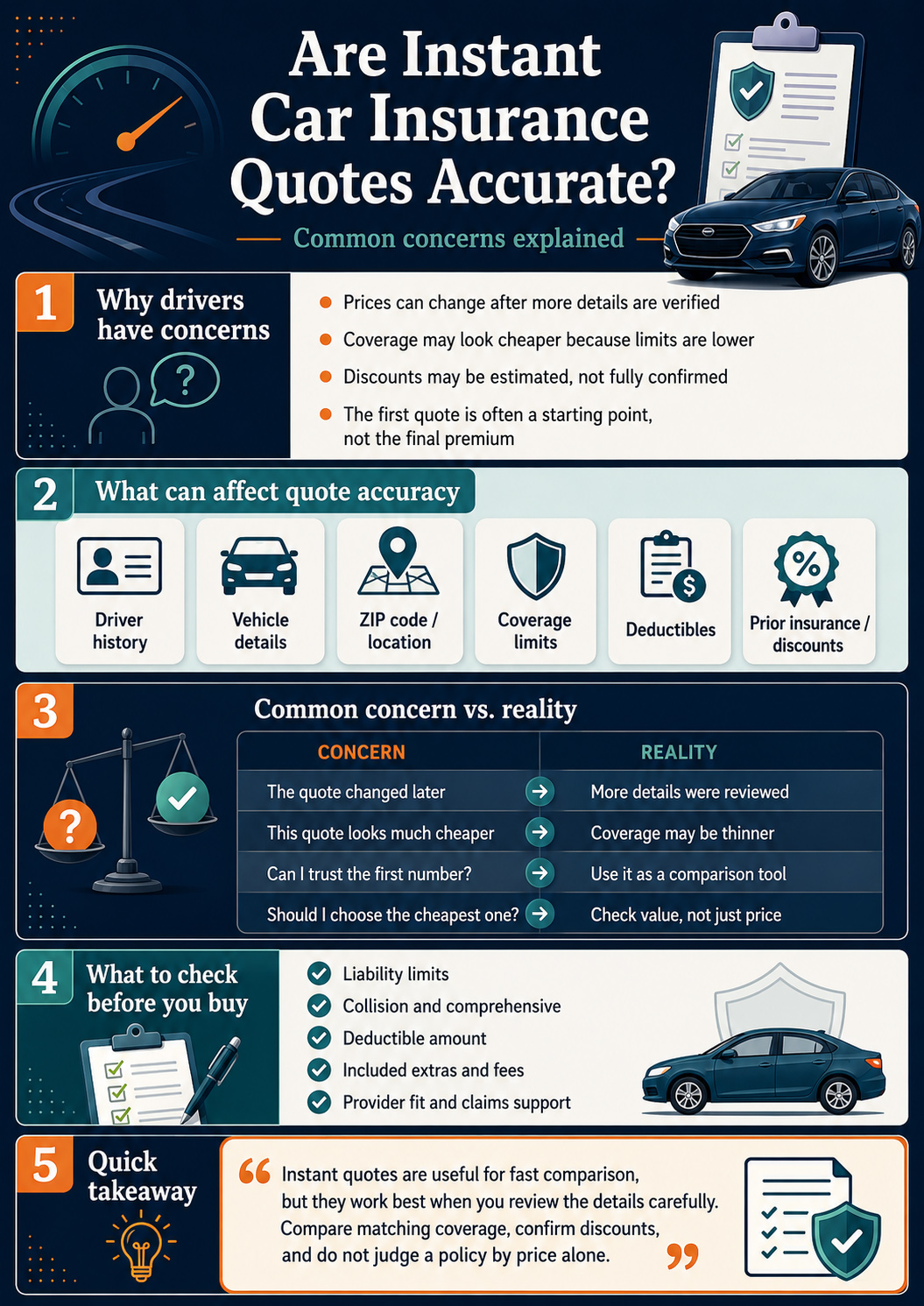
    Infographic explaining whether instant car insurance quotes are accurate, why prices can change, what affects quote accuracy, common quote concerns, and what drivers should check before buying.

    What This Page Helps You Check

    This page focuses on the concerns shoppers often have after seeing an instant quote. Instead of repeating a general guide to instant quotes, it explains why prices can change, what makes a quote more or less reliable, what information matters, and how to avoid choosing a policy based only on speed.

    • Accuracy: whether the quote is realistic enough to use for comparison.
    • Price changes: why the premium may move after verification or underwriting review.
    • Coverage quality: whether the quote includes enough protection for your situation.
    • Red flags: signs that a quote may be too thin, incomplete, or difficult to compare.

    Common Instant Quote Concern vs. What It Usually Means

    Concern What It Often Means Best Response
    The quote looks lower than expected The coverage may be thinner, the deductible may be higher, or some driver or vehicle details may still be missing. Check limits, deductibles, included protections, fees, and payment terms before comparing price alone.
    The quote changed later The insurer may have reviewed more complete information during verification, rating, or underwriting. Confirm all driver, vehicle, address, mileage, and prior insurance details before moving forward.
    The quotes are hard to compare They may not use the same liability limits, deductibles, optional protections, or discount assumptions. Match the policy structure before deciding which quote offers better value.
    The cheapest quote seems too good to be true It may exclude useful protections, use state-minimum limits, or rely on assumptions that do not match your real needs. Review coverage quality and provider fit, not only the monthly premium.
    You are unsure whether the quote affects credit Insurance-related rating practices vary by state and insurer, and the quote process may include disclosures about rating factors. Read the insurer’s disclosures and state-specific notices before assuming how the process works.

    Are Instant Car Insurance Quotes Actually Accurate?

    They can be accurate enough to help you compare options, but they should still be treated as an early shopping tool rather than a final guarantee. The quote becomes more reliable when the information entered is complete, the vehicle details are correct, and the coverage choices match what you actually want to buy.

    Problems usually appear when the quote is based on incomplete or overly simplified inputs. A shopper may enter a rough mileage estimate, skip a household driver, select lower limits without noticing, or leave out a detail that changes the insurer’s risk view. That does not make instant quotes useless. It means the number should be read carefully and verified before you commit.

    Why Do Instant Quote Prices Change?

    A quote may change because the insurer receives fuller information than what was originally entered. That can include a more detailed driving history, more exact vehicle data, address-based rating factors, coverage adjustments, prior insurance information, household driver details, or discount verification.

    Price changes do not always mean something went wrong. Sometimes they simply reflect a shift from a rough quote to a more detailed one. That is why it helps to keep your information as accurate as possible from the start and to understand what parts of the quote are still subject to review.

    Instant Quote vs. Verified Quote vs. Final Policy Price

    Stage What It Means What Can Still Change
    Instant quote A fast price indication based on the information entered during the quote flow. Driver details, vehicle information, discounts, deductibles, and selected coverages.
    Verified quote A more complete price after the insurer reviews more specific driver, vehicle, and coverage information. Eligibility, final discounts, payment plan, policy fees, and state-specific requirements.
    Final policy price The price shown after the policy terms, effective date, coverage selections, and payment method are finalized. Any future renewal changes, endorsements, added drivers, vehicle changes, or payment-plan changes.

    How Can You Tell Whether the Coverage Is Enough?

    Many drivers focus first on the monthly premium. That is understandable, but coverage adequacy matters just as much. A low quote can look attractive because it uses lower liability limits, a higher deductible, or fewer protections than another option. When that happens, the lower price may not represent better value at all.

    Before choosing an instant quote, make sure you understand whether it includes the protection level you actually need. That includes liability limits, deductible size, and whether collision, comprehensive, roadside assistance, rental reimbursement, uninsured motorist coverage, or other features matter for your situation. Our page on types of car insurance coverage is the best next step if the protection side of the quote still feels unclear.

    What Information Should You Have Ready Before Requesting Instant Quotes?

    The more complete your information is, the more useful the instant quote usually becomes. Having a few details ready before you start can reduce confusion and make it easier to compare results later.

    • Driver details: date of birth, license status, address, and recent driving history.
    • Vehicle details: year, make, model, trim, vehicle use, and approximate annual mileage.
    • Current insurance information: current carrier, current coverage level, and renewal timing if you already have a policy.
    • Coverage direction: whether you are looking for basic protection, stronger liability, or broader full coverage.
    • Household information: any additional drivers or vehicles that may affect the quote.

    How Should You Compare Two or More Instant Quotes?

    One of the biggest mistakes is comparing quotes that are not actually equivalent. If one option uses different liability limits, a different deductible, or fewer protections, the lower premium can be misleading. A fair quote comparison works best when the structure of the policy is closely matched from one insurer to the next.

    • Match liability limits: do not compare a weaker policy against a stronger one and assume the lower price is better.
    • Match deductibles: a higher deductible can make a quote look cheaper very quickly.
    • Check included protections: confirm whether collision, comprehensive, roadside, and rental coverage are included or missing.
    • Review discounts carefully: some quotes build them in early, while others only mention them as possible savings.
    • Look at provider fit: service style, claims confidence, and overall insurer fit still matter after the price review.

    For a more price-focused review process, continue to our rate comparison page. For a broader look at insurer fit, service approach, and shopping style, the next step is compare providers.

    When Is an Instant Quote Not Enough by Itself?

    An instant quote may not be enough when your situation is more specific or when the coverage decision carries more weight than speed alone. That can happen with financed vehicles, drivers with recent violations, households with multiple drivers, higher-value vehicles, or shoppers who want a more customized policy setup.

    In those cases, the instant quote is still useful as a first step, but it should usually be followed by a closer review of the actual quote details and the insurer’s final offer. Some shoppers also benefit from checking discount options separately, especially when they are comparing more than one payment style or coverage level. Our discounts and offers page can help with that side of the review.

    Biggest Red Flags to Watch For

    Convenience should not replace careful review. A quote can feel fast and attractive while still being incomplete, too narrow, or built on details that do not match your real profile.

    • A quote that looks dramatically cheaper without a clear explanation.
    • Coverage limits that are lower than you intended to buy.
    • A deductible that feels uncomfortable once you imagine paying it after a claim.
    • Missing household or vehicle details that could change the final result.
    • A buying decision based only on speed instead of on policy fit.

    Frequently Asked Questions

    Do instant car insurance quotes affect your credit?

    Getting a quote is not the same as applying for a loan, but insurance-related rating practices vary by state and insurer. Some insurers may use insurance-based credit information where allowed by law. Review the insurer’s disclosures and your state’s rules before assuming how a quote path handles rating factors.

    Can an instant quote become my final policy price?

    Sometimes it can stay close, but it should not be treated as guaranteed. Final pricing can still shift after the insurer reviews the information more fully or verifies discounts, payment terms, and policy details.

    Should I choose the cheapest instant quote?

    Not automatically. The better choice is the one that balances price, deductible comfort, liability protection, coverage quality, and overall provider fit.

    What is the best next step after reading this page?

    If you want to move directly into faster quote options, go to Instant Quotes. If you still need a more practical pricing path before deciding, use the Car Insurance Calculator.

    Final Thoughts

    Instant car insurance quotes are useful because they make shopping faster, easier, and more accessible. The key is not to treat that speed as proof that the first number you see is the final answer. A stronger result comes from using the quote as a decision tool, checking the details carefully, and comparing policies on more than price alone.

    When you understand why quotes change, what information matters, and how to review the structure behind the premium, instant quotes become much more valuable. That is when they stop being just a quick estimate and start becoming a more practical path toward a policy that fits your real needs.

    Ready to Compare?

    Compare Real Car Insurance Quote Options

    Enter your ZIP code to continue from quote accuracy research into real quote paths that may fit your coverage needs and budget.

  • Transition from Car Insurance Estimate to Quote

    Last updated on April 14, 2026
    CIE

    Author
    CarInsuranceEstimate.org Editorial Team
    — insurance research and content

    This article was prepared by the CarInsuranceEstimate.org editorial team for general educational purposes. Our goal is to explain insurance estimates, quotes, coverage choices, and comparison topics in a clearer and more practical way so readers can make more informed decisions before choosing a policy.

    Moving from a rough car insurance estimate to a more accurate quote is one of the most important steps in the shopping process. An estimate can help you understand a likely price range, but it is still only a starting point. A quote becomes more useful because it is based on more complete information, more specific coverage choices, and a closer review of the risk factors tied to the driver and vehicle.

    That difference matters. Many shoppers see an estimate, assume it reflects their final cost, and then feel confused when the number changes later. In reality, the transition from estimate to quote is where the comparison becomes more reliable. If you want to understand the process first, our guide on how car insurance estimates work is a strong starting point before you move deeper into quotes and policy comparison.

    Graphic showing the transition from a car insurance estimate to a more accurate quote

    This page is intended for general educational purposes. It does not guarantee a premium, policy approval, or final coverage outcome. Actual quotes depend on the insurer, the information provided, selected coverage, and the underwriting review.

    Estimate vs. quote: what changes between the two?

    An estimate is usually a planning number. It can help you decide whether a policy looks affordable enough to explore further, but it may be based on limited or simplified inputs. A quote is more specific. It reflects a fuller picture of your situation, including driver details, vehicle information, deductible choices, coverage limits, and other rating factors.

    That is why the shopping process works better when you treat an estimate as a first step and a quote as the point where real comparison begins. If you still need help choosing what type of protection makes sense before requesting quotes, review our explanation of car insurance coverage types.

    Estimate vs. quote vs. policy

    Stage What it usually shows How to use it
    Estimate A rough price range based on the information entered so far. Use it to understand affordability and decide whether to continue shopping.
    Quote A more specific price based on fuller driver, vehicle, and coverage details. Use it to compare insurers, deductibles, limits, and policy value more seriously.
    Policy The final contract with active limits, deductibles, exclusions, and covered drivers. Use it only after you have reviewed the details carefully and confirmed the fit.

    What you should have ready before requesting accurate quotes

    The easiest way to get better quotes is to prepare the right information in advance. Small mistakes or missing details can lead to weak comparisons, confusing price changes, or quotes that are not truly equivalent.

    • Driver information: license details, date of birth, address, and driving history.
    • Vehicle information: year, make, model, trim, VIN if available, and estimated annual mileage.
    • Current insurance details: current carrier, coverage level, and renewal date if you already have a policy.
    • Preferred coverage structure: liability limits, deductible range, and whether you want extras like roadside assistance or rental reimbursement.
    • Household details: any other drivers or vehicles that may affect the quote.

    Being prepared does not just make the process faster. It also makes the resulting quotes more useful because you are less likely to compare one policy with another that is built on different assumptions.

    How to move from an estimate to a more accurate quote

    The transition works best when you move in order rather than jumping randomly between pages, tools, and providers. A clean process is usually much more effective than chasing the first low number you see.

    1. Start with a realistic estimate. Use the estimate stage to understand a likely cost range, not to make a final decision.
    2. Clarify your coverage direction. Decide whether you are shopping for minimum protection, stronger liability, or broader full coverage.
    3. Move into a calculator or quote path. Once you know your direction, a more practical page like our car insurance calculator or instant quotes page makes more sense.
    4. Use the same information across providers. Keep the driver profile, deductibles, vehicle details, and limits as consistent as possible.
    5. Compare the full structure, not just the monthly number. A cheaper premium is not automatically a better policy if the protection is weaker.
    The goal is not simply to get a quote fast. The real goal is to get quotes that are accurate enough to compare fairly.

    What to compare once the quotes arrive

    Once you have several quotes in front of you, the next step is not to click on the cheapest one automatically. A useful comparison looks at the policy as a whole. This is where many shoppers make mistakes, especially when one quote has a lower price but also a much higher deductible or thinner protection.

    • Liability limits: make sure one quote is not cheaper simply because it offers less protection.
    • Deductibles: compare the out-of-pocket risk, not only the premium.
    • Coverage additions: check whether rental reimbursement, roadside assistance, comprehensive, or collision are included or missing.
    • Discount treatment: confirm whether discounts are already included in the quoted price or only mentioned as a possibility.
    • Provider fit: review claims experience, service style, and overall insurer fit, not just the headline price.

    If you want to focus more specifically on pricing differences, our rate comparison page goes deeper into how to compare quote numbers more carefully. If you want to look more closely at insurer fit, service style, and general provider differences, continue to compare providers.

    Common mistakes that make quotes less accurate

    The most common problem is not that drivers fail to get quotes. It is that they get quotes that are not really comparable. That usually happens because the inputs change, the coverage structure changes, or the shopper focuses too much on one number without checking what sits behind it.

    • Entering different deductibles across providers without noticing.
    • Comparing quotes with different liability limits.
    • Leaving out household drivers or important vehicle details.
    • Assuming the estimate was already close enough to the final quote.
    • Choosing a quote before reviewing policy value, provider fit, and exclusions.

    These mistakes are easy to make, especially when shopping quickly. But they can weaken the entire process and make a policy appear cheaper or better than it really is.

    Before you buy, review the final quote one more time

    Before committing to a policy, take a final pass through the quote details. This is the stage where clarity matters most. You want to confirm that the deductible still fits your budget, the liability limits still make sense, and any optional protections you care about are still included.

    You should also make sure the quote reflects the real information you intended to provide. If anything looks different from what you entered or expected, it is better to clarify it before purchasing rather than after a claim or billing issue appears.

    Frequently asked questions

    Why is my final quote different from my first estimate?

    That usually happens because the estimate was based on more limited inputs, while the quote reflects fuller driver, vehicle, location, and coverage details.

    How many quotes should I compare?

    Three to five quotes is often a practical starting range, as long as the information and coverage structure stay consistent across each comparison.

    Should I always choose the cheapest quote?

    No. A lower premium is only better when the deductible, limits, and overall policy fit still make sense for your situation.

    What is the best next step after reading this page?

    If you still need a practical estimate tool, visit the car insurance calculator. If you are ready to move faster toward quote options, the instant quotes page is the better next step.

    Final thoughts

    Car insurance estimates are useful because they help you understand a likely price range before you go deeper. But accurate quotes are where the real shopping decision begins. That is the stage where the details matter more, the comparison becomes more meaningful, and the difference between a weak policy and a strong one becomes easier to spot.

    A smoother transition from estimate to quote usually comes down to preparation, consistency, and careful comparison. When you keep the coverage structure aligned and review more than just the premium, you give yourself a much better chance of choosing a policy that balances affordability and protection in a more realistic way.

    Ready to move from estimates to real quote options?

    Continue with a clearer understanding of what changes between an estimate and a more accurate quote, and take the next step with the page that best fits your situation.

  • Auto Insurance Quote Without SSN

    Getting auto insurance without a Social Security Number (SSN) is possible, but the process depends on the insurance company, your state, your driver’s license status, and the type of coverage you need. Some insurers ask for an SSN because it can help them verify identity, review insurance history, or apply credit-based rating factors where allowed. However, not every driver has an SSN, and many shoppers can still compare options using other forms of identification.

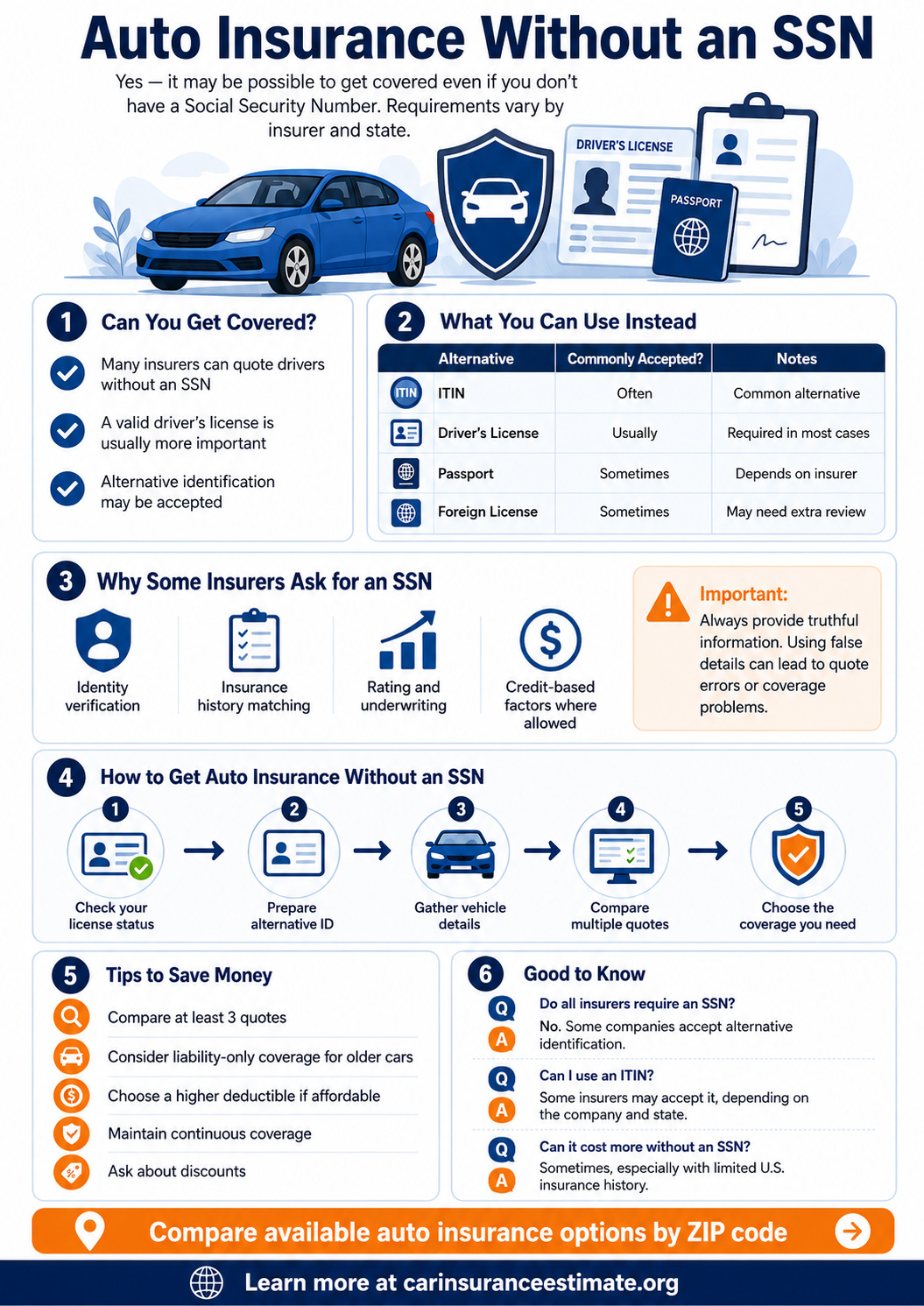
    Infographic about auto insurance without a Social Security Number (SSN), showing accepted alternatives such as ITIN, driver's license, passport, why insurers may ask for an SSN, steps to get covered, and tips to save money.

    This situation is common for new residents, international drivers, students, workers with an Individual Taxpayer Identification Number (ITIN), and people who recently moved to the United States. The most important thing is to be honest with the insurer and provide the documents they accept. You should not use incorrect information or another person’s SSN to get a quote. Instead, look for companies or agents that can quote drivers with alternative identification.

    If you’re looking for a fast solution, you can compare car insurance quotes online and find providers that may not strictly require an SSN to begin the quote process.

    Get a Quote
    Enter your ZIP code and compare available auto insurance options.

    Can You Get Car Insurance Without a Social Security Number?

    Yes, many drivers can get car insurance without providing an SSN, although requirements vary by insurer and state. Some companies may ask for your SSN during the quote process, but others may allow you to continue with a driver’s license number, ITIN, passport, or other accepted documentation.

    Insurance companies usually need enough information to identify the driver, rate the policy, check driving history, and connect the policy to the correct vehicle. That is why they often ask for details such as your name, address, date of birth, driver’s license number, vehicle identification number (VIN), prior insurance history, and sometimes an SSN. If you do not have an SSN, the key is finding a carrier that can work with alternative information.

    In fact, if you use tools like an auto insurance calculator, you’ll often find that the quote process begins with basic information such as ZIP code, vehicle details, coverage preference, and driving profile. The final insurer may still ask for additional documentation before issuing a policy.

    • You may be able to get insured without an SSN
    • Requirements vary by state, insurer, and underwriting rules
    • Alternative identification may be accepted by some companies
    • A valid driver’s license is usually more important than an SSN

    What Can You Use Instead of an SSN?

    If you don’t have an SSN, insurers may accept other forms of identification. The exact documents depend on the company, but these are common alternatives:

    Alternative Accepted? Notes
    ITIN Often accepted A common alternative for people who need a U.S. taxpayer identification number but are not eligible for an SSN
    Driver’s license Usually required Used to review driving history and verify that you can legally drive
    Passport Sometimes accepted May help with identity verification, depending on the insurer
    Foreign driver’s license Sometimes accepted Some insurers may require a U.S. license within a certain period
    State ID or other government ID Depends on insurer May support identity verification but may not replace a driver’s license

    Why Do Some Insurers Ask for an SSN?

    Insurance companies may ask for an SSN for several reasons. In many cases, it is used to help verify identity, match the driver to existing records, check prior insurance history, or apply rating factors. Some insurers also use credit-based insurance scores where permitted by state law. A credit-based insurance score is not the same thing as a regular credit score, but it can be one factor used by some companies when calculating premiums.

    That does not mean an SSN is always mandatory. Some insurers can quote and issue policies using other identifying information. Others may allow you to get an initial quote without an SSN but ask for more documentation before the policy is finalized. This is why it helps to compare more than one company instead of stopping after one insurer says no.

    Important: If an insurer asks whether you have an SSN, answer honestly. Using false information can lead to quote errors, cancellation, claim problems, or difficulty getting coverage later.

    Best Options for Drivers Without SSN

    If you’re trying to get insured quickly, your best option is to compare providers that specialize in flexible underwriting. These companies may focus more on your driving record, license status, vehicle, location, and coverage needs than on a traditional credit-based profile.

    You can also explore cheap full coverage car insurance options if you’re looking for stronger protection beyond state-minimum liability coverage. Full coverage may cost more, but it can be useful if you finance or lease your vehicle, or if you want protection for damage to your own car.

    • Online comparison tools that connect you with multiple carriers
    • Local independent agents who know which insurers accept alternative ID
    • Non-standard insurance providers that work with higher-risk or newer drivers
    • Companies that offer quotes based mainly on license, vehicle, location, and driving record

    How to Get Auto Insurance Without SSN

    1. Check your license status. Most insurers need a valid driver’s license or proof that you are eligible to drive in your state.
    2. Prepare alternative identification. This may include an ITIN, passport, state ID, foreign license, or other government-issued document.
    3. Gather vehicle information. You may need the VIN, year, make, model, mileage, ownership status, and garaging address.
    4. Compare quotes from multiple providers. One company may require an SSN while another may have a more flexible process.
    5. Ask about liability and full coverage. Choose coverage based on your budget, state requirements, and vehicle value.
    6. Review payment options. Some companies may require a larger down payment for drivers with limited U.S. insurance history.

    Will Insurance Cost More Without an SSN?

    Car insurance without an SSN can sometimes cost more, but not simply because you lack an SSN. The higher price often comes from related factors, such as limited U.S. driving history, no prior insurance record, a new license, or fewer records available to the insurer. If the company cannot verify certain information, it may rate the policy more cautiously.

    You can still reduce the cost by comparing several quotes, choosing the right coverage level, maintaining a clean driving record, and asking about discounts. Some insurers offer savings for defensive driving courses, paperless billing, automatic payments, vehicle safety features, or bundling multiple policies.

    Tips to Get Cheaper Insurance Without SSN

    • Compare quotes from at least three providers before choosing a policy
    • Choose liability-only coverage if your vehicle is older and you only need basic protection
    • Consider a higher deductible if you can afford the out-of-pocket cost after a claim
    • Keep continuous insurance coverage to build a better insurance history
    • Avoid lapses, missed payments, and cancellations
    • Ask whether an ITIN or other documentation can help verify your profile
    • Review your quote carefully to make sure your name, address, vehicle, and license information are accurate

    Common Mistakes to Avoid

    One common mistake is assuming that every company has the same rules. If one insurer requires an SSN, that does not mean all insurers will reject your application. Another mistake is buying the cheapest policy without checking the coverage limits. A very low premium may come with state-minimum liability only, which may not be enough after a serious accident.

    Drivers should also avoid leaving out household drivers or giving an old address to get a cheaper price. Insurance companies use accurate garaging address, household information, and vehicle details to rate the policy. If the information is wrong, the policy can become harder to use when you need it most.

    Frequently Asked Questions

    Can I drive legally without an SSN?
    An SSN is not what gives you permission to drive. You generally need a valid driver’s license, valid registration, and the minimum insurance required by your state.

    Do all insurance companies require an SSN?
    No. Some insurers may require it, while others may accept alternative identification or allow the quote process to begin without one.

    Can I use an ITIN instead of an SSN?
    Some insurers may accept an ITIN as an alternative form of identification, but it depends on the company and state.

    Is car insurance more expensive without SSN?
    It can be more expensive in some cases, especially if you have limited U.S. driving or insurance history. Comparing quotes can help you find a better rate.

    Can I get full coverage without an SSN?
    Possibly. If the insurer can verify your identity, license, vehicle, and payment information, you may be able to buy liability, collision, and comprehensive coverage.

    Conclusion

    Getting auto insurance without an SSN is possible, but it requires comparing the right providers and being ready with alternative documents. Some companies may ask for an SSN, while others may accept an ITIN, driver’s license, passport, or other identification. The best approach is to compare quotes, keep your information accurate, and choose coverage that fits both your legal requirements and your budget.

    If your first quote does not work, keep looking. Drivers without an SSN may still find affordable coverage through comparison tools, independent agents, and insurers with more flexible underwriting guidelines.

    Get a Quote
    Enter your ZIP code and compare available auto insurance options.

    References

    1. NAIC — A Consumer’s Guide to Auto Insurance
    2. IRS — Individual Taxpayer Identification Number (ITIN)
  • Personalized Car Insurance Quotes: Get Tailored Coverage

    Car Insurance Resource Center

    Explore Car Insurance Tools, Guides, and Quote Resources in One Place

    CarInsuranceEstimate.org brings together practical quote tools, coverage guides, provider comparison pages, and educational resources to help drivers understand options more clearly before requesting estimates.

    How This Resource Page Helps

    A page like this works best when it does more than list links. It should guide visitors to the right section of the site based on what they need: quick estimates, savings advice, provider comparison, beginner explanations, or specific tools.

    That makes it useful for both readers and internal linking. Instead of looking like an outdated auto-generated page, it becomes a strong support hub that connects your main commercial and informational pages in a cleaner way.

    Browse by Topic

    Category Recommended Pages Best For
    Quote Tools Instant Quotes,
    Insurance Estimates,
    Accurate Quotes Online
    Visitors who want fast estimate-focused pages
    Calculators Estimate Car Insurance Calculator,
    Auto Insurance Calculator,
    Car Insurance Calculator,
    Cost Analyzer
    Drivers trying to understand possible pricing patterns
    Coverage & Savings Type of Coverage,
    Cheap Full Coverage Car Insurance,
    Discounts and Offers
    Users comparing protection levels and savings opportunities
    Provider Research Provider Reviews,
    Compare Providers,
    Rate Comparison,
    Best Comparison Sites
    Readers evaluating insurers and comparison methods
    Help Center FAQ,
    Tips and Advice,
    Car Insurance Guide,
    Resources
    General education and support for less experienced shoppers

    Popular Estimate Tools

    Coverage & Savings Pages

    Where to Start Based on Your Goal

    Your Goal Best Starting Page Why It Helps
    Get started fast Instant Quotes Strong entry page for fast-moving quote intent
    Estimate possible costs Car Insurance Calculator Useful for users who want pricing context before shopping
    Learn basic coverage Car Insurance Basic Simple educational entry point for beginners
    Compare carriers and pages Compare Providers Helps visitors organize provider research
    Get general help FAQ Good support page for common questions and navigation

    Additional Helpful Sections

    • Blog — ongoing articles and informational content.
    • Tools — a natural hub for calculators and estimate resources.
    • Resources — ideal place for grouped educational navigation.
    • About — supports trust and brand transparency.
    • Services — useful if you want to frame what the site actually offers.
    • Contact — important for trust, support, and site legitimacy.

    Frequently Asked Questions

    Is a page like this good for SEO?

    Yes, but only when it is useful. A strong resource page can improve internal linking and navigation. A thin page with only a random list of links usually does very little.

    Should all pages be linked from here?

    Not necessarily. It is better to feature the strongest pages by category instead of stuffing every URL without context. The page should feel curated, not auto-generated.

    Can an older Airtable-made page still be improved?

    Yes. What matters most is whether the final page is helpful, readable, and clearly organized. Old auto-generated content can still become valuable after manual cleanup and restructuring.

    Where should this content live?

    The best fit is usually a page like Resources or Tools. That gives it a clear purpose and keeps it from feeling like filler content.

    Start Exploring Car Insurance Estimate

    Whether you want to compare providers, understand coverage types, or explore estimate tools, this resource hub can help you find the right starting point faster.

  • Compare Car Insurance Quotes & Save | Free Tool

    Last updated on May 9, 2026
    Editorial note: This page is intended for general consumer education. Auto insurance rules, minimum limits, available coverages, and quote methods vary by state and insurer. Always confirm details with the insurer and your state insurance department before buying a policy.

    Compare Car Insurance Quotes With More Clarity

    Comparing car insurance quotes can help you understand pricing, review coverage options, and avoid paying for protection you do not need. A good estimate tool does not replace the final underwriting process, but it can give you a more organized starting point before you choose a policy.

    At CarInsuranceEstimate.org, our goal is to help drivers review quote options more carefully, compare similar coverage levels, and spot the details that matter most before making a decision. This page focuses on how to use a quote or estimate tool correctly: what information to enter, how to compare the results, what can change later, and what to review before buying.

    Car insurance quote and estimate comparison data illustration

    Quick Takeaways

    • Quotes are only useful when you compare similar limits, deductibles, and optional coverages.
    • Your final premium may change after the insurer reviews driving history, vehicle details, household drivers, and state-specific requirements.
    • A lower monthly price is not always the better value if the policy has weaker protection or a deductible you would struggle to pay.
    • The smartest way to shop is to compare price, coverage, insurer reputation, and policy fit together.

    What a Car Insurance Estimate Tool Can Help You Do

    A quote or estimate tool can save time because it gives you a clearer structure for reviewing policies. Instead of calling several companies without a plan, you can start by checking your likely coverage needs, comparing deductible choices, and identifying pages that explain the basics in plain language, such as type of coverage and car insurance basics.

    What the tool helps with Why it matters Helpful page
    Estimate quote ranges Gives you a starting point before you speak with an insurer or agent. Insurance Estimates
    Compare similar coverage setups Makes quote shopping more accurate and less misleading. Rate Comparison
    Review price factors Helps you understand why two quotes may differ. Cost Analyzer
    Review provider options Price is only one part of the decision. Compare Providers
    Learn the basics before buying Reduces confusion around terms, limits, and optional protections. Car Insurance Guide

    What Makes a Quote Tool Useful?

    A car insurance quote tool is useful when it helps you organize the same information across several quote paths. The tool itself does not decide the final premium. It helps you start the comparison process with details such as ZIP code, vehicle information, coverage preference, deductible choice, and driver profile.

    The strongest use of a quote tool is not simply finding the lowest number. It is using the tool to compare similar policies more consistently. If you change limits, deductibles, or vehicle-use details from one quote to another, the results may stop being comparable.

    That is why a quote tool should be treated as the beginning of the insurance decision, not the end. After you see a quote, review the policy structure, verify the information, and confirm the final details with the insurer before buying.

    Quote Tool Input Why It Matters Common Mistake
    ZIP code or garaging address Location can affect price because accident frequency, theft risk, traffic density, and state rules vary. Using an old address or a mailing address instead of where the vehicle is kept.
    Vehicle details Year, make, model, trim, repair cost, safety features, and theft risk can influence the quote. Entering a similar model instead of the exact vehicle or VIN when required.
    Coverage limits Higher limits may cost more but can provide stronger financial protection after a covered loss. Comparing a minimum-limit quote against a higher-limit quote as if they were equal.
    Deductible A higher deductible can lower premium but raises the amount you may pay after certain claims. Choosing a deductible that would be difficult to afford just to lower the monthly price.
    Drivers and mileage Household drivers and estimated use can affect eligibility and pricing. Leaving out regular drivers or entering unrealistic mileage.

    Quote Tool vs. Estimate vs. Final Policy

    A quote tool, an estimate, and a final policy price are related, but they are not the same thing. A quote tool helps collect and organize information. An estimate gives a likely price range or starting number. A final policy price is the number shown after the insurer completes its process and confirms the policy details.

    This distinction matters because many drivers treat the first online number as final. In reality, the final premium may change after the insurer reviews driving history, vehicle details, garaging address, listed drivers, coverage selections, discounts, and payment plan.

    Stage What It Means What to Do Next
    Quote tool A tool or form that collects information to begin the quote process. Enter accurate driver, vehicle, address, coverage, and deductible information.
    Estimate An early pricing indication based on the available information. Use it to compare possible price paths, not as a guarantee.
    Final policy price The price after the insurer finalizes rating, eligibility, coverage, discounts, and payment terms. Review the declarations page, effective date, payment schedule, coverage limits, and exclusions before buying.

    Why Quotes Change From One Driver to Another

    Car insurance pricing is not based on one detail alone. Two drivers can own similar cars and still get different estimates because insurers look at a mix of rating factors. That is why it helps to use pages like our estimate car insurance calculator and auto insurance calculator as educational tools, not as guarantees of the final premium.

    Factor How it can affect the estimate What to review
    Driving record Accidents, violations, and claims history can change eligibility and pricing. Check that all driver information is entered correctly.
    Vehicle type Repair costs, theft risk, safety features, and model value may affect rates. Review trim, VIN details, and usage.
    Coverage limits Higher protection often means a higher premium, but also stronger financial protection. Do not compare low-limit and high-limit quotes as if they were equal.
    Deductible choice A higher deductible can lower the premium, but increases out-of-pocket risk after a claim. Choose an amount you could realistically afford.
    Household drivers and mileage Who drives the vehicle and how often it is used can affect the final quote. Be accurate when entering household and vehicle-use details.

    How to Compare Quotes the Right Way

    1. Match the same liability limits, deductibles, and optional coverages across all quotes.
    2. Check whether roadside assistance, rental reimbursement, or other extras are included or priced separately.
    3. Review the insurer, not just the price. You can explore provider reviews and broader comparison-site guidance.
    4. Look carefully at discounts, but confirm that they actually apply to your situation.
    5. Treat the estimate as the beginning of the decision, not the end of it.

    Coverage Terms Worth Understanding Before You Buy

    One of the biggest mistakes drivers make is shopping by price alone without understanding what is inside the quote. If you are new to the topic, our how car insurance estimates work page, coverage-type guide, and FAQ can help you compare policies with more confidence.

    Common quote items to review

    • Liability coverage: pays for damage or injuries you cause to others, subject to policy limits.
    • Collision: helps pay for damage to your car after a covered crash, usually with a deductible.
    • Comprehensive: generally applies to non-collision losses such as theft, vandalism, weather, or animal impact.
    • Uninsured or underinsured motorist: may help if another driver does not have enough coverage.
    • Deductible: the amount you pay out of pocket before certain coverages begin to pay.

    Ways to Lower Cost Without Shopping Blindly

    Looking for a cheaper premium is reasonable, but the goal should be better value, not just a lower number. Sometimes a cheaper quote becomes a weaker deal once you notice lower limits, a much higher deductible, or reduced optional protection. If your priority is affordability, start with our discounts and offers page and our guide to cheap full coverage car insurance.

    Smart savings ideas to review

    • Ask whether all eligible discounts are applied.
    • Review whether a higher deductible makes sense for your emergency budget.
    • Check whether older vehicles still need the same level of physical damage coverage.
    • Keep driver, address, mileage, and vehicle information accurate.
    • Compare multiple quotes using the same setup instead of changing variables from one quote to the next.

    Important Consumer Note

    A quick online quote can be useful, but it is not the same as a fully issued policy. The final premium may change after the insurer verifies driving records, claims history, vehicle information, household details, coverage elections, and state-specific requirements. This is especially important for drivers comparing options for younger motorists or special situations, such as young driver quotes or questions around quotes without an SSN.

    If you are financing a vehicle, review optional products carefully. A lower monthly payment does not always mean a lower total cost, and not every add-on is necessary for every driver.

    Before You Trust a Quote Tool Result

    Before relying on a quote tool result, check whether the quote reflects the coverage you actually want. A quote can look attractive because it removes optional protections, uses a higher deductible, or shows only minimum liability limits. That does not automatically make it bad, but the trade-off should be clear.

    • Confirm that the vehicle, drivers, ZIP code, and mileage are accurate.
    • Compare the same liability limits and deductibles across quotes.
    • Check whether collision and comprehensive coverage are included if you need them.
    • Review whether discounts are guaranteed, estimated, or conditional.
    • Compare the total policy cost, not only the monthly payment.

    Frequently Asked Questions

    Can an online quote tell me my exact final premium?

    Not always. It can provide a strong starting estimate, but the final premium may change after the insurer verifies your information and applies state-specific rules.

    Should I choose the cheapest quote?

    Only if the coverage, deductible, and policy fit are still appropriate. The lowest price is not automatically the best value.

    Why do two quotes look very different?

    The insurer may be using different assumptions, discounts, limits, deductibles, optional coverages, or driver and vehicle details. Always compare matching setups.

    What should I check before trusting a quote tool result?

    Check the listed drivers, vehicle details, ZIP code, mileage, liability limits, deductibles, discounts, payment plan, and whether collision or comprehensive coverage is included if you need it.

    Is this page a substitute for an insurer or state regulator?

    No. This page is educational. Before buying, confirm requirements, policy details, and final price directly with the insurer and your state insurance department.

    Final Thoughts

    A quote tool works best when you use it to compare similar policies, understand your coverage choices, and review the trade-off between price and protection. It should help you ask better questions, not rush you into a weak policy.

    If you want to continue your research, explore our tailored quote guidance, visit our resources, or browse more articles in our blog.

    Get a Quote
    Enter your ZIP code and compare available auto insurance options.
  • Car Insurance Estimator: Get Accurate Quotes Online

    Last updated on April 13, 2026
    Editorial note: This page is for general consumer education. Car insurance pricing, coverage availability, discounts, and legal requirements can vary by insurer and state, so final quotes and policy terms should always be confirmed before purchase.

    Get More Accurate Car Insurance Quotes Online

    A car insurance estimator can help you organize your search, compare quote paths, and understand how coverage choices may affect the price you see. Used correctly, it saves time and gives you a more structured way to review your options before moving forward with a policy.

    The key is to treat an estimate as a starting point, not a final guarantee. A quote only becomes useful when you compare similar coverage levels, deductibles, and optional protections across more than one provider. That is why it helps to begin with pages like Instant Quotes, Insurance Estimates, and Rate Comparison so you can evaluate prices with more clarity.

    Why an estimator can be useful

    • It gives you a faster starting point than contacting multiple insurers one by one.
    • It helps you review how deductibles and coverage choices may change the quote range.
    • It encourages more organized comparison shopping instead of choosing the first low price you see.
    • It can help you spot whether a quote looks incomplete, underinsured, or unusually high.

    What this tool can and cannot do

    A good estimator is valuable because it helps drivers prepare before they commit to a policy. Still, it is important to understand its limits. The final premium can change once the insurer verifies driving history, vehicle details, household drivers, location, mileage, and policy elections. For a clearer foundation, it helps to review Car Insurance Basic, Type of Coverage, and our Car Insurance Guide before relying too much on the first number you get.

    Estimator benefit What it helps you do What to keep in mind
    Fast comparison start Review multiple quote paths without starting from zero every time. You still need to compare the same limits and deductibles.
    Coverage planning See how coverage choices may affect price. Cheaper is not always better if protection is weaker.
    Budget review Estimate whether a policy setup may fit your monthly budget. A low premium may come with a higher deductible or fewer extras.
    Provider screening Use price as one factor while continuing to review providers and policy fit. Provider quality, service, and claim experience also matter.

    Why two drivers rarely see the same quote

    Car insurance quotes are built around many variables, not one. Even if two drivers own similar vehicles, their estimates can differ because insurers are evaluating a combination of personal, vehicle, and policy details. That is why educational pages such as our Estimate Car Insurance Calculator, Auto Insurance Calculator, and Cost Analyzer can help you understand quote ranges more realistically.

    Factor Why it matters How to use it when comparing
    Driving record Past violations, claims, or accidents can affect risk and pricing. Make sure the quote uses accurate driver information.
    Vehicle details Repair cost, theft risk, safety features, and model value all matter. Confirm make, model, year, and usage are consistent.
    Coverage limits Higher protection often changes the quote more than people expect. Only compare quotes with matching limits.
    Deductible amount A higher deductible may lower premium but raise out-of-pocket risk. Use a deductible you could actually afford after a claim.
    Household and mileage Who drives the car and how often it is used can affect the final price. Keep household and driving-use details accurate.

    How to compare quotes more accurately

    1. Use the same driver and vehicle information every time.
    2. Match liability limits, deductibles, and optional coverages across quotes.
    3. Review the insurer and not just the price. Our Provider Reviews and Compare Providers pages can help with that step.
    4. Check which extras are included, such as roadside assistance, rental reimbursement, or glass coverage.
    5. Use discounts as a bonus, not as a substitute for reviewing the actual policy setup.

    What to prepare before you request a quote

    Quote tools work better when you gather the right information first. This reduces input errors and makes your comparison more useful. It also helps you move from a rough estimate to a cleaner final quote with less back-and-forth later.

    Helpful information to have ready

    • Driver details: license status, driving history, and household drivers.
    • Vehicle details: year, make, model, ownership status, and how the car is used.
    • Coverage goals: whether you want basic legal protection or broader coverage.
    • Budget preferences: how much you could manage monthly and what deductible feels realistic.
    • Special circumstances: younger drivers, financed vehicles, or questions about quote paths that do not require an SSN at the early stage.

    Look beyond price before choosing a policy

    The cheapest estimate is not automatically the best choice. Many drivers focus on the monthly premium and forget to review what is actually included. A low price can sometimes mean lower liability limits, fewer protections, or a deductible that is too high for the driver’s real financial situation.

    That is why it helps to compare price with policy fit. If you are trying to reduce cost without weakening your protection too much, review our Discounts and Offers, Cheap Full Coverage Car Insurance, and Tips and Advice pages before deciding that the lowest number is the right answer.

    Smarter ways to look for savings

    • Ask whether all available discounts are already included.
    • Review deductible options carefully instead of lowering coverage too quickly.
    • Check whether older vehicles still need the same physical damage setup.
    • Compare quotes with matching assumptions so the results are meaningful.
    • Balance affordability, protection, and provider fit rather than chasing one low number.

    Useful pages for special quote situations

    Some drivers need more specific guidance than a general quote page can provide. For example, younger drivers often face higher prices and may need extra context, while other shoppers may want to understand how quote flows work when they are early in the shopping process. In those cases, you can also review Car Insurance Quotes for Young Drivers, Tailored Car Insurance Quotes, and Auto Insurance Quote Without SSN for more focused reading.

    Helpful external resource

    For broader consumer guidance on comparison shopping, coverages, and policy review, see:

    Frequently Asked Questions

    Can an online estimator tell me my exact final premium?

    Not always. It can give you a useful starting estimate, but the final premium may change when the insurer verifies details and applies its full underwriting process.

    Should I choose the lowest quote?

    Only if the limits, deductibles, optional protections, and provider fit still make sense for your situation.

    Why do two quotes look so different?

    The inputs may not match. Differences in driver history, vehicle details, deductibles, limits, or optional coverages can change the quote significantly.

    Where should I go next after using an estimator?

    Continue with quote comparison, provider research, and basic coverage review so you can make a better-informed final decision.

    Final Thoughts

    A car insurance estimator works best when it helps you compare similar quotes, understand the trade-off between price and protection, and organize your next steps. It should make shopping clearer, not push you into choosing a policy too quickly.

    To keep researching, you can also browse our Resources, visit the Tools section, explore the Blog, or learn more about the site through our About, Services, Contact, and FAQ pages.

    Get a Quote
    Enter your ZIP code and compare available auto insurance options.

  • Cheap Full Coverage Car Insurance: Lower Costs Without Losing Protection

    By CarInsuranceEstimate.org Editorial Team

    Editorially reviewed informational content for U.S. car insurance shoppers

    Editorial details
    • Full Coverage
    • Cost Comparison
    • Coverage Decisions

    The CarInsuranceEstimate.org Editorial Team creates informational content about car insurance estimates, full coverage decisions, quote comparison, deductibles, coverage types, and practical shopping questions for U.S. drivers.

    Articles are written to help readers understand how liability limits, collision, comprehensive coverage, deductibles, vehicle value, discounts, insurer requirements, and state rules may affect quote results and final policy pricing.

    This content is for general informational purposes only and does not constitute insurance, legal, financial, or professional advice. Coverage availability, pricing, discounts, and policy terms vary by insurer, state, vehicle, and driver profile.

    Full Coverage Savings Guide
    Editorial note
    This page is for general consumer education. Auto insurance pricing, discounts, coverage availability, and policy requirements vary by insurer and state. Always confirm your final quote and policy details before purchase.

    Cheap Full Coverage Car Insurance: How to Lower Costs Without Losing Important Protection

    Cheap full coverage car insurance is possible, but it usually comes from smarter comparison shopping, not from chasing the lowest number on the screen. A good quote is one that balances price, deductibles, liability limits, and the protection you actually need for your vehicle and budget.

    For many drivers, “full coverage” usually means a policy that includes liability coverage plus collision and comprehensive protection. That setup can make sense when your vehicle still has meaningful value, when a lender requires it, or when you want broader financial protection than a minimum-limit policy can provide.

    To compare your options more carefully, review our Instant Quotes, Rate Comparison, Insurance Estimates, and Type of Coverage pages.

    Car insurance documents and policy savings concept for cheap full coverage comparison
    Car insurance policy comparison with savings and coverage considerations.

    Quick Takeaways

    • Cheap full coverage usually comes from better comparison shopping, higher but manageable deductibles, and accurate discounts.
    • “Full coverage” is not one standardized policy. It usually refers to liability coverage plus collision and comprehensive, but exact protections vary.
    • The cheapest quote is not always the best value if the liability limits are weak or the deductible is too high for your emergency budget.
    • Quotes only compare fairly when the limits, deductibles, and optional coverages are matched across insurers.
    • If your car is financed or leased, collision and comprehensive may be required by your lender.

    What “Full Coverage” Usually Means

    Drivers often use the phrase “full coverage” as shorthand, but the important part is what is actually included in the policy. In most real-world shopping situations, full coverage means liability insurance plus collision and comprehensive coverage. It may also include other optional protections such as uninsured motorist coverage, rental reimbursement, roadside assistance, glass coverage, or gap coverage depending on the policy and state.

    Full coverage is not a single official package that every insurer sells in the same way. Two companies can both describe a quote as “full coverage” while using different liability limits, deductibles, exclusions, add-ons, and payment terms. That is why a cheap full coverage quote should always be reviewed line by line before buying.

    If you are still comparing basic policy structure, it helps to read Type of Coverage, Car Insurance Basic, and our Car Insurance Guide before focusing only on price.

    Coverage Part What It Generally Helps Cover Why It Matters
    Liability Damage or injuries you cause to other people and their property, subject to policy limits. This is the legal core of most auto policies and can protect against major out-of-pocket exposure.
    Collision Damage to your car after a covered crash, rollover, or impact, minus the deductible. Important when the vehicle still has enough value to justify the premium or when a lender requires it.
    Comprehensive Damage from theft, vandalism, hail, flood, fire, falling objects, or animal impact, minus the deductible. Useful for protecting the car from losses that are not collision-related.
    Optional Extras Rental reimbursement, roadside assistance, glass, gap, or uninsured/underinsured motorist coverage depending on policy and state. These can improve convenience or protection, but they also change price.

    Full Coverage vs. Liability-Only: What Changes?

    Many shoppers compare cheap full coverage against liability-only coverage because liability-only is often less expensive. The difference is that liability-only usually does not help repair or replace your own vehicle after a covered collision or non-collision loss. Full coverage is broader, but the added protection usually costs more.

    Option Best Fit Main Trade-Off
    Liability-Only Older vehicles with low market value, drivers focused mainly on meeting state requirements, or shoppers who can absorb vehicle repair costs themselves. Usually cheaper, but it generally does not protect your own car from collision or comprehensive losses.
    Standard Full Coverage Financed or leased vehicles, newer cars, or drivers who could not easily replace the vehicle out of pocket. Costs more than liability-only, but adds protection for your own vehicle.
    Higher-Deductible Full Coverage Drivers who want broader protection but can handle more out-of-pocket cost after a claim. May lower premium, but the deductible must still be realistic for your emergency budget.
    Customized Full Coverage Drivers who want to keep collision and comprehensive but review extras such as rental, roadside, or gap coverage. Can improve value, but each add-on should be reviewed for usefulness and cost.

    When Full Coverage May Be Worth Keeping

    Full coverage is often worth considering when your car is still expensive to repair or replace, when it is financed or leased, or when losing the vehicle without broader protection would create a major financial problem. The right answer depends on the value of the vehicle, your deductible comfort level, and how much risk you can personally absorb.

    Situations Where Full Coverage Often Makes More Sense

    • Your vehicle is financed or leased.
    • Your car still has meaningful market value.
    • You could not easily replace or repair the vehicle out of pocket.
    • You live in an area with higher theft, hail, flood, or other non-collision risks.
    • You want broader protection while you continue shopping for better pricing.

    When It May Make Sense to Reduce Full Coverage

    Reducing full coverage can make sense in some situations, but it should be done carefully. If the annual cost of collision and comprehensive is high compared with the value of the vehicle, you may want to compare the cost of keeping those coverages against what the insurer would likely pay after a total loss.

    This does not mean dropping protection is always smart. If you could not repair or replace the vehicle without insurance help, keeping broader coverage may still be worth the cost. The key is to compare premium, deductible, vehicle value, loan status, and your available savings before changing the policy.

    Questions to Ask Before Reducing Coverage

    • Is the car financed or leased? If yes, your lender may require collision and comprehensive.
    • What is the vehicle worth? Compare market value against annual premium and deductible.
    • Could you replace the car yourself? If not, removing protection may create more risk than savings.
    • Are you dropping the right part? Reducing physical damage coverage is different from cutting liability limits too low.
    • Would a higher deductible be safer? Sometimes raising a deductible is better than removing coverage completely.

    How to Make Full Coverage Cheaper Without Weakening the Wrong Parts

    The best way to lower the cost of full coverage is usually to compare equivalent quotes, review discounts, and adjust property-damage coverages carefully rather than cutting liability protection too early. If you want more tools for that process, use the Car Insurance Calculator, Cost Analyzer, and the Rate Comparison guide.

    Smart Ways to Reduce Cost

    • Raise deductibles carefully: this can lower collision and comprehensive premium, but only if the higher out-of-pocket amount is realistic for you.
    • Check discounts: multi-policy, multi-car, safe-driver, telematics, paperless, paid-in-full, and student discounts can matter.
    • Compare equal quotes: the cheapest company on paper may only look cheaper because the quote has weaker limits or different deductibles.
    • Review optional add-ons: rental, roadside, gap, and other extras may or may not be worth their cost in your case.
    • Keep your information accurate: mileage, garaging address, household drivers, and vehicle use can all affect price.
    Cost-Saving Move Why People Use It Trade-Off to Watch
    Higher Deductible Often lowers collision and comprehensive premium. You must be able to pay that deductible after a loss.
    Fewer Add-Ons Keeps the policy simpler and sometimes cheaper. You may lose convenience protections you actually use.
    Discount Optimization Can reduce cost without cutting coverage. Not every discount applies to every driver.
    Shopping Multiple Insurers Different insurers can price the same risk very differently. The quotes must be matched carefully to be meaningful.

    What Drivers Get Wrong When Shopping for Cheap Full Coverage

    One of the most common mistakes is comparing quotes that do not actually match. Another is dropping liability limits too low while focusing only on the monthly payment. Cheap full coverage should still protect you from losses that could seriously hurt your finances.

    Common Shopping Mistakes

    • Comparing quotes with different liability limits.
    • Ignoring collision and comprehensive deductibles.
    • Choosing the lowest quote without reviewing provider quality.
    • Paying for add-ons by default without checking whether they are needed.
    • Assuming one insurer will always stay the cheapest for every driver profile.

    How to Compare Cheap Full Coverage Quotes the Right Way

    Start with the same driver, vehicle, and garaging details for every quote. Match the same liability limits and the same collision and comprehensive deductibles. Then review optional items such as rental reimbursement, roadside assistance, and uninsured motorist coverage before deciding that one quote is truly better than another.

    If you want to keep researching before choosing, compare your options with Compare Providers, Best Auto Insurance Comparison Sites, and Provider Reviews.

    A Cleaner Quote-Comparison Checklist

    1. Match liability limits across every quote.
    2. Match collision and comprehensive deductibles.
    3. Check whether optional add-ons are included or separate.
    4. Review discounts and payment-plan differences.
    5. Compare price, provider fit, and coverage quality together.

    Special Situations That Can Change the Best Option

    Cheap full coverage does not look the same for every driver. Some shoppers need faster quotes, some want to compare without sharing certain information too early, and others want to understand quote flows before submitting more personal details.

    For those cases, you may also want to read Instant Quotes, Auto Insurance Quote Without SSN, and Tailored Car Insurance Quotes.

    Frequently Asked Questions

    Is cheap full coverage worth it?

    It can be, especially when your car still has value or when a lender requires broader protection. The key is making sure the quote is truly comparable and the deductible still fits your finances.

    Does a higher deductible make full coverage cheaper?

    Often yes, but mainly for the collision and comprehensive portions. It lowers premium by shifting more cost to you if there is a covered loss.

    Should I always keep full coverage on an older car?

    Not always. It depends on the vehicle’s value, your loan status, the premium, and whether you could afford to repair or replace the car without collision and comprehensive.

    What is the biggest mistake when shopping for cheap full coverage?

    Comparing quotes that do not match. If the limits, deductibles, or optional coverages are different, the cheaper quote may not actually be the better deal.

    Final Thoughts

    Cheap full coverage car insurance is less about finding one magic company and more about comparing equivalent quotes, reviewing discounts carefully, and choosing deductibles and protections that make sense for your real situation.

    To keep researching related topics, visit Type of Coverage, Rate Comparison, Car Insurance Calculator, Compare Providers, and Instant Quotes.

    Ready to Compare?

    Compare Full Coverage Quote Options

    Enter your ZIP code to compare available auto insurance quote paths and review options that may fit your coverage needs and budget.

  • Car Insurance Calculator: Get Instant, Accurate Quotes

    Published on August 22, 2025 | Last updated on April 13, 2026
    Editorial note
    This page is for general consumer education. Auto insurance pricing, discounts, coverage availability, and policy requirements vary by insurer and state. Always confirm your final quote and policy details before purchase.

    Car Insurance Estimator: A Smarter Way to Compare Quotes and Coverage

    A car insurance estimator can make quote shopping easier, but it works best when you use it as a comparison tool instead of treating the first number you see as a final answer. Good insurance decisions come from reviewing price, coverage, deductibles, and provider differences together.

    At CarInsuranceEstimate.org, the goal is to help drivers compare quote paths more clearly and understand what may affect the premium before choosing a policy. You can begin with Instant Quotes, review Insurance Estimates, or use tools like our Car Insurance Calculator and Auto Insurance Calculator to organize your next steps.

    Quick takeaways

    • An estimator helps you compare quote paths faster, but it is not always the final premium.
    • Quotes only compare fairly when liability limits, deductibles, and optional coverages are similar.
    • A lower premium can come with a weaker policy, a higher deductible, or fewer protections.
    • The best quote is usually the one that balances affordability, protection, and policy fit.

    Calculator displaying car insurance quotes with a protective shield.

    What a car insurance estimator actually helps you do

    An estimator is useful because it helps you start with structure. Instead of guessing which policy may fit, you can compare how deductible choices, coverage levels, and insurer differences may affect the price range. It also gives you a better foundation for asking the right questions before buying.

    What the estimator helps with Why it matters Helpful internal page
    Organizing quote shopping Lets you compare multiple options with more structure. Instant Quotes
    Understanding price differences Shows how rating factors and policy choices may change the quote. Cost Analyzer
    Reviewing policy structure Helps you look past price and review what is actually included. Type of Coverage
    Comparing insurers Price is only part of the decision. Compare Providers
    Learning the basics Useful for drivers who want more context before choosing a policy. Car Insurance Guide

    Why estimates can change

    A quick estimate is helpful, but your final quote can still change once the insurer verifies more information. That happens because insurers may use underwriting and rating factors such as driving history, vehicle details, garaging location, expected mileage, household drivers, coverage elections, and discounts.

    Factor How it can affect the estimate What to review
    Driving history Past claims, accidents, or violations may change risk and pricing. Make sure driver details are accurate.
    Vehicle details Repair cost, theft risk, trim level, and value can all matter. Confirm year, make, model, and usage.
    Coverage limits Higher protection often changes the premium more than expected. Only compare matching limits.
    Deductibles A higher deductible may lower premium but increase your out-of-pocket risk. Choose an amount you could realistically pay.
    Discounts and policy options Applied discounts and optional coverages can change the final result. Check what is included and what is optional.

    How to compare quotes more accurately

    1. Use the same driver and vehicle information every time.
    2. Match liability limits, deductibles, and optional coverages across all quotes.
    3. Review the insurer, not only the price. You can use Provider Reviews and Best Auto Insurance Comparison Sites for more context.
    4. Check which extras are included, such as rental reimbursement, roadside assistance, or uninsured motorist coverage.
    5. Treat the estimate as a starting point for a better decision, not as the entire decision.

    Coverage terms that matter before you buy

    Many drivers focus on the premium first and only later notice that one quote has different limits, a different deductible, or different protections. That is why understanding the structure of the policy matters before you choose the cheapest option.

    Key items to review

    • Liability coverage: helps pay for damage or injuries you cause to others, subject to policy limits.
    • Collision: generally helps pay for damage to your car after a covered crash, minus the deductible.
    • Comprehensive: generally applies to non-collision losses such as theft, vandalism, hail, flood, fire, or animal impact.
    • Deductible: the portion you pay out of pocket before certain coverages begin to pay.
    • Optional protections: rental reimbursement, roadside assistance, GAP, or other coverages that may change the premium.

    Ways to lower cost without shopping blindly

    Looking for a cheaper premium is reasonable, but a lower number does not automatically mean better value. In many cases, a lower quote reflects weaker coverage, different deductibles, or fewer optional protections. A better strategy is to keep the comparison fair and then look for savings opportunities inside that same policy structure.

    Smarter savings ideas

    • Review all available discounts through Discounts and Offers.
    • Compare providers instead of assuming one company is always cheapest.
    • Review deductible options carefully before lowering key protections.
    • Make sure mileage, garaging address, and household driver information are accurate.
    • Use tools and guides to compare similar quotes, not random quote screens with different assumptions.

    Special quote situations

    Some drivers need more focused guidance than a general estimator page can provide. Younger drivers often see higher rates and may need more context. Other users may want tailored quote paths or early-stage quote flows that do not always require the same information up front. For those cases, you can also read Car Insurance Quotes for Young Drivers, Tailored Car Insurance Quotes, and Auto Insurance Quote Without SSN.

    Helpful external resources

    For broader consumer guidance, review:

    Frequently Asked Questions

    How accurate is a car insurance estimator?

    It can provide a useful starting estimate, but the final premium may still change once the insurer verifies details and applies full underwriting.

    Why do two quotes look very different?

    They may be using different assumptions, discounts, limits, deductibles, optional protections, or driver and vehicle details.

    Should I choose the cheapest estimate?

    Only if the coverage, deductible, and insurer fit still make sense for your situation.

    What should I do after using an estimator?

    Continue with quote comparison, provider review, and coverage review before you make a final choice.

    Final Thoughts

    A car insurance estimator is most useful when it helps you compare similar quotes, understand what changes the price, and avoid choosing a policy based on one number alone. It should make quote shopping clearer, not more rushed.

    To keep researching, you can also visit our Resources, Tools, Blog, About, Services, Contact, and FAQ pages.

    Get a Quote
    Enter your ZIP code and compare available auto insurance options.