Author: admin

  • Get Instant Car Insurance Quotes: Fast, Free & Easy

    By CarInsuranceEstimate.org Editorial Team

    Editorially reviewed informational content for U.S. car insurance shoppers

    Editorial details
    • Instant Quotes
    • Coverage Comparison
    • Quote Research

    The CarInsuranceEstimate.org Editorial Team creates informational content about car insurance estimates, instant quote paths, coverage choices, provider comparison, and practical shopping questions for U.S. drivers.

    Articles are written to help readers understand how driver details, vehicle information, coverage limits, deductibles, location, discounts, and insurer review may affect quote results and final policy pricing.

    This content is for general informational purposes only and does not constitute insurance, legal, financial, or professional advice. Coverage availability, pricing, discounts, and policy terms vary by insurer, state, vehicle, and driver profile.

    Instant Quote Guide

    Instant Car Insurance Quotes: What They Help With and What to Check Before You Buy

    Instant car insurance quotes can make shopping easier because they let you compare options without starting from scratch each time. Instead of calling multiple insurers one by one, you can review quote paths faster, compare policy structures, and get a clearer sense of how coverage choices may affect your price.

    That convenience is useful, but it also helps to keep expectations realistic. An instant quote is usually a starting point, not always the final premium. The final number may change after the insurer verifies driver details, vehicle information, discounts, location, payment plan, and the exact coverage options selected.

    If you want more context while comparing, review our Type of Coverage, Car Insurance Basic, and Car Insurance Guide pages.

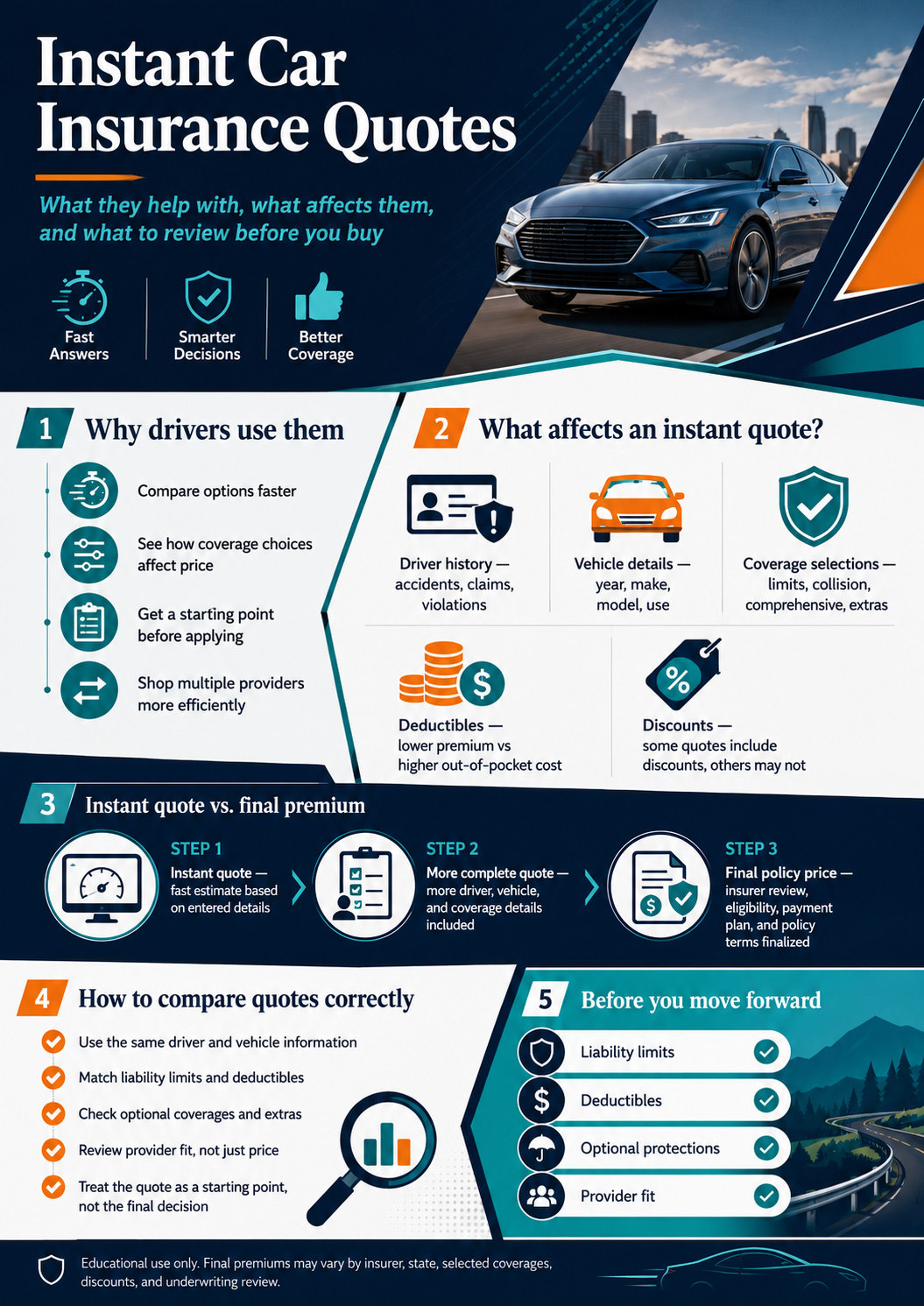
    Infographic explaining instant car insurance quotes, including why drivers use them, what affects quote results, the difference between an instant quote and final premium, how to compare quotes correctly, and what to review before buying.

    Why Drivers Use Instant Quotes

    The main reason people look for instant quotes is speed. They want a quick way to see what coverage may cost, compare providers, and decide whether a policy direction fits their budget before spending more time on the full application process.

    • They save time when you want to compare more than one provider.
    • They help you see how deductibles and coverage levels may change the quote.
    • They give you a starting point before speaking with an insurer or agent.
    • They make it easier to compare price, coverage, and policy fit in one session.

    Instant Quote vs. Final Premium

    Stage What It Usually Means What to Review
    Instant quote A fast estimate based on the details entered during the quote flow. Check whether the quote uses the coverage limits, deductibles, and vehicle details you intended.
    More complete quote A more detailed price after more driver, vehicle, and coverage information is included. Review listed drivers, VIN, garaging address, mileage, coverage options, and discounts.
    Final policy price The price shown after the insurer finalizes eligibility, rating, payment plan, and policy terms. Review the declarations page, effective date, exclusions, payment schedule, fees, and cancellation rules.

    What Happens After You Submit a ZIP Code?

    Many instant quote paths begin with a ZIP code because location can affect the quote process. After that, the form may ask for vehicle details, driver profile, coverage preference, and contact information. The quote path may then connect you with one or more insurer or partner options.

    This does not mean every displayed price is final. The insurer may still need to verify the vehicle, confirm the driver record, apply discounts, check eligibility, and finalize the selected coverage. That is why an instant quote should be used as a comparison starting point rather than a guaranteed premium.

    What an Instant Quote Usually Depends On

    Factor Why It Matters What to Check
    Driver history Accidents, claims, and violations may affect the rate. Make sure all driver details are accurate.
    Vehicle details Year, make, model, trim, repair cost, safety features, and vehicle use can change the quote. Review the exact car information entered.
    Coverage selections Liability limits, collision, comprehensive, uninsured motorist coverage, and extras can change the premium. Compare matching policies, not random combinations.
    Deductibles Higher deductibles may lower the premium but increase out-of-pocket cost after certain claims. Choose a deductible you could actually afford.
    Discounts Applied discounts can make one quote look much lower than another. Check whether discounts are confirmed, estimated, or conditional.

    How to Compare Instant Quotes the Right Way

    The most common mistake is comparing two quotes that do not really match. If one quote has higher liability limits, lower deductibles, or more extras included, it is not a fair one-to-one comparison. A cheaper quote can look better than it really is if the policy is thinner.

    • Use the same driver and vehicle information across every quote path.
    • Match liability limits, deductibles, and optional coverages before judging price.
    • Check whether roadside assistance, rental, or other extras are included or priced separately.
    • Review the provider, not just the monthly premium, because service and claims support can matter later.
    • Treat the instant quote as a starting point for a better decision, not the whole decision.

    When an Instant Quote Is Most Useful

    Instant quotes are especially helpful when you are starting research, trying to compare multiple insurers quickly, or checking how a change in deductible or coverage level might affect the price. They can also be useful for drivers who want to understand the market before they move to a more detailed application.

    • You are shopping around before renewal.
    • You want a faster way to compare several providers.
    • You are testing how deductibles or limits may change the premium.
    • You want a quick starting point before speaking with a company directly.

    Things to Review Before Moving Forward With a Policy

    What to Review Why It Matters Helpful Page
    Liability limits The cheapest quote may have weaker protection than expected. Type of Coverage
    Deductibles A lower premium can mean a higher out-of-pocket cost after a loss. Cost Analyzer
    Optional protections Rental, roadside, uninsured motorist, collision, and comprehensive options can affect both value and price. Tips and Advice
    Provider fit Price alone does not tell you everything about the policy or company. Provider Reviews

    Special Situations Where Extra Research Helps

    Some quote situations need more explanation than a general instant quote page can give. Younger drivers often face higher prices. Other shoppers may want more tailored quote guidance, while some are trying to understand early-stage quote options before sharing all personal information.

    For those situations, explore Car Insurance Quotes for Young Drivers, Tailored Car Insurance Quotes, and Auto Insurance Quote Without SSN.

    Frequently Asked Questions

    Are instant car insurance quotes always final?

    Not always. They are often a strong starting point, but the final premium may change once the insurer verifies your details and applies its full underwriting process.

    Why can two instant quotes look very different?

    They may be using different assumptions, discounts, deductibles, liability limits, or optional coverages. That is why matched comparisons matter.

    Should I choose the cheapest instant quote?

    Only if the coverage structure, deductible, and provider fit still make sense for your situation. The lowest number is not always the best value.

    What should I do after getting an instant quote?

    Review the coverage, compare similar quotes, check the deductible, and continue researching the provider before moving forward.

    Final Thoughts

    Instant quotes are useful because they make comparison shopping faster and easier, but they work best when you use them carefully. The goal is not only to find a low number. It is to find a quote that still makes sense once you review the policy structure, deductibles, discounts, payment terms, and provider.

    To keep researching related topics, visit Rate Comparison, Compare Providers, Provider Reviews, and Estimate Car Insurance Calculator.

    Ready to Compare?

    Compare Real Car Insurance Quote Options

    Enter your ZIP code to continue from instant quote research into real quote paths that may fit your coverage needs and budget.

  • Discounts and Offers

    By CarInsuranceEstimate.org Editorial Team

    Editorially reviewed informational content for U.S. car insurance shoppers

    Editorial details
    • Car Insurance Discounts
    • Quote Savings
    • Coverage Comparison

    The CarInsuranceEstimate.org Editorial Team creates informational content about car insurance estimates, quote comparison, discounts, coverage choices, pricing factors, and practical shopping questions for U.S. drivers.

    Articles are written to help readers understand how discounts may affect quoted premiums, why savings can be conditional, and how to compare offers without weakening important coverage.

    This content is for general informational purposes only and does not constitute insurance, legal, financial, or professional advice. Discount availability, pricing, eligibility, and policy terms vary by insurer, state, vehicle, and driver profile.

    Discounts and Offers Guide

    Car Insurance Discounts and Offers: How to Compare Real Savings

    Car insurance discounts can make a real difference, but they only help when you understand how they work and whether they actually apply to your situation. Many drivers focus on the base premium first and only later realize that discounts, deductibles, payment terms, and policy structure can change the true value of a quote.

    This page explains common types of car insurance discounts, which savings may be confirmed or conditional, and how to compare offers without getting misled by a headline percentage. A discount can be helpful, but it should never replace a careful review of coverage limits, deductibles, exclusions, and final premium.

    If you want to keep researching while you compare, visit our Instant Quotes, Car Insurance Basic, Car Insurance Calculator, and Rate Comparison pages.

    Car insurance discount and savings concept showing policy offers and ways drivers may compare available savings
    Discounts can help reduce cost, but the full quote structure still matters.

    Why Discounts Matter, but Do Not Tell the Whole Story

    Discounts can lower the cost of a policy without automatically reducing your protection. That is why they are often one of the first things drivers look for when comparing quotes. Still, the value of a discount depends on the policy underneath it. A policy with a discount is not always the better deal if it has weaker limits, fewer protections, higher fees, or a deductible that is too high.

    • A discount can reduce cost, but it does not automatically make a quote better.
    • Two quotes should be compared with similar limits, deductibles, and optional coverages.
    • The best value usually comes from combining discounts with a policy that still fits your needs.
    • A large advertised discount may matter less than the final premium after all terms are reviewed.

    Confirmed vs. Estimated vs. Conditional Discounts

    Discount Type What It Means What to Check Before Relying on It
    Confirmed discount A discount that appears to be included in the quote after the insurer has enough information to apply it. Confirm that it remains on the final policy documents before buying.
    Estimated discount A savings amount shown early in the quote process before full verification is complete. Ask whether the discount still applies after driver, vehicle, payment, or eligibility review.
    Conditional discount A discount that depends on proof, behavior, enrollment, bundling, payment method, or continued eligibility. Check the conditions, renewal rules, and whether the discount can be removed later.
    Promotional offer A time-sensitive or campaign-related savings opportunity that may not be permanent. Review expiration dates, renewal pricing, and whether the offer affects only the first policy term.

    Common Car Insurance Discounts Drivers Often See

    Not every insurer offers the same discounts, and not every driver qualifies for the same ones. Even so, several categories appear often enough to be worth checking when you compare quotes.

    • Safe driver discounts: often tied to a clean driving history or fewer recent claims.
    • Bundling discounts: may apply when auto insurance is combined with home, renters, condo, or another policy.
    • Good student discounts: sometimes available for younger drivers who meet academic requirements.
    • Multi-car discounts: can help households insuring more than one vehicle.
    • Usage-based or telematics discounts: may reward lower-risk driving behavior, depending on the insurer’s program.
    • Vehicle safety or anti-theft discounts: may apply when the vehicle has qualifying safety or anti-theft features.
    • Payment-related discounts: may include paperless billing, autopay, or paid-in-full savings.

    How to Compare Discounts Without Getting Misled

    What to Compare Why It Matters What to Ask
    Final premium A big discount on a higher base premium may still leave you paying more. What is the total six-month or annual premium after all discounts and fees?
    Liability limits A cheaper quote may have weaker protection. Are the liability limits the same across every quote?
    Deductibles A lower premium can come with higher out-of-pocket risk. Are collision and comprehensive deductibles matched?
    Optional coverages Roadside, rental, gap, and other extras can change value and price. Are these included, excluded, or priced separately?
    Discount eligibility Some discounts may require verification or may not apply after full review. Is this discount confirmed, estimated, or conditional?

    Discounts vs. Lower Coverage: Do Not Confuse the Two

    A real discount lowers the cost of a policy without necessarily removing protection. A cheaper quote, however, may come from weaker coverage instead of a true discount. This difference matters because a policy can look more affordable simply because it has lower liability limits, higher deductibles, or missing protections.

    Savings Move vs. Possible Trade-Off

    Savings Move Can Be Helpful When Trade-Off to Watch
    Applying verified discounts The discount is confirmed and the policy still matches your needs. Eligibility may depend on proof, behavior, or continued participation.
    Raising deductibles You can realistically afford the higher out-of-pocket cost after a claim. A high deductible can make the policy uncomfortable when you need it.
    Reducing optional add-ons The add-on is not useful for your situation. You may lose rental, roadside, gap, or other convenience protections.
    Lowering liability limits You understand the risk and still meet state requirements. This can create serious out-of-pocket exposure after a major accident.

    Ways Drivers Can Improve Savings Opportunities

    There is no guaranteed way to unlock every discount, but there are practical steps that make comparison shopping more useful. The goal is to make sure each quote is accurate enough to compare and that eligible discounts are not being missed.

    • Keep your driver, household, and vehicle information accurate when getting quotes.
    • Ask whether all available discounts are already included in the quote.
    • Compare multiple insurers instead of assuming one company is always cheapest.
    • Review deductible choices carefully before lowering major protections.
    • Check whether your life situation has changed since your last policy review.
    • Ask whether a discount continues at renewal or only applies during the first policy term.
    • Compare total policy cost instead of focusing only on monthly payment.

    If you want to compare savings ideas with broader policy structure, our Cheap Full Coverage Car Insurance, Cost Analyzer, and Tips and Advice pages can help you go one step further.

    What to Watch Before Relying on an Offer

    Some discount language sounds stronger than it really is. A quote may mention available savings before all information is verified, or the offer may depend on conditions that do not apply to every driver. This is where careful review matters more than marketing language.

    • Expiration periods: some offers may only apply during a promotional window.
    • Verification requirements: discounts tied to school status, profession, driving behavior, or policy bundling may need proof.
    • Stacking limits: not all discounts combine in the same way, and some insurers cap how much can be reduced.
    • Renewal changes: a discount available today may change when the policy renews.
    • Program requirements: telematics or usage-based savings may depend on continued enrollment and driving behavior.

    Who May Benefit From Different Discount Types?

    Driver Situation Discounts to Ask About Important Caution
    Clean driving history Safe driver, claim-free, accident-free, or defensive driving discounts. Eligibility windows and violation lookback periods can vary by insurer.
    Student or young driver Good student, student away at school, driver training, or telematics programs. Some discounts need proof or may depend on age, school status, or grades.
    Multiple policies or vehicles Bundling, multi-policy, multi-car, or household discounts. Bundling is not always cheapest; compare the combined cost against separate policies.
    Low-mileage driver Low-mileage, usage-based, or pay-how-you-drive programs. Telematics programs may monitor driving behavior and may not fit every shopper.
    Vehicle with safety features Anti-theft, safety equipment, passive restraint, or vehicle technology discounts. Availability depends on vehicle features, insurer rules, and state-specific rating practices.

    Who This Page Can Help Most

    This page is most useful for drivers who are already shopping and want a clearer way to think about savings. It can also support younger drivers, first-time shoppers, renewal shoppers, and families comparing multi-car or bundled policies.

    For related topics, explore Car Insurance Quotes for Young Drivers, Tailored Car Insurance Quotes, Estimate Car Insurance Calculator, and Car Insurance Estimator.

    Frequently Asked Questions

    Do discounts always make a quote the best option?

    No. A discounted quote can still be weaker or more expensive overall if the limits, deductibles, optional coverages, payment fees, or provider fit are different.

    Can car insurance discounts change after the quote?

    Yes. Some discounts are estimated or conditional during the quote process. They may change after the insurer verifies driver information, vehicle details, payment method, bundling status, or eligibility.

    Can car insurance discounts be combined?

    Sometimes, but not always. Insurers may allow some discounts to stack while limiting or capping others. The final premium matters more than the number of discounts shown.

    Should I lower coverage just to get a cheaper premium?

    Not automatically. It is usually better to review discounts, provider differences, deductible choices, and optional add-ons before weakening important liability or physical damage protection.

    What is the easiest way to improve my chances of finding savings?

    Compare multiple insurers, keep your quote details accurate, ask which discounts are confirmed, and compare total policy cost instead of focusing only on the monthly payment.

    Final Thoughts

    Car insurance discounts can help lower your premium, but the best savings are the ones that still leave you with a policy that fits your real needs. A discount should be reviewed together with coverage limits, deductibles, optional protections, final premium, payment terms, and provider fit.

    When you compare offers carefully, discounts become more useful. Instead of chasing the biggest advertised savings, focus on the quote that gives you the clearest balance of price, protection, and reliability.

    Ready to Compare?

    Compare Car Insurance Quote Options

    Enter your ZIP code to compare available auto insurance quote paths and review options that may fit your coverage needs and budget.

  • Rate Comparison: How to Compare Car Insurance Quotes More Clearly

    Comparing car insurance rates can save money, but only when the comparison is fair. Many drivers look at the monthly premium first and assume the cheapest quote is automatically the best one. In reality, two quotes can look very different because the liability limits, deductibles, optional coverages, discounts, payment terms, and driver details are not the same.

    This guide explains how to compare car insurance rates with more accuracy. The goal is not just to find the lowest number, but to understand whether a quote gives you the right balance of price, coverage, deductible comfort, claims protection, and provider fit.

    Quick rule: a quote is only useful when you know what is included. A lower premium can be a good deal, but only if the policy still gives you the protection you meant to buy.

    Compare Equal Policies

    Use the same liability limits, deductibles, vehicle details, driver information, and coverage choices for every quote.

    Look Beyond Premium

    The monthly payment matters, but deductible risk, fees, coverage exclusions, and claim support can change the real value.

    Review Final Cost

    Compare the final price after discounts, payment fees, and policy choices, not just the first number shown in a quote form.

    Why Rate Comparison Matters

    A rate comparison page is useful because it helps drivers slow down and compare policies on more than price alone. A lower premium can come from weaker limits, fewer protections, a higher deductible, or discounts that may not apply after underwriting. A slightly higher premium can sometimes give better value if the policy structure is stronger.

    The National Association of Insurance Commissioners explains that what you pay for auto insurance is generally shaped by two major processes: underwriting and rating. Underwriting helps the insurer evaluate the risk of the applicant, while rating assigns a price based on what the insurer believes it may cost to cover a potential claim. [1]

    • A rate comparison is only fair when the quotes are built the same way. If Quote A has lower limits than Quote B, the lower price may simply reflect less protection.
    • The cheapest premium is not always the best overall value. Deductibles, coverage gaps, and claim support can matter as much as the monthly payment.
    • A stronger comparison helps you avoid choosing a weak policy by mistake. It forces you to review what the policy actually includes before you buy.

    What Should Match When You Compare Rates?

    The biggest mistake drivers make is comparing quotes that are not actually equivalent. If one quote has different liability limits, a different deductible, or more optional protections, the lower price may not mean much. Before comparing providers, make the policy settings as similar as possible.

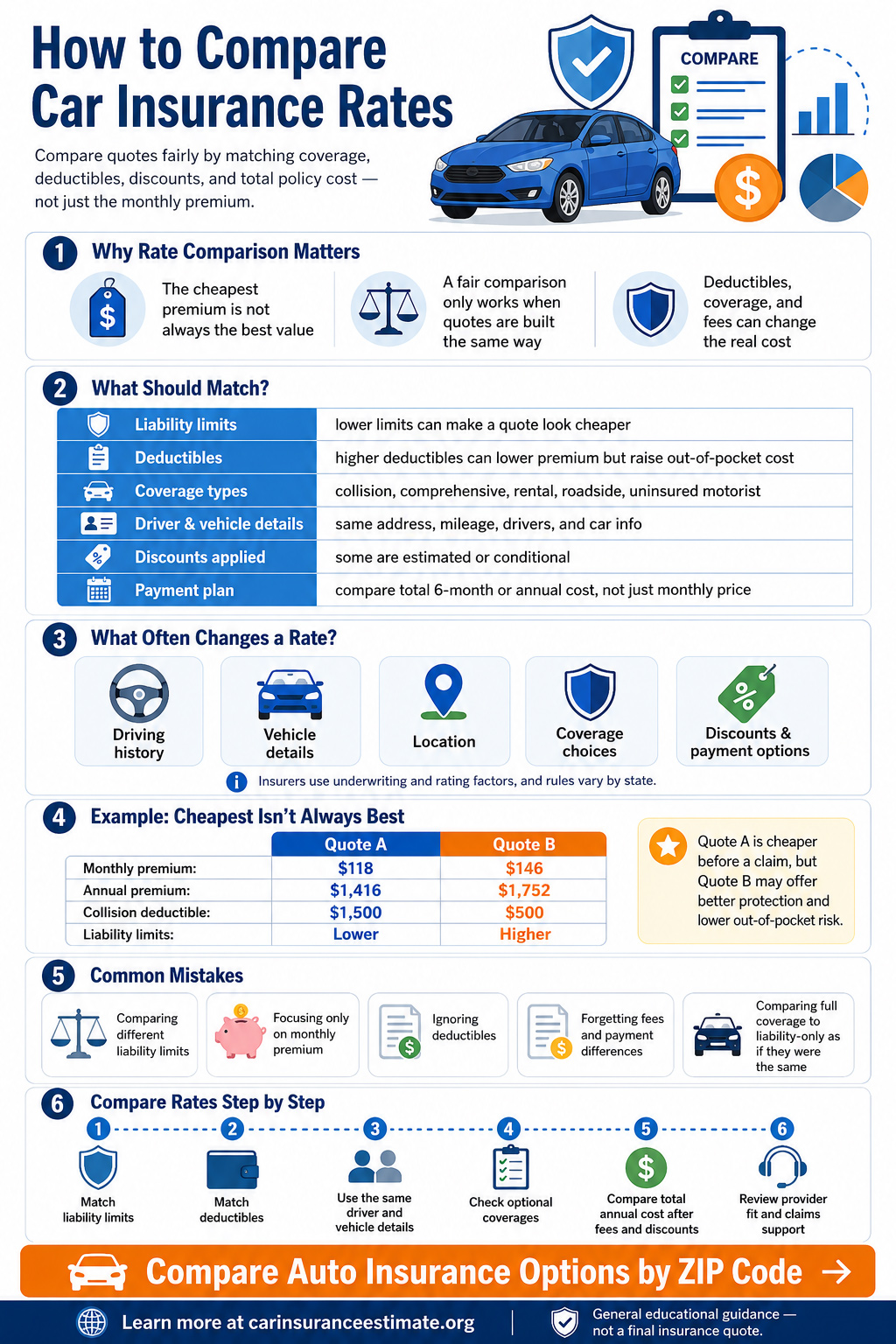
    What to Match Why It Matters What to Check Before Choosing
    Liability limits A lower-priced policy may simply offer less protection for injury or property damage you cause to others. Check bodily injury and property damage limits side by side.
    Deductibles A high deductible can reduce premium but increase your out-of-pocket cost after a covered claim. Ask whether you could comfortably pay the deductible if an accident happened tomorrow.
    Coverage types Collision, comprehensive, uninsured motorist, roadside assistance, rental reimbursement, and other add-ons affect both price and value. Confirm which coverages are included and which ones were removed to lower the price.
    Driver and vehicle details Different assumptions can produce very different rates, even with the same company. Use the same garaging address, mileage, vehicle use, drivers, and vehicle information.
    Discounts applied Some quotes include discounts upfront while others require proof or eligibility checks. Review whether discounts are guaranteed, conditional, or only estimated.
    Payment plan Monthly payments may include installment fees, while paid-in-full options may reduce total cost. Compare total six-month or annual cost, not only the monthly bill.

    What Often Changes a Car Insurance Rate?

    Even before you compare one insurer against another, your own quote can shift depending on the information provided. Quote results are usually starting points rather than final guarantees because insurers may verify driving records, vehicle details, claims history, prior insurance, garaging address, and eligibility for discounts.

    Infographic explaining how to compare car insurance rates fairly by matching liability limits, deductibles, coverage types, driver and vehicle details, discounts, payment plans, and total annual policy cost.

    NAIC lists common rating factors that may affect auto insurance prices, including location, age, gender, marital status, driving experience, driving record, claims history, credit history, previous insurance coverage, vehicle type, vehicle use, miles driven, chosen coverages, and deductibles. Rules vary by state, and not every factor is allowed or used the same way everywhere. [2]

    • Driving history: accidents, claims, and violations can affect price because they may signal higher risk.
    • Vehicle details: year, make, model, trim, repair costs, safety features, and theft risk can all influence the rate.
    • Location: rates often vary by garaging address, traffic density, theft patterns, accident frequency, and state coverage rules.
    • Coverage choices: stronger liability limits, lower deductibles, collision, comprehensive, and added protections usually change the premium.
    • Discounts and payment options: bundling, safe-driver programs, paid-in-full discounts, paperless billing, or automatic payments can change the final result.

    If you want to go deeper into quote factors, you can also explore Estimate Car Insurance Calculator, Auto Insurance Calculator, and Car Insurance Estimator.

    Example: Why the Cheapest Monthly Rate Can Be Misleading

    Imagine two quotes for the same driver and vehicle. Quote A costs $118 per month and Quote B costs $146 per month. At first glance, Quote A looks better because it saves $28 per month. Over a year, that is $336 in premium savings.

    But now look at the deductible and coverage details. Quote A has a $1,500 collision deductible and state-minimum liability limits. Quote B has a $500 collision deductible and higher liability limits. If the driver has one covered collision claim, Quote A may require $1,000 more out of pocket before coverage responds. The monthly savings may not be enough to justify that extra risk for a driver with limited emergency savings.

    Comparison Item Quote A Quote B Why It Matters
    Monthly premium $118 $146 Quote A is cheaper before a claim.
    Annual premium $1,416 $1,752 Quote A saves $336 per year before fees or claims.
    Collision deductible $1,500 $500 Quote B may be easier to handle after a covered accident.
    Liability limits Lower Higher Quote B may offer more financial protection after a serious accident.

    The better quote is not always the one with the lowest monthly number. The better quote is the one that matches your budget, vehicle, coverage needs, and ability to handle a deductible.

    How Deductibles Affect Rate Comparison

    Deductibles are one of the easiest ways to change the price of collision and comprehensive coverage. A higher deductible usually lowers the premium because you agree to pay more out of pocket before the coverage responds. That can be a smart choice for some drivers, but it becomes risky when the deductible is higher than your emergency savings.

    The Insurance Information Institute notes that choosing higher deductibles can lower auto insurance costs, but also warns that drivers should make sure they have enough money set aside to pay the deductible if they have a claim. That point is important because a policy is not truly affordable if the monthly premium is low but the deductible would be difficult to pay. [3]

    How Discounts Can Distort a Rate Comparison

    Discounts can make a quote look attractive, but they should be reviewed carefully. Some discounts are easy to understand, such as multi-policy, multi-car, safe-driver, paperless billing, or paid-in-full savings. Others may depend on telematics participation, usage-based driving data, continuous coverage, or eligibility that must be verified.

    A quote with many discounts is not automatically better than a quote with fewer discounts. What matters is the final premium, the coverage included, and whether those discounts will still apply when the policy renews. For that reason, compare the final policy cost after discounts, then review the coverage structure again.

    Common Mistakes During Rate Comparison

    Rate comparison works best when it is done with patience. Many bad decisions happen because the driver sees one low number and stops reviewing the rest of the policy.

    • Comparing quotes with different liability limits.
    • Ignoring deductibles while focusing only on the monthly premium.
    • Assuming one insurer is always cheapest for every driver type.
    • Choosing a quote before checking optional protections and exclusions.
    • Comparing one quote with full coverage against another quote with liability-only coverage.
    • Forgetting to include policy fees, installment fees, or payment-plan differences.
    • Not checking whether the quote includes every household driver who must be listed.
    • Stopping at price without reviewing provider fit or policy structure.

    When the Cheapest Rate Is Not the Best Choice

    A lower premium can still be the wrong choice if it leaves you underinsured or creates an out-of-pocket risk you cannot comfortably handle. This is especially important when comparing policies for newer vehicles, financed vehicles, leased vehicles, or households that need broader protection.

    A cheap policy can make sense when the driver understands the trade-off. For example, liability-only coverage may be reasonable for an older vehicle with low market value. A higher deductible may be reasonable for a driver with strong savings. But those choices should be intentional, not hidden inside a quote that simply looks cheaper.

    That is why it helps to compare this page with Cheap Full Coverage Car Insurance, Provider Reviews, Compare Providers, and Best Auto Insurance Comparison Sites.

    How to Compare Car Insurance Rates Step by Step

    Step What to Do Why It Helps
    1 Choose the same liability limits for every quote. This prevents a low-limit policy from looking cheaper than a stronger policy.
    2 Use the same deductibles for collision and comprehensive coverage. This makes the premium comparison more accurate.
    3 Enter the same vehicle, mileage, garaging address, and driver details. Small differences in inputs can create different prices.
    4 Check whether optional coverages are included or removed. Roadside assistance, rental reimbursement, and uninsured motorist coverage can affect value.
    5 Compare total six-month or annual cost after discounts and fees. The monthly payment may not show the full cost of the policy.
    6 Review the provider, claims process, and service style. A slightly higher premium may be worth it if the policy is easier to manage and use.

    Frequently Asked Questions

    What is the most important rule when comparing rates?

    Make sure the quotes are based on similar limits, deductibles, coverage selections, driver details, and vehicle information. Without that, the comparison is weak.

    Why can one insurer be much cheaper than another?

    Different insurers weigh risk factors differently. One company may price your profile more favorably, while another may see the same driver, vehicle, or location as higher risk.

    Should I always choose the lowest premium?

    Not automatically. A lower price is only better when the policy still gives you the protection, deductible level, and provider fit that make sense for your situation.

    How many car insurance quotes should I compare?

    Comparing at least three quotes is a practical starting point because prices can vary significantly by insurer, driver profile, state, vehicle, and coverage selection.

    Can changing my deductible lower my rate?

    Yes, a higher deductible can lower the premium for some coverages, but only choose a deductible you could realistically pay after a covered claim.

    Do credit-based insurance scores affect car insurance rates?

    In states where allowed, some insurers may use credit-based insurance information as part of underwriting or rating. State rules vary, so this factor does not apply the same way everywhere.

    Final Thoughts

    Comparing car insurance rates works best when you look beyond the lowest premium and review what each policy actually includes. A quote can only be judged fairly when the coverage limits, deductibles, optional protections, discounts, fees, and driver details are similar.

    A careful rate comparison can help you find a policy that balances affordability and protection more effectively. Before making a final decision, take time to review the coverage details, check which discounts are included, and confirm that the quote still fits your real needs.

    References

    1. National Association of Insurance Commissioners: Auto Insurance Consumer Information
    2. NAIC: Auto Insurance Rating Factors
    3. Insurance Information Institute: Nine Ways to Lower Your Auto Insurance Costs
    4. Insurance Information Institute: How to Save Money on Auto Insurance
    Get a Quote
    Enter your ZIP code and compare available auto insurance options.
  • Provider Reviews

    Car insurance provider reviews can be useful, but only when they help you compare companies in a practical way. A recognizable brand name does not automatically mean the best fit for your policy, and the lowest premium does not always mean the best overall value.

    This page is designed to help you compare well-known car insurance companies more carefully by looking at policy fit, quote experience, discounts, support options, and what you should verify before buying. If you want to keep researching while you compare, you can also visit Compare Providers, Rate Comparison, Instant Quotes, Type of Coverage, and Car Insurance Guide.

    Happy family of four standing beside a red sedan with major U.S. car insurance company logos in the background, representing provider comparison and auto insurance shopping.

    What to review before comparing companies

    A useful provider review should go beyond slogans and look at how the company may fit your shopping style, budget, and coverage needs. The comparison works best when you keep the quote structure as similar as possible across insurers.

    What to review Why it matters
    Coverage structure Two companies cannot be compared fairly if the limits, deductibles, and optional coverages are different.
    Quote and account experience Some drivers prefer a local agent, while others prefer an app-based or online-first experience.
    Discount structure A headline discount only matters if it actually applies and still leaves you with a strong policy.
    Complaint and service research It helps to check complaint resources and your state insurance department if you want more background before buying.
    Financial strength Price matters, but company stability also matters when you are trusting a carrier to handle claims.

    State Farm

    State Farm is often considered by shoppers who prefer a more traditional insurance experience with access to local agents as well as online account tools. It can be worth comparing if you want guidance from an agent while still being able to manage parts of the policy online.

    • May fit drivers who want: local-agent support, quote guidance, and a familiar national brand.
    • What to compare: total premium, deductible choices, bundling value, and whether agent access matters enough to you.
    • What to verify before buying: final limits, applied discounts, and how the quote compares with equally structured quotes elsewhere.

    GEICO

    GEICO is often compared by drivers who are comfortable handling more of the shopping and policy management process online or through an app. That can be a practical fit for shoppers who want speed and simple digital account access.

    • May fit drivers who want: a more digital-first experience and easy app-based policy management.
    • What to compare: how the final quote changes with discounts, coverages, and deductibles.
    • What to verify before buying: whether the lower quote still gives you the protections you actually want.

    Progressive

    Progressive is often on the comparison list for drivers who want to explore quote options, usage-based insurance, or budget-focused quote paths. It can be a useful company to compare when you want to see how different pricing approaches affect the result.

    • May fit drivers who want: flexible quote exploration and a usage-based option to compare.
    • What to compare: total premium, how discounts are applied, and whether usage-based pricing is actually a good fit for your habits.
    • What to verify before buying: whether the quote stays competitive after matching the same limits and deductibles used with other carriers.

    Allstate

    Allstate is commonly compared by drivers who want more than one way to shop, including online, by phone, or through a local agent. It can make sense to compare if you want a mix of digital access and human support.

    • May fit drivers who want: flexible shopping channels and ongoing access to support options.
    • What to compare: quote structure, discounts, optional protections, and whether the support model is worth the price difference.
    • What to verify before buying: final premium after review and whether the policy still makes sense compared with similarly built quotes.

    Liberty Mutual

    Liberty Mutual is often compared by shoppers who want to review coverage choices more closely and think through which optional protections they do or do not want. It can be worth considering if customization matters to you.

    • May fit drivers who want: more room to compare policy options and tailor coverage decisions.
    • What to compare: base quote, optional coverages, and whether customization raises the total price more than expected.
    • What to verify before buying: which protections are included by default and which are optional add-ons.

    How to use provider reviews more effectively

    A provider review page should help you narrow the field, not push you toward one company too quickly. The most useful approach is to compare companies after you have already decided what kind of policy structure you want.

    • Start by matching coverage limits and deductibles across every quote.
    • Use provider reviews to think about fit, not just headline pricing.
    • Check complaint resources and your state insurance department if you want extra background.
    • Review financial strength and claims-related support before deciding that the cheapest option is enough.

    If you want to keep comparing, you can also explore Best Auto Insurance Comparison Sites, Cheap Full Coverage Car Insurance, Discounts and Offers, and Car Insurance Estimator.

    Frequently Asked Questions

    What is the biggest mistake when reading provider reviews?

    Treating brand reputation or one advertised feature as more important than the actual quote structure. The policy still needs to be compared fairly.

    Should I choose a provider based only on the cheapest quote?

    Not automatically. A cheaper quote may reflect weaker limits, a higher deductible, or fewer useful protections.

    How should I use this page?

    Use it to narrow your shortlist, then compare matched quotes more carefully before choosing a company.

    Does this page help the site?

    Yes, when it stays practical and educational. It works best as a support page for your broader quote, provider, and coverage cluster.

    Final Thoughts

    Provider reviews are most useful when they help you compare insurers more carefully instead of pushing you toward one brand too quickly. A strong comparison should look at quote structure, service model, discounts, and overall policy fit together.

    Used that way, a provider review page can help readers make better decisions and move through the quote-shopping process with more clarity.

    NAIC Auto Insurance Consumer Guide and III guidance on financial strength are useful places to continue your research.

  • FAQ

    Car Insurance FAQ

    Car Insurance FAQs: Estimates, Quotes, Coverage, and Provider Comparison

    This FAQ page answers common questions about car insurance estimates, quote tools, coverage choices, provider comparison, and price differences. It is designed as a practical support page for shoppers who want clearer next steps before choosing a policy.

    Car insurance prices can change based on driver information, vehicle details, location, coverage limits, deductibles, discounts, and insurer underwriting rules. That is why a useful FAQ should do more than send readers to another page. It should explain what the terms mean, why quotes can change, and how to compare options more fairly.

    If you want to go deeper while you compare, you can also visit Instant Quotes, Type of Coverage, Rate Comparison, Compare Providers, Car Insurance Guide, and Resources.

    Estimate vs. quote

    Understand why an estimate is a planning tool, while a final quote can change after full underwriting and review.

    Coverage choices

    See how deductibles, liability limits, and full coverage decisions can affect both price and policy value.

    Better comparison

    Learn how to compare companies more fairly by matching policy structure instead of looking only at the lowest number.

    Best Next Page to Visit by Topic

    Topic Best Page to Visit Next Why It Helps
    Fast quote research Instant Quotes Good starting point when you want to move from general questions into active shopping.
    Coverage differences Type of Coverage Useful when you want to understand what you are actually paying for before comparing prices.
    Comparing insurers Compare Providers and Provider Reviews Helpful when you want to look beyond brand names and compare fit, support style, and quote structure.
    Price analysis Rate Comparison and Discounts and Offers Useful when you want to understand why prices vary and which savings may actually matter.
    Calculator-based research Estimate Car Insurance Calculator, Auto Insurance Calculator, and Car Insurance Calculator Helpful for shoppers who want a more guided way to think through possible price ranges.

    Frequently Asked Questions

    1. What is the difference between a car insurance estimate and a car insurance quote?

    A car insurance estimate is usually an early price range based on limited information. It helps you understand what your policy might cost before you complete a full application. A quote is typically more detailed because it reflects more specific rating information, policy choices, and review steps.

    That distinction matters because shoppers sometimes compare one company’s estimate against another company’s more complete quote and assume the lower number is automatically better. The better approach is to keep the structure as consistent as possible across every option you review. You can continue that comparison on Insurance Estimates, Instant Quotes, and Car Insurance Estimator.

    2. How accurate is an online car insurance estimate?

    An online estimate can be useful for planning, but it is still a starting point rather than a final guarantee. The closer your information matches the policy details a carrier reviews later, the more useful the estimate tends to be. Even then, the final price may still change once the insurer confirms rating details and the exact coverage structure.

    That is why it helps to treat estimates as a comparison tool instead of a promise. They are most useful when you want to narrow down options, compare rough pricing paths, and decide which companies deserve a closer look. For a more structured comparison, visit Rate Comparison and How Car Insurance Estimates Work.

    3. What information do I usually need to get a car insurance estimate?

    Most estimate tools work best when you enter consistent basics such as your ZIP code, vehicle details, driver profile, desired coverage level, and deductible preferences. Some tools may ask for more than others, but the main goal is always the same: to create a policy structure that is detailed enough to support a realistic comparison.

    The more important point is consistency. If you change deductibles, liability limits, or coverage types from one company to another, the numbers stop being easy to compare fairly. That is why many shoppers benefit from reviewing Type of Coverage before they start comparing prices.

    4. Do I need a Social Security number to compare options?

    Not always at the earliest research stage. Some shoppers begin with general estimate tools or simplified quote paths before deciding whether to continue with a more complete application. The exact process depends on the insurer, the quote path, and how detailed the request becomes.

    The practical takeaway is that you can often begin researching without treating the first step like a full commitment. If this is a major concern for your comparison process, the most relevant page on the site is Auto Insurance Quote Without SSN.

    5. Why do coverage limits and deductibles change the price so much?

    Price is never just about the company name. It is also about what the policy is built to do. Higher liability limits, lower deductibles, and broader protection can raise the premium because the policy is designed to provide more protection. On the other hand, a cheaper policy may simply reflect less coverage, a higher deductible, or fewer optional protections.

    This is one of the biggest reasons shoppers get confused when they compare insurers. A low number only tells part of the story. The better question is whether the policy structure fits your needs. A good place to keep that research organized is Type of Coverage and Cheap Full Coverage Car Insurance.

    6. Why can two companies show very different prices for similar drivers?

    Different insurers may evaluate risk, discounts, driving profile details, vehicle characteristics, and coverage packaging in different ways. That is why one company may look strong for one shopper while another carrier may look better for someone with a different vehicle, location, coverage target, or driver profile.

    The key lesson is that brand familiarity does not guarantee the best result, and a single quote does not tell you enough about the broader market. The smarter move is to compare several similarly structured options and then review support model, discounts, and overall fit. Pages like Compare Providers, Provider Reviews, and Best Auto Insurance Comparison Sites can help you do that more carefully.

    7. Is the cheapest car insurance policy always the best option?

    Not automatically. A lower premium can be attractive, but the best value depends on what the policy includes, how the deductibles are set, and whether the protection matches your needs. A policy that looks cheaper at first can feel less useful later if it leaves you with weaker protection than you expected.

    That is why it helps to compare price and policy design together. Use low price as a signal to investigate further, not as the only decision factor. For additional support, review Discounts and Offers, Car Insurance Basic, and Car Insurance Guide.

    8. How can I compare car insurance providers more fairly?

    Start by choosing the coverage structure you actually want. Then keep the main elements aligned across every quote: liability limits, deductibles, vehicle information, and optional protections. Once the structure is consistent, it becomes much easier to compare companies on price, support style, convenience, and overall fit.

    A fair comparison also means looking beyond marketing language. Some shoppers prefer a digital-first experience, while others value agent access, support channels, or more flexible policy customization. That is why provider comparison should look at both price and policy experience. The best supporting pages for that step are Compare Providers, Provider Reviews, and Rate Comparison.

    9. Do young drivers always pay more for car insurance?

    Young drivers often see higher prices than older drivers with longer driving histories, but that does not mean every policy will look the same or that every company will price the same way. Coverage choices, vehicle type, location, and discount eligibility can still affect the outcome in meaningful ways.

    That is why younger shoppers benefit from broad comparison rather than guessing based on one company or one ad. If that topic is central to your search, visit Car Insurance Quotes for Young Drivers and then continue comparing through Instant Quotes.

    10. Can I estimate full coverage separately from basic or liability-focused coverage?

    Yes. In practice, many shoppers compare more than one coverage path so they can understand the tradeoff between lower monthly cost and broader protection. That comparison is especially useful when you are trying to decide whether paying more gives you enough additional value for your situation.

    Instead of treating every estimate as the same type of policy, it helps to review basic, liability-focused, and fuller coverage paths separately. The most useful pages for that are Car Insurance Basic, Cheap Full Coverage Car Insurance, and Type of Coverage.

    11. How often should I refresh my car insurance estimate?

    It makes sense to refresh your estimate when important details change, such as your location, vehicle, driver profile, coverage goals, or comparison priorities. Even when nothing dramatic has changed, revisiting the estimate can still help if you are moving from early research into active quote shopping.

    The goal is not to check constantly. The goal is to revisit the process when your policy needs, budget priorities, or shopping stage becomes different from before. A practical next step is to review Car Insurance Estimator Get Accurate Quotes Online, Insurance Estimates, and Tools.

    12. What is the best way to use this site before choosing a policy?

    The best approach is to move in order. Start with educational pages so you understand estimates, coverage types, and the difference between lower price and better value. Then use calculators and comparison pages to narrow your options. After that, review provider-focused content to compare policy fit more carefully.

    A simple path could look like this: Car Insurance GuideType of CoverageEstimate Car Insurance CalculatorRate ComparisonCompare Providers.

    13. What factors usually affect a car insurance price?

    Car insurance prices are usually based on a mix of driver, vehicle, location, coverage, and policy factors. The exact formula varies by insurer and state, but common factors can include driving record, claims history, vehicle type, ZIP code, annual mileage, coverage limits, deductible choices, prior insurance history, and available discounts.

    This is why two drivers with similar vehicles can receive very different prices. One driver may have a cleaner driving record, lower annual mileage, stronger prior insurance history, or a garaging address in an area with fewer claims. Another driver may pay more because the insurer sees higher risk based on the information used for rating.

    14. Why should I compare the same coverage limits across quotes?

    Comparing different coverage limits can make a quote look cheaper than it really is. For example, one policy may show a lower premium because it uses state-minimum liability limits, while another quote may include higher liability limits, uninsured motorist coverage, rental reimbursement, or lower deductibles.

    A fair comparison should keep the main policy structure as similar as possible. Match liability limits, collision and comprehensive deductibles, optional coverages, vehicle information, driver information, and payment terms. Once the structure is similar, the price difference becomes more meaningful.

    15. What is the difference between liability-only and full coverage?

    Liability-only coverage generally focuses on injuries or property damage you cause to others, up to the limits of the policy. It usually does not pay to repair or replace your own vehicle after an at-fault accident. Full coverage is not one single official coverage type, but shoppers often use the term to describe a policy that includes liability plus collision and comprehensive coverage.

    Collision coverage may help pay for damage to your own vehicle after a covered crash, while comprehensive coverage may help with non-collision losses such as theft, vandalism, fire, hail, or certain weather-related damage. If your vehicle is financed or leased, your lender or leasing company may require physical damage coverage.

    16. Why can an estimate change after I submit more information?

    An estimate can change because early quote tools often use limited information. Once an insurer reviews more complete details, the price may adjust. That can happen after verifying your driving record, claims history, vehicle identification number, garaging address, prior insurance, household drivers, coverage selections, and discount eligibility.

    This does not always mean the original estimate was wrong. It means the first number was based on a smaller set of assumptions. The closer your original information is to the final policy details, the more useful the estimate will usually be.

    17. What deductible should I choose?

    The right deductible depends on your budget and risk comfort. A higher deductible can lower the premium, but it also means you may need to pay more out of pocket after a covered claim. A lower deductible may cost more each month, but it can make the policy easier to use after an accident or covered loss.

    A practical rule is to choose a deductible you could realistically pay without creating financial stress. If the premium savings are small but the deductible becomes difficult to afford, the cheaper monthly quote may not be the better value.

    18. How many car insurance quotes should I compare?

    Comparing at least three quotes is a practical starting point. Prices can vary because insurers weigh risk factors differently, offer different discounts, and package coverage in different ways. One insurer may be competitive for a driver with a clean record, while another may be better for a driver with a different vehicle, location, or coverage need.

    The key is to compare quotes with the same assumptions. Use the same liability limits, deductibles, drivers, vehicle details, mileage, and coverage selections. That makes the comparison more useful than simply collecting several unrelated prices.

    19. When should I review or compare my car insurance again?

    It is smart to review your car insurance at renewal, especially if the premium increases. You should also compare again after moving, buying a car, selling a car, adding or removing a driver, changing your commute, paying off a vehicle loan, or deciding that your current deductible or coverage limits no longer fit your budget.

    A quote that made sense last year may not be the best fit today. Your vehicle value, household drivers, driving habits, and coverage goals can change over time.

    20. What should I check before buying a policy?

    Before buying, review the declarations page or quote summary carefully. Check liability limits, deductibles, covered vehicles, listed drivers, effective date, payment schedule, discounts, optional coverages, exclusions, and whether the policy includes collision, comprehensive, uninsured motorist, rental reimbursement, or roadside assistance if you expected those protections.

    Also confirm that the ZIP code, garaging address, vehicle use, mileage estimate, and driver information are accurate. Incorrect information can cause price changes or coverage issues later.

    Key Car Insurance Terms Explained

    Term Plain-English Meaning Why It Matters
    Premium The amount you pay to keep the policy active. A low premium can be useful, but it should be compared with coverage limits and deductibles.
    Deductible The amount you may pay before certain coverages respond to a claim. A higher deductible can lower the premium but increase out-of-pocket risk.
    Liability limit The maximum amount the policy may pay for covered damage or injuries you cause to others. Lower limits may reduce price but can leave less financial protection.
    Collision coverage Coverage that may help repair or replace your vehicle after a covered crash. Often important for financed, leased, newer, or higher-value vehicles.
    Comprehensive coverage Coverage that may help with non-collision losses such as theft, vandalism, fire, hail, or certain weather damage. Can add protection beyond accident-related damage.
    Underwriting The process insurers use to evaluate risk and decide eligibility or pricing. Final pricing can change after more complete information is reviewed.
    Ready to Compare?

    Explore Car Insurance Quotes With More Clarity

    Enter your ZIP code to continue comparing car insurance options and review quote paths that may fit your coverage needs and budget.

  • Car Insurance Shopping Tips

    Shopping Checklist
    Created: October 2023
    Updated: May 9, 2026

    Buying car insurance is easier when you compare quotes with the same coverage structure, the same deductible approach, and the same general policy goals. A lower number is not always the better option if the coverage behind that quote is weaker than you expected.

    This page is designed as a practical car insurance shopping checklist. Before choosing a policy, review coverage limits, deductibles, discounts, payment terms, vehicle details, driver information, and the provider’s service style. That gives you a better chance of comparing real value instead of only comparing the lowest monthly price.

    If you want to continue your research, you can also visit Instant Quotes, Type of Coverage, Rate Comparison, Discounts and Offers, and Compare Providers.

    Match the quote structure

    Compare similar liability limits, deductibles, and optional protections so the price difference actually means something.

    Review discounts carefully

    A discount sounds good, but it only matters if the final policy still fits your budget and protection goals.

    Check before buying

    Use the final checklist to confirm policy type, listed drivers, vehicle details, discounts, total cost, and provider fit.

    What to Review Before Choosing a Policy

    What to Review Why It Matters
    Coverage limits Two prices are not really comparable if one policy gives you much less protection than the other.
    Deductible amount A higher deductible can lower the premium, but it also changes what you may need to pay out of pocket later.
    Discount eligibility Some discounts apply only in certain situations, so the headline savings may not reflect your real final premium.
    Provider fit Some shoppers want a more digital process, while others prefer stronger support or more traditional guidance.
    Policy changes over time A quote that looked strong before may deserve a second look when your vehicle, location, or coverage needs change.

    What Information Should You Have Before Comparing Quotes?

    A car insurance quote is only as useful as the information behind it. If you enter different details from one quote form to another, the results may not be comparable. Before starting a serious comparison, gather the same driver, vehicle, coverage, and payment information so each quote is built from the same starting point.

    Useful information includes your ZIP code, vehicle year, make and model, estimated annual mileage, main vehicle use, driver history, current coverage status, desired liability limits, deductible preference, and whether you want collision, comprehensive, rental reimbursement, roadside assistance, or uninsured motorist coverage. These details matter because insurers may rate risk differently, and even small changes can affect the premium.

    • Driver information: age range, licensed drivers in the household, driving history, and prior insurance status can affect the quote process.
    • Vehicle information: year, make, model, trim, ownership status, safety features, and repair cost can influence the rate.
    • Coverage choices: liability limits, deductibles, collision, comprehensive, uninsured motorist, rental, and roadside options should stay consistent across quotes.
    • Payment preference: monthly payments, paid-in-full options, installment fees, and autopay discounts can change the final cost.

    Why Similar Quotes Can Still Have Different Prices

    Even when two quotes look similar, the final price can vary because insurers do not rate every driver the same way. One company may weigh driving history more heavily, while another may price the vehicle type, ZIP code, mileage, or prior insurance history differently. That is why one insurer can be competitive for one driver but expensive for another.

    NAIC explains that auto insurance premiums can be affected by factors related to the driver, the vehicle, the amount of coverage purchased, and available discounts. It also notes that not every insurer uses the same factors in the same way. This is the main reason comparison shopping matters: you are not only comparing prices, you are comparing how different companies evaluate the same risk profile.

    Factors That Can Change a Quote

    Factor Why It Matters
    Driving record Accidents, tickets, and claims can affect how risky a driver appears to an insurer.
    Vehicle type Repair costs, theft risk, safety features, and vehicle value can influence pricing.
    Location Rates can vary by ZIP code because of traffic patterns, accident frequency, theft risk, and state insurance rules.
    Coverage amount Higher limits and broader protection usually cost more but may provide stronger financial protection.
    Discounts Safe-driver, multi-policy, multi-car, paperless, autopay, and paid-in-full discounts can affect the final premium.

    When Should You Compare Car Insurance Again?

    You do not need to compare quotes every week, but there are specific moments when a fresh comparison can be useful. Rates and coverage needs can change when your personal situation changes, when your insurer adjusts pricing, or when your policy renewal arrives. A quote that was competitive last year may not be the strongest option today.

    A practical habit is to review your options at renewal, especially if your premium increased without a clear reason. It also makes sense to compare again after moving, buying or selling a car, adding a driver, getting married, improving your driving record, paying off a vehicle loan, or changing how much you drive. These events can affect either the rate itself or the type of coverage that makes sense.

    • At renewal: compare before automatically accepting a higher premium.
    • After moving: ZIP code and garaging location can affect pricing.
    • After buying a vehicle: a newer, financed, leased, or more expensive car may need different coverage.
    • After a household change: adding or removing drivers can affect the policy structure.
    • After driving habits change: lower mileage or remote work may change what quote options make sense.

    Use This Infographic as a Quick Shopping Checklist

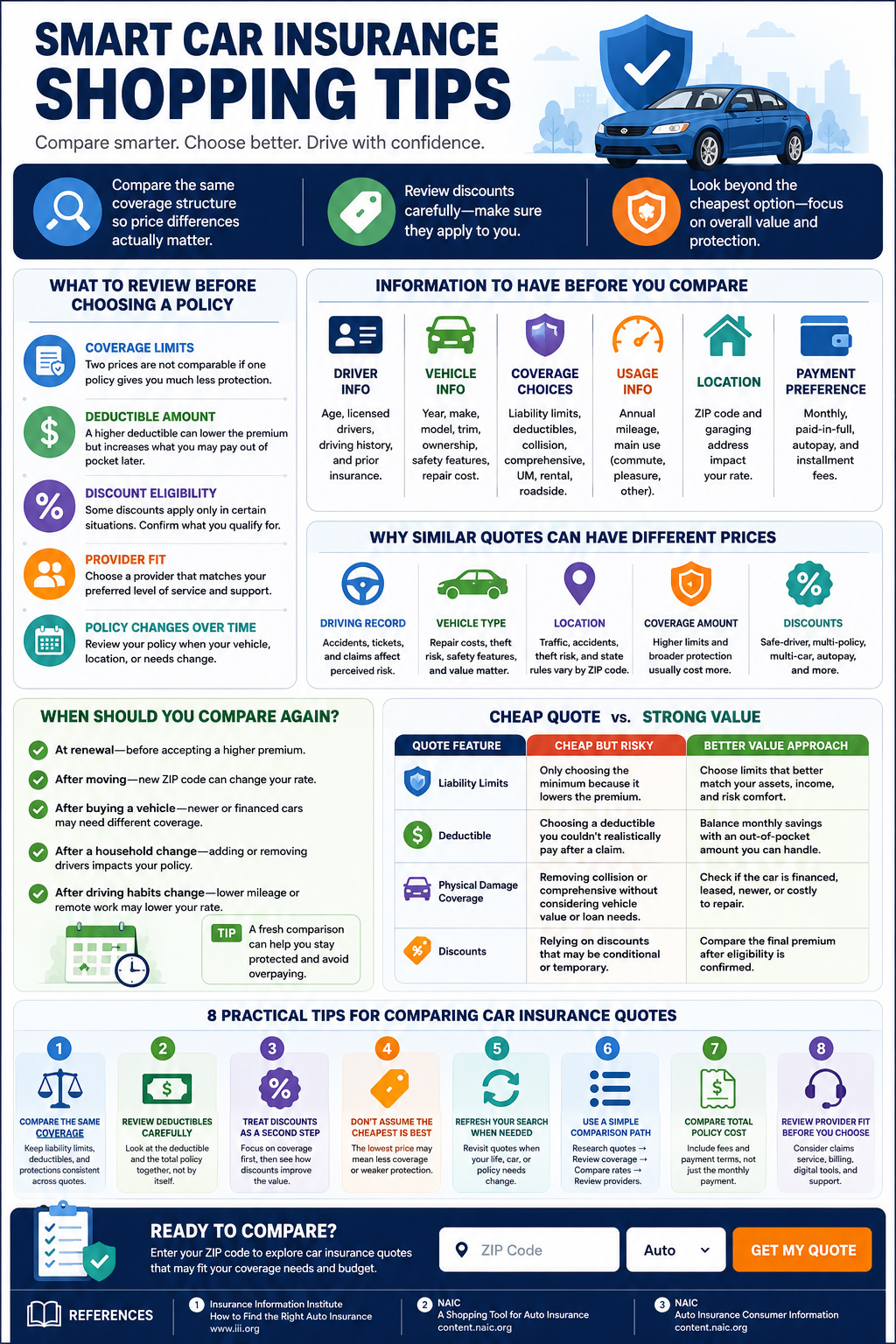
    The infographic below summarizes the most important shopping checks before choosing a policy: what to review before buying, what information to gather before comparing quotes, why rates can differ, when to compare again, and how to avoid choosing a policy that looks cheap but is too thin.

    Infographic with smart car insurance shopping tips, including what to review before choosing a policy, information to gather before comparing quotes, reasons rates can differ, when to compare again, and how to avoid choosing a thin policy.

    How to Avoid Choosing a Policy That Is Too Thin

    A thin policy is not always obvious from the price alone. It may meet state minimum requirements but leave you with low liability limits, no physical damage coverage for your own vehicle, a high deductible, or missing optional protections you assumed were included. This is why a cheap quote deserves a closer review before you treat it as the best option.

    A policy can be a reasonable low-cost choice when the trade-off is intentional. For example, liability-only coverage may make sense for an older car with low market value. A higher deductible may make sense for a driver with enough emergency savings. But those choices should be made knowingly, not because the quote form quietly removed coverage to produce a lower premium.

    Cheap Quote vs. Strong Value

    Quote Feature Cheap But Risky Better Value Approach
    Liability limits Only choosing the minimum because it lowers the premium. Choosing limits that better match your assets, income, and risk comfort.
    Deductible Choosing a deductible you could not realistically pay after a claim. Balancing monthly savings with an out-of-pocket amount you can handle.
    Physical damage coverage Removing collision or comprehensive without considering vehicle value or loan requirements. Checking whether the car is financed, leased, newer, or costly to repair.
    Discounts Relying on discounts that may be conditional or temporary. Comparing the final premium after eligibility is confirmed.

    Car Insurance Shopping Checklist Before You Buy

    1. Compare the Same Coverage Before Comparing the Price

    One of the most common shopping mistakes is comparing quotes that are built differently. If one company shows lower liability limits, a higher deductible, or fewer protections, the lower premium may not represent better value. It may only reflect a weaker policy design.

    The better approach is to keep the main structure as consistent as possible across every quote. That makes it easier to judge whether a company is really more affordable or simply offering less. This is especially important before moving from research into active quote shopping.

    2. Review the Deductible With the Rest of the Quote, Not by Itself

    A deductible can change the monthly premium enough to make one quote look much more attractive than another. That is why it helps to review the deductible and the total policy structure together instead of focusing only on the premium shown on the screen.

    A lower premium can feel appealing at first, but it may come with a deductible that changes how comfortable the policy feels later. A fair comparison should look at both the monthly cost and the policy setup behind it.

    3. Treat Discounts as a Second Step, Not the Main Decision

    Discounts can help, but they should not be the only reason you choose a policy. A quote can advertise multiple savings and still end up being less useful than another option that gives you a better balance of coverage and price.

    The most useful way to review discounts is after you have already checked the main coverage structure. Once the policy basics make sense, then you can decide whether the discounts improve the overall value enough to matter.

    4. Do Not Assume the Cheapest Quote Is the Best Quote

    The lowest number on the page does not always tell the full story. A cheaper quote may reflect different coverage choices, fewer protections, or a policy structure that is not as strong as it first appears. That does not automatically make it a bad option, but it does mean it deserves a closer look.

    A better shopping mindset is to ask whether the quote fits your actual needs, not just whether it is the smallest number available. This helps you avoid buying a policy that looks good at first but feels too thin once you review the details more carefully.

    5. Refresh Your Quote Search When Your Situation Changes

    Car insurance shopping is not something you do once and forget forever. Changes in your location, vehicle, driving profile, or coverage goals can all affect what makes sense for your next comparison. That is why revisiting the process can be useful even if you are not starting from zero.

    A fresh comparison can also help when you move from early research into active shopping. The point is not to check constantly. The point is to revisit your options when the details behind your policy decision have changed in a meaningful way.

    6. Use a Simple Comparison Path Instead of Jumping Around

    Shopping gets easier when you follow a clear order. Start with basic quote research, review the type of coverage you want, compare rates more carefully, and then look at providers with the same policy structure in mind. That flow reduces confusion and helps you avoid judging one part of the process without enough context.

    A simple structure often works best:

    • Start with quote research so you can see realistic pricing paths.
    • Review coverage choices before deciding what “cheap” really means for you.
    • Compare rates with matched deductibles and policy structure.
    • Review providers only after the basic quote setup is clear.

    7. Compare Total Policy Cost, Not Just the Monthly Payment

    Monthly payments are easy to understand, but they do not always show the full cost of the policy. Some policies include installment fees, processing fees, or different payment-plan terms. A quote that looks cheaper monthly may cost more over six months or twelve months once fees are included.

    When possible, compare the total premium for the same policy term. If one quote is monthly and another is paid in full, convert both to the same time period before deciding. This gives you a cleaner view of the real cost.

    8. Review Provider Fit Before Making the Final Choice

    Price and coverage matter, but the provider also matters. Some drivers prefer a digital-first company with fast online tools. Others want local-agent support, more guidance, or a clearer claims process. A policy that saves a small amount each month may not feel like the best value if it is difficult to manage when you need help.

    Before choosing, consider how you want to handle billing, policy changes, document access, claims, and customer support. The best quote is the one that fits both your budget and your service expectations.

    Car Insurance Shopping Checklist Before You Buy

    Before You Buy What to Confirm Why It Matters
    Policy type Confirm whether the quote is liability-only or includes collision and comprehensive coverage. A cheaper quote may simply include less protection for your own vehicle.
    Liability limits Check bodily injury and property damage limits side by side. Minimum limits may satisfy state law but may not match your financial risk comfort.
    Deductible Confirm the deductible for collision and comprehensive coverage. A high deductible can lower the premium but increase out-of-pocket cost after a claim.
    Listed drivers Make sure regular household drivers are handled correctly. Missing driver information can cause quote changes or policy issues later.
    Vehicle details Review year, make, model, trim, VIN, vehicle use, and garaging address. Incorrect vehicle or address details can change the final premium.
    Discounts Check whether discounts are confirmed, estimated, or conditional. Some discounts may depend on proof, bundling, payment method, or eligibility review.
    Total cost Compare six-month or annual cost, not only the monthly payment. Installment fees can make a monthly plan more expensive than it first appears.
    Provider fit Review support style, claims process, online tools, and policy management options. The best quote is not only cheap; it should also be manageable when you need help.
    Ready to Compare?

    Explore Car Insurance Quotes With More Clarity

    Enter your ZIP code to continue comparing car insurance options and review quote paths that may fit your coverage needs and budget.

  • How it Works

    Estimate Guide
    Created: September 2023
    Updated: April 13, 2026

    How Car Insurance Estimates Work

    Car insurance estimates can be useful at different stages of the shopping and claims process, but they do not all mean the same thing. Some estimates help you compare possible policy costs before you buy coverage, while others focus on repair costs after a vehicle has been damaged.

    This page explains how car insurance estimates work in a practical way, what information may affect the number you see, and why the final result can change after a fuller review. If you want to continue your research, you can also visit Insurance Estimates, Instant Quotes, Type of Coverage, Car Insurance Calculator, and FAQ.

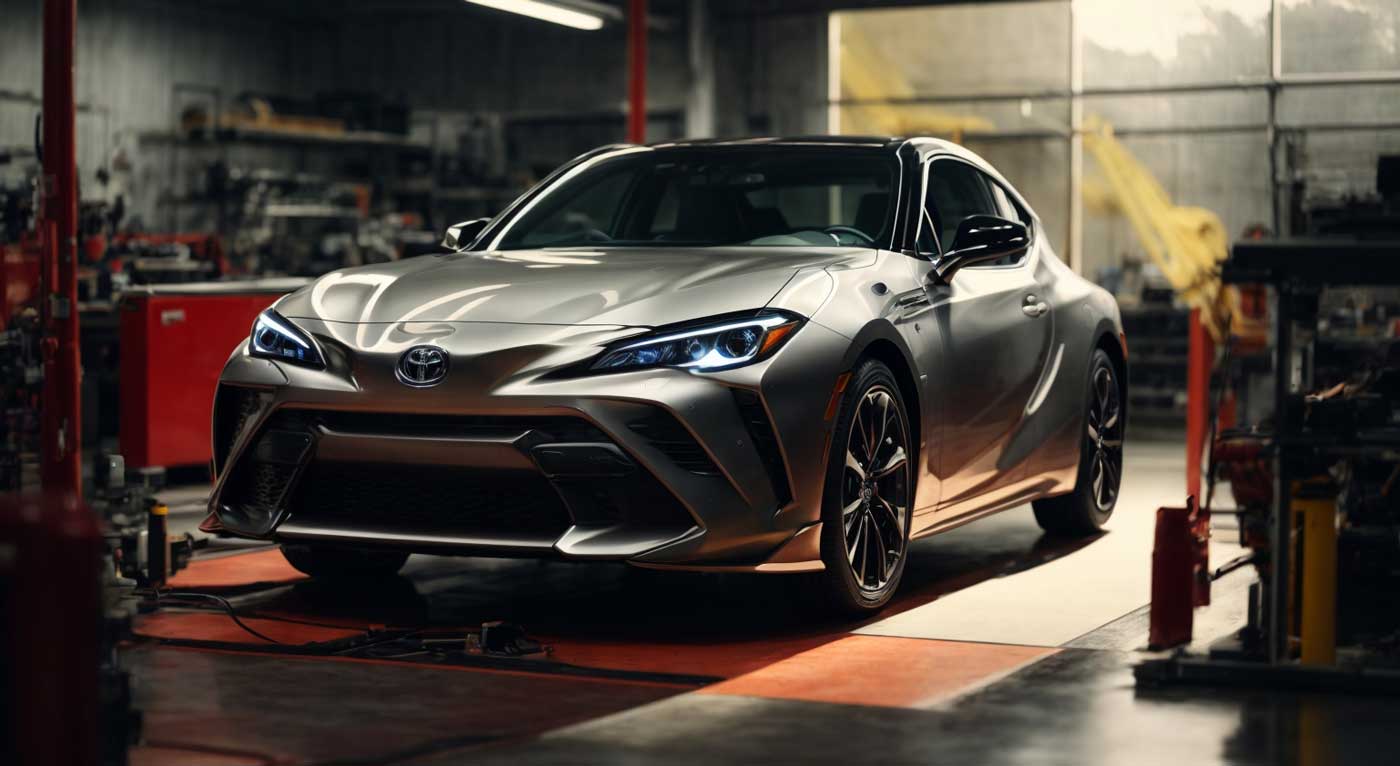
    Car in a garage showing a car repair estimate

    Shopping estimate

    A pre-purchase estimate is usually a planning tool that helps you compare possible policy costs before final underwriting.

    Repair estimate

    A repair estimate focuses on the cost of fixing vehicle damage after an accident or loss, not on your future premium.

    Final review

    The number can change when the insurer reviews more complete information, confirms details, or adjusts the policy structure.

    Estimate vs. quote vs. repair estimate

    Type What it usually means Why it matters
    Car insurance estimate An early price range based on limited or simplified information. Useful for planning and comparing options before you go deeper into the buying process.
    Car insurance quote A more detailed price tied to more specific policy and rating information. Usually gives a stronger basis for comparison, but still depends on the exact policy setup.
    Repair estimate A document that outlines the cost of repairing vehicle damage after a covered event. Helps explain repair pricing and supports the claims review process after a loss.

    How car insurance estimates work in practice

    1. A car insurance estimate is usually a starting point, not a final promise

    Many shoppers first see an estimate before they ever see a final policy offer. That estimate is often based on the basic details entered into a quote tool, such as vehicle type, ZIP code, driver profile, and general coverage preferences. It can be useful because it helps narrow the market and shows what direction the pricing may move.

    The most important thing to remember is that an estimate is usually not the final word. It works best as an educational comparison tool, especially when you are still trying to understand what kind of policy structure you want before making a stronger decision.

    2. The number depends on the information behind it

    Estimates become more useful when the information entered is consistent and realistic. A number based on one deductible, one set of liability limits, and one type of coverage cannot be compared fairly against another estimate built with a very different structure.

    That is why it helps to review the policy setup first. If you want clearer context before you compare prices, pages like Type of Coverage and Car Insurance Basic can help you decide what kind of policy you are actually trying to estimate.

    3. Repair estimates are different from shopping estimates

    The older version of this page mixed premium research and repair-estimate language together, so it helps to separate them clearly. A shopping estimate is about possible policy cost before you buy. A repair estimate is about the cost of fixing damage after an accident or other covered loss.

    A repair estimate typically focuses on visible damage, labour, parts, and the work needed to restore the vehicle. A policy estimate, by contrast, is about expected premium, coverage design, and rating inputs. These are related to insurance, but they serve very different purposes.

    4. The final number can change after deeper review

    Even when an estimate is helpful, it may still change later. That can happen because the insurer reviews more complete details, confirms rating information, or adjusts the policy structure after the shopping process moves forward. It can also happen because the estimate and the final quote were not built with the exact same coverage choices.

    That does not make the early estimate useless. It simply means you should use it as a step in the process rather than as a locked result. A good comparison always looks at the details behind the number, not only at the number itself.

    What can affect an estimate

    Factor Why it can change the estimate
    Coverage limits Higher or lower liability choices can change how strong the policy is and how the price is calculated.
    Deductible level A different deductible can make one estimate look cheaper even when the overall policy may feel less comfortable later.
    Vehicle details Vehicle type, repair profile, and related characteristics can influence the estimate.
    Location Where the vehicle is primarily kept can affect how the estimate is built.
    Shopping path An estimate from a quick tool may differ from a later quote that uses more complete information.

    5. Calculators can help, but they still work best when your inputs are consistent

    Calculator pages can help you organize your comparison and understand possible price ranges, but the same rule still applies: consistency matters. If you change the coverage structure every time you run the numbers, the results become much harder to compare in a useful way.

    That is why calculator tools work best after you already understand the policy direction you want. If you want to continue in that direction, the most relevant next pages are Estimate Car Insurance Calculator and Car Insurance Calculator.

    6. Instant quotes are helpful, but they should still be read carefully

    Instant quote paths can save time and make early comparison easier, especially when you want a faster way to see what the market may look like. But the convenience of speed should not replace careful review. The strongest comparison still depends on matching coverage choices, deductible levels, and the overall policy design.

    In other words, speed is useful, but structure still matters. That is why Instant Quotes can be a strong next step after reading this page, not a replacement for understanding how the estimate itself works.

    7. A good estimate page should help you ask better questions

    The real value of an estimate is not just the number itself. It is the clarity it gives you when you decide what to compare next. A useful estimate should help you ask whether the coverage structure matches your needs, whether the deductible makes sense, and whether the quote path deserves a closer look.

    That kind of clarity is what turns an estimate into a better shopping tool. It helps you avoid rushing toward the cheapest result before you understand what you are actually getting.

    • Check whether the estimate and the later quote use the same coverage choices.
    • Review deductibles before assuming a lower price means better value.
    • Separate policy estimates from repair estimates so the process stays clearer.
    • Use related tools only after you understand the purpose of the estimate you are looking at.
  • Car Insurance Basic

    Car Insurance Estimate Overview
    Created: September 2023
    Updated: May 9, 2026

    Get More Accurate Car Insurance Estimates With Clearer Inputs

    CarInsuranceEstimate.org is designed to help drivers research car insurance estimates, review coverage basics, compare quote paths more carefully, and move through the shopping process with better context. The goal is to help you understand what affects an estimate before you compare prices or choose a provider.

    A car insurance estimate is most useful when the information behind it is realistic and consistent. Your ZIP code, garaging address, vehicle details, mileage, drivers, coverage limits, deductible choices, and discount eligibility can all affect the quote process. A number that appears quickly online may still change when an insurer verifies details or finalizes the policy.

    If you want to go deeper, you can continue to Instant Quotes, Type of Coverage, Rate Comparison, Estimate Car Insurance Calculator, Compare Providers, Provider Reviews, Car Insurance Guide, and FAQ.

    Illustration representing liability coverage as part of car insurance estimate research

    Estimate research

    Start by understanding what an estimate can and cannot tell you before you compare companies too quickly.

    Coverage direction

    Review the policy structure you want first so that your price comparison has better context.

    Better comparison

    Use calculators, rate pages, and provider comparison pages in a clear order instead of mixing everything at once.

    Best Next Page to Visit by Topic

    Topic Best Page to Visit Next Why It Helps
    Fast quote research Instant Quotes Useful when you want to move from general research into active estimate and quote comparison.
    Coverage basics Type of Coverage and Car Insurance Basic Best for understanding what the policy includes before using price as the main decision factor.
    Price analysis Rate Comparison Helpful when you want to understand why one estimate may differ from another.
    Calculator path Estimate Car Insurance Calculator Useful for shoppers who want a more guided, tool-based way to explore pricing.
    Provider comparison Compare Providers and Provider Reviews Helpful after your coverage structure is already clear and you want to compare companies more carefully.
    Questions and definitions FAQ and Car Insurance Guide Useful when you want quick answers before continuing to the next step.

    What Makes a Car Insurance Estimate More Accurate?

    A car insurance estimate becomes more useful when the information behind it is specific, consistent, and realistic. A rough estimate can help with early planning, but the number may change once an insurer reviews more complete details. The goal is not to guess the perfect final premium. The goal is to create a reliable starting point that helps you compare policies more fairly.

    The most important details usually include ZIP code or garaging address, vehicle year, make and model, estimated annual mileage, main vehicle use, household drivers, driving record, coverage limits, deductible preference, and whether the vehicle is financed or leased. If one of those details is missing or entered differently across quote forms, the estimate may become less useful.

    A more accurate estimate also depends on comparing the same policy structure. For example, a liability-only estimate should not be compared directly against a broader policy that includes collision and comprehensive coverage. Those are different products, and the price difference may simply reflect different levels of protection.

    Information That Can Improve Estimate Quality

    Information Why It Matters What to Avoid
    ZIP code or garaging address Location can affect pricing because accident frequency, theft risk, traffic patterns, and state rules vary. Using an old address or a mailing address instead of where the vehicle is usually kept.
    Vehicle details Year, make, model, trim, repair costs, safety features, and theft risk can influence the estimate. Choosing a similar vehicle instead of the exact model or VIN when available.
    Coverage limits Higher limits usually cost more, but they may offer stronger financial protection after a covered accident. Comparing minimum-limit and higher-limit estimates as if they were equal.
    Deductible preference A higher deductible can lower the premium but increase your out-of-pocket cost after certain claims. Choosing a deductible only to lower the monthly price without checking affordability.
    Drivers and mileage Household drivers, commute, vehicle use, and estimated mileage may affect the final quote. Leaving out regular drivers or entering unrealistic mileage.

    Why an Estimate Can Change Later

    A car insurance estimate can change when the insurer receives more complete or verified information. Early estimate tools may use a smaller set of details, while a final quote may include more specific driver, vehicle, garaging, coverage, and discount information.

    Normal reasons for a change include a verified driving record, updated claims history, a corrected vehicle identification number, a different garaging address, added household drivers, changed deductibles, changed liability limits, payment-plan fees, or discounts that do not apply after eligibility is reviewed.

    This does not mean the estimate was useless. It means the estimate should be treated as a planning number. The closer the original information is to the final policy details, the more useful the estimate usually becomes.

    Estimate vs. Quote vs. Final Premium

    Stage What It Means How to Use It
    Estimate An early planning number based on limited or simplified information. Use it to understand possible cost range and compare broad policy directions.
    Quote A more specific price based on detailed driver, vehicle, and coverage information. Use it to compare similar policy structures side by side.
    Final premium The price after the insurer finalizes eligibility, rating, discounts, payment terms, and policy details. Review it before buying and confirm coverage limits, deductibles, fees, and exclusions.

    Common Mistakes That Make Estimates Less Useful

    Many estimates become unreliable because the comparison is not consistent. A driver may use one deductible on one quote form, a different liability limit on another, and a different mileage estimate on a third. The result is a set of numbers that look comparable but are actually based on different assumptions.

    • Comparing different coverage levels: a liability-only estimate is not the same as a policy with collision and comprehensive coverage.
    • Changing deductibles between quotes: a higher deductible can make one estimate look cheaper even when the risk is higher.
    • Ignoring household drivers: regular drivers in the household may need to be listed depending on insurer and state rules.
    • Focusing only on monthly payment: installment fees, policy fees, and total six-month or annual cost may change the real comparison.
    • Assuming discounts are final: some discounts depend on proof, payment method, bundling, telematics participation, or eligibility review.

    How to Use This Site Without Creating Confusing Comparisons

    The best path is to use each page for its own job. Start with coverage basics if you do not know what policy structure you want. Use estimate or calculator pages when you want to organize likely cost ranges. Use rate comparison when you already have numbers to compare. Use provider comparison when the policy structure is clear and you want to evaluate company fit.

    This keeps the shopping process cleaner. Instead of jumping from one price to another, you move through a sequence: understand coverage, estimate cost, compare similar quotes, then choose a provider based on both price and policy fit.

    What This Page Is Meant to Do

    1. Give You a Clean Starting Point

    This page is meant to be a broad, practical introduction to car insurance estimate research. It helps you understand the main research paths available without trying to replace the pages that already explain coverage, estimate tools, provider comparison, or rate differences in more detail.

    That matters because estimate research works best when it has an order. First, understand the basic policy structure. Then estimate possible costs. After that, compare similar quotes and review provider fit.

    2. Help You Move From Estimate Research to Better Comparison

    Many drivers start with a basic estimate because they want a rough sense of what coverage may cost. That is a useful first step, but it is only the beginning. Once you have that early number, the stronger move is to compare the policy structure behind it, not just the price shown on the screen.

    A lower estimate may come from lower liability limits, a higher deductible, missing collision or comprehensive coverage, or discounts that may need confirmation. Looking beyond the first number helps you avoid choosing a policy that looks cheap but does not fit your needs.

    3. Use Each Resource for a Specific Job

    This overview page is most useful when it helps you choose the right next step. Detailed coverage explanations belong on the coverage guide, quote-speed questions belong on instant quote pages, calculator questions belong on calculator pages, and company comparisons belong on provider pages.

    Keeping those jobs separate helps you avoid confusion. It also makes the research process easier: learn the terms first, estimate possible costs next, compare similar quotes after that, and only then evaluate which provider may fit your needs.

    4. Point You Toward the Next Useful Action

    A strong overview page should not trap users in vague content. It should help them continue with the right resource based on what they need next. That may mean moving to an instant quote path, reviewing coverage definitions, using a calculator, or comparing providers after the policy structure is already in place.

    • Use Instant Quotes when you want to start comparing estimate paths.
    • Use Type of Coverage when you need more clarity on what a policy can include.
    • Use Rate Comparison when you want to understand price differences more carefully.
    • Use Compare Providers when you are ready to compare insurers with the same general policy structure in mind.
  • Type of Coverage

    Coverage Guide
    Created: September 2023
    Updated: April 13, 2026

    Types of Car Insurance Coverage: What Each Option May Help Cover

    Understanding car insurance coverage gets easier when you separate the main policy parts instead of trying to compare everything at once. This page is designed to explain the core auto coverage types that many drivers review before comparing quotes more carefully.

    To avoid overlap with the rest of the site, this page stays focused on coverage definitions and practical use. If you want to continue your research after this, you can also visit Car Insurance Basic, Instant Quotes, How Car Insurance Estimates Work, Rate Comparison, Cheap Full Coverage Car Insurance, and FAQ.

    Green car driving in a city representing auto insurance coverage choices

    Required coverage

    Liability coverage is often the starting point because it is the base protection many drivers review first.

    Vehicle protection

    Collision and comprehensive coverage help explain how damage to your own vehicle may be handled.

    Optional add-ons

    UM/UIM, medical coverage, roadside help, or rental reimbursement may matter depending on your situation.

    Main car insurance coverage types at a glance

    Coverage type What it may help cover Why drivers compare it
    Liability coverage Damage or injuries you cause to others, up to policy limits. Often the foundation of a policy and a common legal requirement.
    Collision coverage Damage to your own vehicle after a covered collision. Useful when you want more protection for your own car, not just others.
    Comprehensive coverage Non-collision events such as certain theft, vandalism, weather, or similar risks. Helpful when you want broader vehicle protection beyond crashes.
    UM/UIM coverage Situations involving a driver with too little insurance or no insurance. Important when you want more protection against other drivers’ limits.
    Medical coverage Depending on the policy and state, certain injury-related costs for you or passengers. Useful when reviewing how the policy may respond after an accident.

    How to think about coverage more clearly

    1. Liability coverage is often the first layer to understand

    Liability coverage is usually where many drivers begin because it helps address damage or injuries they may cause to others in a covered accident. It does not mainly exist to repair your own vehicle, which is why people sometimes misunderstand what a basic policy is actually built to do.

    This is also why basic and broader policies can look very different on price. A lower-cost policy may simply reflect a narrower structure rather than better overall value.

    2. Collision and comprehensive serve different purposes

    Drivers often group these together, but they are not the same thing. Collision coverage is usually tied to damage involving a crash, while comprehensive coverage is generally used for certain covered events outside a collision, such as theft or weather-related damage.

    Keeping those roles separate helps you compare policies more carefully. It also helps you understand why two quotes can look very different even when both are described casually as “full coverage.”

    3. UM/UIM coverage can matter more than many shoppers expect

    Uninsured and underinsured motorist protection is one of the most important parts of the conversation for many drivers because it shifts attention away from your own behavior and toward the risk created by someone else’s insurance situation. That can make it an important coverage to review, not just an optional detail you ignore.

    It is especially useful to understand this coverage before comparing companies too quickly, because one policy may handle this area differently from another.

    4. Medical-related coverage deserves its own review

    Medical coverage, including state-specific options like MedPay or PIP where relevant, can affect how a policy supports injury-related costs after an accident. Because rules and policy structure can vary, it helps to treat this as its own review area rather than assuming every auto policy handles it the same way.

    This part of the policy often becomes easier to understand after you already know the difference between basic liability protection and broader vehicle protection.

    This page is intentionally limited to core auto coverage types. It does not go deep into business insurance, homeowners insurance, calculators, or provider-by-provider reviews. That helps keep the intent clean and reduces cannibalization across your site.

    Questions to ask before choosing a coverage mix

    Question Why it helps
    Am I comparing the same liability limits across quotes? Without matching limits, the price comparison becomes much less useful.
    Do I want protection mainly for others, or also for my own vehicle? This helps separate liability-only thinking from broader policy design.
    Would a higher deductible change how comfortable the policy feels? Price can drop, but the tradeoff may matter later.
    Does “full coverage” actually mean the same thing in each quote? It often does not, which is why structure matters more than labels.
    Should I review optional coverages before deciding the quote is complete? That helps avoid missing pieces that may matter for your situation.

    5. Optional coverages can be useful, but they should come after the basics

    Many policies may include or offer additional features such as rental reimbursement, roadside assistance, or similar support options. These can be helpful, but they make the most sense after you already understand the main structure of the policy.

    In other words, it is usually smarter to understand liability, collision, comprehensive, and UM/UIM first. Then you can decide whether the add-ons improve the overall fit enough to matter.

    6. Coverage should be compared before provider branding

    One of the easiest ways to get confused is to compare companies before you decide what kind of policy you actually want. Coverage structure comes first. Company comparison works better after you already know which types of protection matter most to you.

    That is why this page should come before provider review pages in the user journey. It gives the quote comparison more context and helps reduce weak decision-making based only on brand familiarity.

    7. A simple path works better than trying to learn everything at once

    The easiest path is usually to start with the coverage types, then move to quote tools, then compare rate differences, and only after that compare providers more closely. That sequence keeps the research process more organized.

    Get a Quote
    Enter your ZIP code and compare available auto insurance options.

  • Instant Quotes

    Quote Guide
    Created: September 2023
    Updated: May 9, 2026

    Instant Car Insurance Quotes: Compare Fast Without Losing Accuracy

    Instant car insurance quotes can help you move through the shopping process faster, but speed only helps when the comparison stays structured. The goal is not just to see a number quickly. The goal is to review quotes that are built on accurate information, realistic coverage choices, and a useful comparison process.

    A fast quote should be treated as a starting point, not as the final policy price. The premium may change after the insurer reviews more complete information, confirms vehicle details, applies or removes discounts, verifies driving history, or finalizes the coverage structure.

    This page focuses on the instant quote process itself: what to enter, why fast quotes can change, how to compare them fairly, and what to review before buying. If you want to keep researching after this, you can also visit How Car Insurance Estimates Work, Type of Coverage, Car Insurance Calculator, Rate Comparison, Auto Insurance Quote Without SSN, and Compare Providers.

    Driver sitting on a car while researching instant car insurance quotes online

    Fast starting point

    Instant quotes help you move from broad research into active shopping without waiting for a long manual process.

    Accurate inputs matter

    The faster process still depends on the details you enter, so quote quality improves when your information is realistic and complete.

    Comparison still matters

    A quick quote is useful, but it becomes much more valuable when you compare matched policy structure instead of price alone.

    What Instant Quote Pages Should Help You Do

    Step What to Focus On Why It Matters
    Start quote research Enter the basic details needed to begin a realistic comparison. Quick results are more useful when they begin with the right foundation.
    Review coverage choices Check limits, deductibles, and the general policy structure. Two fast quotes are not truly comparable if they were built differently.
    Compare quote paths Look at more than one option instead of relying on a single number. This helps reduce weak decisions based only on the first result you see.
    Finalize carefully Review the quote before treating it like the final answer. An instant quote can still change once the process becomes more detailed.

    What Makes an Instant Quote Different From a Final Premium?

    An instant car insurance quote is usually a fast estimate based on the information entered during the quote process. It can help you compare possible prices quickly, but it is not always the final premium you will pay. The final price may change after the insurer reviews more complete information, confirms eligibility for discounts, verifies the vehicle, checks driving history, or finalizes the exact coverage selections.

    This difference matters because shoppers sometimes treat the first number they see as a guaranteed price. A better approach is to use the instant quote as a starting point, then review the policy details before buying. The most important items to confirm are liability limits, deductibles, collision and comprehensive coverage, uninsured motorist coverage, listed drivers, vehicle information, payment schedule, fees, and discounts.

    Auto insurance prices can be affected by rating factors such as location, driving experience, driving record, claims history, vehicle type, vehicle use, miles driven, chosen coverages, and deductibles. That means even a fast quote can change when more complete or corrected information is reviewed.

    Instant Quote vs. Final Policy Price

    Stage What It Usually Means What to Check
    Instant quote A fast price estimate based on the details entered during the quote flow. Check whether the quote uses the coverage limits, deductibles, and vehicle details you intended.
    More complete quote A more detailed price after additional driver, vehicle, and coverage information is included. Review listed drivers, VIN, garaging address, mileage, coverage options, and discounts.
    Final policy price The price shown after the insurer finalizes eligibility, rating, payment plan, and policy terms. Review declarations, effective date, exclusions, payment schedule, fees, and cancellation rules.

    Why an Instant Quote Can Change After You Continue

    A quote can change for several normal reasons. The vehicle may be identified more precisely after the VIN is entered. The garaging address may affect the price differently than a broad ZIP-code estimate. A driver’s accident, ticket, or claims history may be verified. A discount that appeared during the first step may need eligibility confirmation. The payment plan may also change the total cost if monthly installments include fees.

    This does not mean instant quotes are useless. It means they should be used correctly. Their job is to help you start comparison shopping quickly. Your job is to make sure the details behind each quote are accurate before treating the price as final.

    • Vehicle verification: year, make, model, trim, VIN, safety features, and repair cost can affect pricing.
    • Driver verification: accidents, violations, claims, prior insurance, and household drivers may affect the final quote.
    • Coverage verification: liability limits, deductibles, collision, comprehensive, and uninsured motorist coverage can change the premium.
    • Discount verification: safe-driver, multi-policy, multi-car, paperless, autopay, and paid-in-full discounts may depend on eligibility.

    What to Review Before You Trust the Fastest Quote

    The fastest quote is not always the most useful quote. A very low price can come from lower liability limits, a higher deductible, missing physical damage coverage, or fewer optional protections. Before moving forward, compare the quote summary against what you actually need.

    A practical quote comparison should include more than the monthly premium. Review the total policy cost, coverage limits, deductibles, listed drivers, vehicle information, discounts, and payment terms. If two quotes use different limits or different deductibles, they are not a fair side-by-side comparison.

    • Check whether the quote is liability-only or includes collision and comprehensive coverage.
    • Confirm that the deductible is an amount you could realistically pay after a covered claim.
    • Review whether uninsured or underinsured motorist coverage is included or excluded.
    • Compare total policy cost, not only the monthly payment.
    • Make sure all regular drivers and vehicles are listed correctly.

    Common Instant Quote Mistakes

    Mistake Why It Can Hurt the Comparison Better Approach
    Only comparing the monthly price The lower monthly number may hide higher deductibles, lower limits, or missing coverage. Compare coverage structure, deductible, fees, and total policy cost.
    Entering different details on different quote forms The results may no longer be comparable because each quote is based on different assumptions. Use the same vehicle, drivers, mileage, garaging address, and coverage choices.
    Ignoring payment-plan fees Installment fees can make a monthly plan cost more than it appears at first. Compare the total six-month or annual cost when available.
    Assuming discounts are guaranteed Some discounts may depend on eligibility, proof, bundling, payment method, or driving data. Review the final quote after discounts are confirmed.

    How to Use Instant Quotes More Carefully

    1. Treat Instant Quotes as a Fast Comparison Tool, Not a Final Guarantee

    Instant quotes are useful because they let you see possible pricing paths quickly. That makes them a strong early tool when you want to narrow your options. But a fast quote should usually be treated as a structured starting point rather than as a locked final premium.

    This helps set the right expectation from the beginning. The value of the quote is in how it guides your next decision, not just in how quickly it appears on the screen.

    2. The Best Instant Quotes Still Depend on Accurate Information

    A quote engine can only work with the information it is given. When the vehicle details, ZIP code, driver profile, or recent history are incomplete or inconsistent, the quote may become less useful for comparison. That does not mean the tool failed. It means the input quality affected the result.

    This is why honest and consistent information matters. The more realistic the inputs are, the more useful the comparison becomes.

    3. Instant Quotes Work Better When Your Coverage Direction Is Already Clear

    Many shoppers rush into quote comparison before they know what kind of policy they are trying to build. That can create confusion because one quick quote may reflect a different deductible, different liability limits, or a different protection level than another.

    If your coverage direction is not clear yet, it helps to review that first on Type of Coverage or Car Insurance Basic before deciding which fast quote looks better.

    4. Speed Matters, but Matched Quote Structure Matters More

    A common mistake is to compare two quick quotes without checking whether the underlying policy is actually similar. A lower number may reflect weaker limits, a higher deductible, or fewer protections rather than a truly better overall offer.

    That is why instant quote pages should be used together with review pages, not instead of them. The quote is the start of the comparison, not the whole comparison.

    Instant quotes are most useful when they help you compare realistic policy options quickly. Before buying, always review the quote summary, coverage limits, deductibles, listed drivers, vehicle details, payment schedule, and policy effective date.

    What to Have Ready Before You Start

    Information Why It Helps
    ZIP code Location is one of the basic pieces that shapes early quote direction.
    Vehicle details The quote process works better when the vehicle is identified clearly.
    Coverage goal It helps you avoid comparing a basic policy against a broader one without noticing.
    Recent driving history More realistic history inputs usually lead to a more realistic quote path.
    Deductible preference A different deductible can make one quote look cheaper even when the tradeoff matters later.

    5. Compare More Than One Quote Path Before Moving Forward

    One fast quote can help you start, but a stronger decision usually comes from comparing several paths. That does not mean opening endless tabs with random differences. It means reviewing a small set of more structured options and checking whether they still make sense after you look at coverage and deductibles more carefully.

    If you want the next step after this page, the most useful support pages are Rate Comparison and Compare Providers.

    6. Some Drivers May Need a More Specific Quote Path

    Not every shopper starts from the same place. Some drivers want a faster path because they are shopping without a Social Security number, while others may want a path shaped around age or first-time-driver concerns. In those cases, a more specific support page can make the instant quote process easier to understand.

    7. The Strongest Quote Journey Is Usually Simple

    A clean user journey usually works better than trying to learn everything at once. Start with instant quotes, review the coverage structure behind the results, compare rates more carefully, and only then move into deeper provider comparison if needed.

    Start Your Quote Search

    Enter your ZIP code to begin exploring instant car insurance quote paths with a clearer idea of what to compare next.