
Car insurance shopping guide
Compare Car Insurance Providers Beyond the Advertised Price
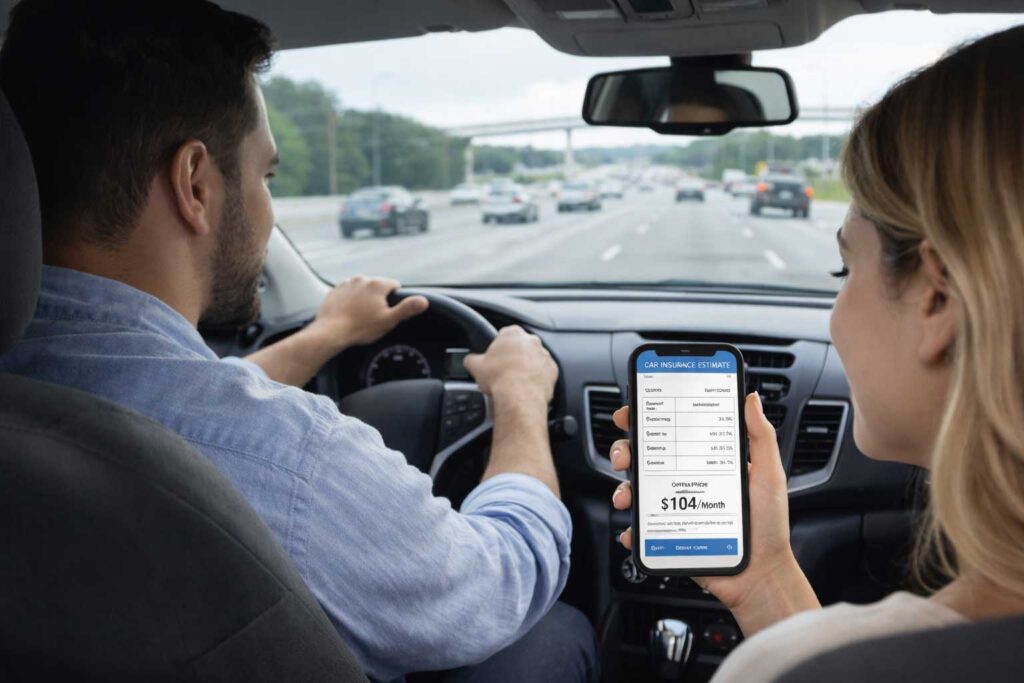
Choosing an auto insurer is not a popularity contest. The useful question is which specific insurance company and policy will cover your drivers and vehicles, in your state, at the limits and deductibles you need. This guide compares documented shopping tools offered by six well-known providers. It does not rank insurers by price, claims satisfaction or financial strength.
Editorial scope: Published by CarInsuranceEstimate.org. Provider features and third-party guidance checked on . This article is general educational information, not a personalized recommendation, insurer quote or coverage guarantee. No independent rate survey or claims-handling test was performed.
How providers were chosen: The six insurers below are illustrative examples with publicly documented shopping, agent, coverage or telematics features. Inclusion is not a ranking, endorsement or exhaustive list. Availability, policy form, underwriting company, state rules and eligibility may vary.
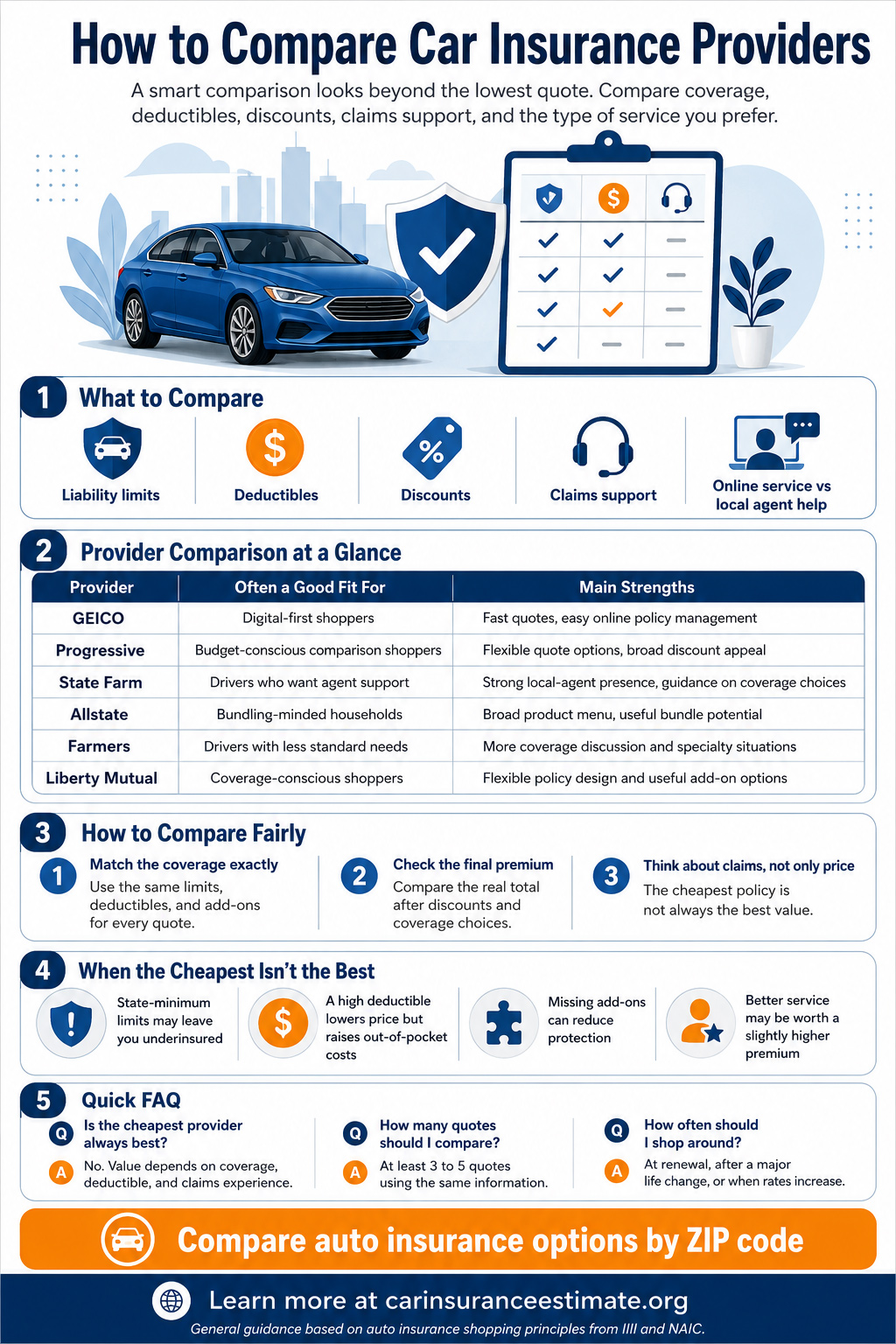
The Insurance Information Institute (Triple-I) recommends obtaining quotes from at least three insurers while matching coverage types and limits. Price also needs to be evaluated with deductible, total policy cost and company information. [1]
Check the licensed company
Identify the actual underwriting company, not just the brand name, and confirm it is authorized in your state.
Use equivalent coverages
Match liability limits, uninsured-motorist selections, physical-damage coverage and deductibles.
Evaluate service evidence
Review state complaint information and the claims-reporting options you would actually use.
Calculate the full term
Compare six- or 12-month premium, installment fees, payment requirements and renewal terms—not just a monthly figure.
Our Comparison Method: What We Verify and What We Do Not Rate
We reviewed published information from each insurer about a specific feature, such as digital account services, an agent locator, optional coverage or a driving-data program. We also relied on the NAIC’s consumer shopping guide and Triple-I’s guidance for the general comparison framework. [1] [2]
| Decision factor | Evidence to check | Common comparison error |
|---|---|---|
| Price | Written quotes with the same drivers, vehicles, limits and term | Comparing a monthly payment with a six-month premium |
| Coverage | Coverage page, declarations or quote breakdown, exclusions and endorsements | Treating “full coverage” as a standardized policy |
| Complaints | NAIC Consumer Insurance Search and state insurance department records | Comparing different subsidiaries or complaint categories |
| Financial condition | Current financial-strength information for the underwriting insurer | Assuming every company under a brand has one rating |
| Service model | Actual agent, app and claims-contact options available to you | Assuming a national feature is offered in every state |
To verify licensing, complaint information and insurer identity, start with the NAIC consumer tools or your state insurance department. NAIC warns that companies operating under the same consumer-facing brand may have different legal subsidiaries. [9]
Six Insurers: Documented Features Worth Comparing
These descriptions identify features the insurers publish themselves. They are not performance scores, and a listed feature may not be included in a particular quote or state.
| Insurance brand | Documented feature | What to verify before choosing |
|---|---|---|
| GEICO | Mobile app can display ID cards, manage a policy and handle claims. [3] | Which functions apply to your actual policy and underwriting company? |
| Progressive | Name Your Price shows coverage options based on a stated budget. [4] | Does the package preserve the liability limits and protection you need? |
| State Farm | Public directory for finding local insurance agents. [5] | Is an agent available locally and which insurers or products can the agent offer? |
| Allstate | Drivewise may adjust pricing based on driving data. [6] | Eligibility, data collected, renewal effect and possible price increases. |
| Farmers | Published optional coverage menu includes roadside, rental and other endorsements. [7] | Which endorsements are sold and what exclusions apply in your state? |
| Liberty Mutual | RightTrack is a driving-data program with state-dependent variations. [8] | Whether participation can increase or decrease applicable premiums. |
Detailed Provider Checks
GEICO: Policy Management and Claims in the Mobile App
Documented: GEICO describes mobile access to ID cards, payments, vehicle changes and claim filing or tracking. [3]
- Potential use: Drivers who want to handle routine transactions on a phone.
- Limitation: An available app does not establish claim quality or lower prices.
- Ask: Can every named driver access proof of insurance and can I contact a person during a disputed claim?
Progressive: Coverage Choices With Name Your Price
Documented: Progressive’s Name Your Price tool displays policy options around a customer-entered budget; Progressive notes that it is not a price-matching tool. [4]
- Potential use: Exploring tradeoffs between a premium target and coverage configuration.
- Limitation: Lower-cost options may provide less protection; availability varies.
- Ask: Did any displayed option reduce limits or exclude collision or comprehensive coverage?
State Farm: Local Agent Search and Policy Support
Documented: State Farm maintains an agent locator, allowing customers to look for local support. [5]
- Potential use: Reviewing complex household coverage with an agent.
- Limitation: The existence of agents does not prove that a quote is cheaper or a claim is handled better.
- Ask: Can this office explain exclusions and offer a written, itemized quote?
Allstate: Drivewise and Driving-Based Pricing
Documented: Allstate says Drivewise uses driving behavior to help determine pricing where available. Its documentation also warns that riskier driving may increase a rate. [6]
- Potential use: Comparing a telematics option with conventional pricing.
- Limitation: Participation involves collecting driving-related data and a possible renewal price change.
- Ask: Which behaviors and drivers are measured, and what happens if I opt out?
Farmers: Optional Coverages and Endorsements
Documented: Farmers describes optional choices including towing, rental reimbursement, certain equipment protections and other coverage options; restrictions vary by state. [7]
- Potential use: Drivers with a financing agreement, rental-car concern or unusual vehicle use.
- Limitation: A listed endorsement is not necessarily offered or suitable for your vehicle or state.
- Ask: What does each endorsement cost, and what exclusions or claim limits apply?
Liberty Mutual: RightTrack and Program Conditions
Documented: Liberty Mutual publishes RightTrack terms explaining its driving-data program and variations in how participation affects premium. [8]
- Potential use: Evaluating usage-based insurance alongside a standard quote.
- Limitation: Different state or enrollment rules can change data collection and premium effects.
- Ask: Which RightTrack program applies to my ZIP and which coverages can change in price?
Example: The Lower Monthly Price May Not Be Comparable
Hypothetical illustration only. The following numbers are invented to demonstrate quote comparison. They are not 2026 averages, advertised offers or actual insurer prices.
| Quote detail | Illustrative Quote A | Illustrative Quote B |
|---|---|---|
| Monthly equivalent | $112 | $95 |
| 12-month equivalent | $1,344 | $1,140 |
| Bodily injury liability | $100,000 / $300,000 | $50,000 / $100,000 |
| Property damage liability | $100,000 | $50,000 |
| Collision deductible | $500 | $1,000 |
| Other coverages and fees | Not specified | Not specified |
For a deeper examination of price differences, see our car insurance rate comparison guide. This page focuses on provider features and evaluating the insurer; that guide focuses on rates and premium comparisons.
Printable Three-Quote Comparison Worksheet
Ask three licensed insurers for written quotes based on exactly the same drivers and vehicles. Record the details below and save the quote documentation. The spaces are intentionally blank; no insurer prices are being estimated here.
| Item to record | Quote 1 | Quote 2 | Quote 3 |
|---|---|---|---|
| Licensed company / policy name | ______________ | ______________ | ______________ |
| Term dates / months | ______________ | ______________ | ______________ |
| Total term premium | $_____________ | $_____________ | $_____________ |
| Payment or installment fees | $_____________ | $_____________ | $_____________ |
| Bodily injury liability limits | ______________ | ______________ | ______________ |
| Property damage liability limit | ______________ | ______________ | ______________ |
| Collision / comprehensive deductible | ______________ | ______________ | ______________ |
| Uninsured / underinsured motorist | ______________ | ______________ | ______________ |
| Rental, roadside and other extras | ______________ | ______________ | ______________ |
| Discount or telematics conditions | ______________ | ______________ | ______________ |
| Claims contacts and complaint checks | ______________ | ______________ | ______________ |
Unsure which coverage line means what? See our guide to types of auto insurance coverage before changing a deductible or limit.
Five Checks Before Accepting a Policy
Confirm the exact insurer
Match the legal underwriting company in your quote to state licensing and complaint records. A brand name may cover multiple subsidiaries.
Request equivalent written quotes
Use the same drivers, vehicles, liability limits, physical-damage coverages and deductibles.
Read endorsements and exclusions
Ask about delivery or rideshare use, rental car needs, excluded drivers and lender requirements where relevant.
Review total cost and renewal conditions
Separate term premium from installment charges and verify whether usage-based discounts can change.
Confirm effective coverage
Do not cancel an existing policy based only on an online estimate. Confirm issue date, effective date and proof of insurance.
Questions Drivers Should Ask About Insurance Providers
How do I check whether an insurance company is licensed?
Find the full legal underwriting company name on the proposed policy, then check your state’s insurance department or NAIC’s consumer search tools. The marketing brand alone may not be precise enough. [9]
Can a complaint index tell me which insurer is best?
No. Complaint information is one input. Confirm the right company, state, insurance line and reporting year; compare it with coverage, price and financial-condition information.
Can driving-data programs increase my premium?
Depending on the insurer, state and program rules, driving data can affect the price at renewal. Review written terms, the behaviors measured and opt-out conditions before enrolling. [6] [8]
Why can a provider’s advertised feature be unavailable in my ZIP code?
Insurance is regulated by state and products are issued by particular underwriting companies. Available features, eligibility, pricing, discounts and endorsements can differ by location.
What should I ask about renewal prices?
Ask which discounts end or change, whether driving-data programs affect renewals, when you will receive a renewal notice, and whether the company can re-quote your policy with unchanged coverage.
Is an online quote proof that I am insured?
No. A displayed estimate or a quote request is not an issued policy. Obtain written confirmation of coverage and its effective date before relying on the insurance.
Decision Checklist
Choose a provider only after you can answer these questions: Who underwrites the policy? Are its limits adequate? What does the complete term cost? What exclusions matter to me? How will I report a claim? Are any discounts conditional?
To browse additional shopping approaches, use our guide to insurance comparison websites. It serves a different purpose from this insurer-feature comparison.
Explore Quotes Through an External Service
Enter your five-digit U.S. ZIP code, then choose one destination. This website does not calculate a binding insurance premium here. You will leave CarInsuranceEstimate.org for the selected third-party quote service, where availability and any additional information requested are governed by that provider.
Only the destination you choose is opened. This page does not open multiple tabs or redirect you to a second site in the background.
References and Verification Sources
- Insurance Information Institute (Triple-I): How to Find the Right Auto Insurance
- NAIC: A Shopping Tool for Auto Insurance
- GEICO: Contact Us by Mobile App
- Progressive: Name Your Price Tool
- State Farm: Find an Agent
- Allstate: Drivewise
- Farmers: Auto Insurance Coverages
- Liberty Mutual: RightTrack
- NAIC: Consumer Insurance Tools (complaints, licenses and financial information)
Source descriptions reflect information checked on October 10, 2026; links, available products and program terms may change.