
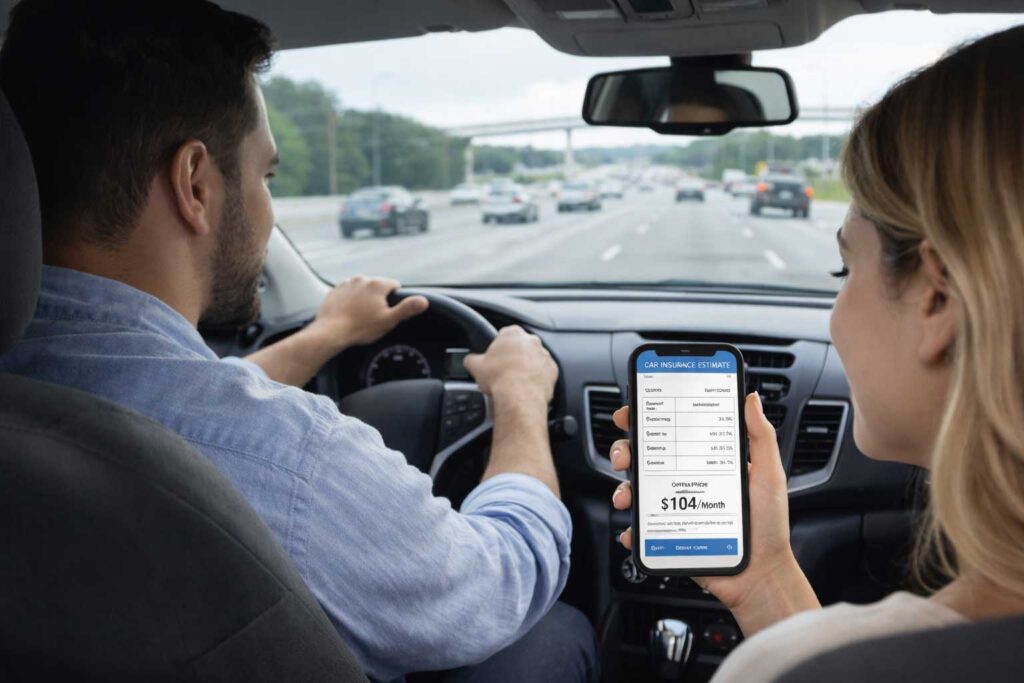
Kentucky Auto Insurance Estimate
Kentucky Car Insurance Calculator
Estimate your potential Kentucky car insurance cost based on your location, driver profile, vehicle, coverage preferences, and driving history.
Estimated Kentucky car insurance cost
$0 – $0 per month
This educational estimate is not a binding insurance quote. Actual rates depend on the insurer, driver, vehicle, location, coverage selections, discounts, underwriting, and policy terms.
By CarInsuranceEstimate.org Editorial Team
Educational information for Kentucky drivers comparing insurance costs, required coverage, no-fault benefits, policy options, and quote estimates.
Created on July 11, 2026
Last updated on July 11, 2026
The Kentucky Car Insurance Calculator above creates educational monthly, six-month, and annual estimates using the ZIP code, driver age, driving record, vehicle details, annual mileage, coverage level, and deductible selected in the form.
Kentucky insurance prices can vary widely because insurers evaluate drivers and vehicles under different rating and underwriting plans. Claims history, traffic violations, household drivers, vehicle use, garaging location, policy limits, optional protection, deductibles, discounts, and payment arrangements may all affect a real quote.
The displayed result is not a guaranteed premium, an insurance offer, or proof that coverage has been issued. CarInsuranceEstimate.org is an independent informational website and is not an insurance company, insurance agency, or Kentucky government agency. You can learn more about our website and editorial purpose before using the estimate.
Kentucky Minimum Car Insurance Requirements
Owners generally may not operate a vehicle in Kentucky until required insurance has been obtained. Kentucky’s minimum split liability limits are commonly shown as 25/50/25. A qualifying $60,000 single-limit liability policy may also satisfy the liability requirement. [1]
Kentucky policies for most private passenger vehicles also include basic reparation benefits, commonly called Personal Injury Protection or PIP. Basic PIP provides up to $10,000 per person per accident unless a valid no-fault rejection changes the coverage arrangement. Motorcycles are treated differently under Kentucky law. [2]
Bodily Injury per Person
This is the minimum amount available for covered bodily injury damages involving one person when an insured driver is legally responsible for an accident.
Bodily Injury per Accident
This is the total minimum bodily injury limit for all people injured in one covered accident, subject to the $25,000 per-person limit.
Property Damage per Accident
Property Damage Liability may pay for qualifying damage an insured driver causes to another person’s vehicle, building, fence, or other property.
Basic PIP per Person
Basic PIP may pay qualifying medical expenses, wage loss, replacement services, and survivor benefits after a covered motor vehicle injury, regardless of fault.
Kentucky Minimum Coverage vs. Full Coverage
A Kentucky minimum policy focuses on required liability protection, basic PIP when applicable, and mandatory-offer coverage such as Uninsured Motorist protection unless properly rejected. Minimum coverage generally does not repair or replace the policyholder’s own vehicle after a collision, theft, flood, fire, or similar loss.
Full coverage is an informal phrase rather than a standardized policy title. It commonly describes a policy that combines liability, collision, and comprehensive coverage with the Kentucky protections that apply to the insured. Limits, deductibles, exclusions, endorsements, and optional benefits still vary by company. [4]
| Coverage category | How the calculator treats it | What to review |
|---|---|---|
| Kentucky minimum | A lower-cost baseline centered on required liability and the state protections normally associated with a compliant personal auto policy. | It generally excludes collision and comprehensive coverage for damage to the insured vehicle. |
| Standard protection | An editorial modeling category using Kentucky’s blended marketplace average as its starting point. | It is not a uniform package sold under that name by every insurer. |
| Full coverage | A modeled policy combining liability, collision, comprehensive, and applicable Kentucky coverages. | Collision typically addresses covered crash damage. Comprehensive typically addresses covered non-collision losses. |
| Higher-limit full coverage | A higher editorial baseline for broader liability and physical-damage protection. | Real policy limits and deductibles should be compared line by line rather than relying on a general label. |
What Affects Car Insurance Costs in Kentucky?
The Kentucky Department of Insurance explains that companies may consider several factors when setting rates, including the type of vehicle, driving history, ages of household drivers, repair costs, accident frequency, theft exposure, local conditions, and insurance scoring information. [5]
Driving Record
Tickets, serious violations, at-fault accidents, and previous claims may change eligibility, rating tier, surcharges, and available discounts.
Driver Age and Experience
Younger or less-experienced drivers may receive higher prices because insurers associate those groups with different expected claim patterns.
Vehicle and Repair Costs
Vehicle value, body style, safety equipment, theft risk, parts availability, technology, and repair expense may influence collision and comprehensive premiums.
Annual Mileage and Use
Commuting distance, annual mileage, business use, delivery activity, and other usage information may change an insurer’s assessment of road exposure.
Garaging Area
Actual insurers may evaluate approved territory information such as traffic density, accident frequency, medical costs, theft, weather, and local repair expenses.
Limits and Deductibles
Higher limits and broader coverage generally increase premiums. Higher physical-damage deductibles may lower premiums while increasing the amount paid after a covered claim.
How the Kentucky Car Insurance Calculator Works
The Kentucky Car Insurance Calculator uses May 2026 marketplace data published by Experian as reference points. Experian reported an average of approximately $178 per month for minimum coverage, $204 per month across the Kentucky policies analyzed, and $267 per month for full coverage. Additional car insurance tools can help drivers compare estimates and coverage choices from different angles. [6]
Choose a Starting Baseline
The model begins at $178 for minimum coverage, $204 for standard protection, $267 for full coverage, or $307 for higher-limit full coverage.
Adjust for the Driver
The selected age range and driving-record category apply simplified editorial multipliers to the chosen coverage baseline.
Adjust for Vehicle and Use
Vehicle year, vehicle type, annual mileage, and deductible apply additional modeled adjustments. The deductible does not change the minimum-coverage result.
Show a Cost Range
The calculator rounds the adjusted amount and displays a range approximately 10% below and 10% above the modeled monthly result, followed by six-month and annual projections.
Ways to Compare Kentucky Car Insurance Costs
A fair quote comparison requires more than checking the monthly payment. Liability limits, PIP elections, uninsured motorist protection, deductibles, exclusions, endorsements, fees, and the total policy cost should be compared on the same basis. Our car insurance blog includes additional educational articles for drivers reviewing policy options.
Match the Coverage Details
Use the same drivers, vehicles, liability limits, PIP arrangement, UM/UIM limits, physical-damage coverage, deductibles, and payment schedule for each quote.
Ask About Available Discounts
Ask whether the price includes multi-policy, multi-vehicle, good-student, safe-driver, anti-theft, vehicle-safety, low-mileage, automatic-payment, or paperless discounts.
Review the Deductible
A higher deductible may reduce collision or comprehensive premiums, but the amount should remain affordable after an unexpected covered loss.
Verify Application Information
Check all drivers, VINs, garaging information, mileage, vehicle use, prior claims, and requested coverages before accepting the quote.
Check Licensing and Complaints
Confirm that the company and producer are authorized in Kentucky and review available consumer information before making a payment.
Revisit the Policy at Renewal
Review listed drivers, vehicles, limits, deductibles, discounts, optional coverage, effective dates, and total premium at every renewal.
How Kentucky Basic PIP Coverage Works
Kentucky requires basic PIP on most motor vehicles other than motorcycles. Benefits are generally paid by the insurer covering the vehicle occupied by the injured person, or the vehicle that struck an injured pedestrian, regardless of fault. [2]
Medical Expenses
Basic PIP may pay qualifying accident-related medical expenses within the available $10,000 per-person benefit.
Lost Wages
Kentucky’s basic benefit includes qualifying wage loss of up to $200 per week, subject to the policy and statutory requirements.
Replacement Services
PIP may cover qualifying replacement-service costs arising from a covered injury when the injured person cannot perform certain usual activities.
Survivor Benefits
The basic benefits can include qualifying survivor benefits after a covered motor vehicle death.
Kentucky No-Fault Rights and Rejection
Kentucky’s Motor Vehicle Reparations Act combines PIP eligibility with limitations on the right to sue and be sued. A person who accepts the no-fault system generally must meet a statutory injury threshold before recovering certain damages from the at-fault party. [2]
Medical-Expense Threshold
One listed threshold is more than $1,000 in medical expenses arising from the motor vehicle injury.
Specified Serious Injuries
A broken bone, permanent disfigurement, permanent injury, or death can also satisfy the statutory threshold.
Written Rejection
An individual may reject the tort limitations using the required written form filed with the Kentucky Department of Insurance before the rejection becomes effective.
Effect on PIP Benefits
A person with an effective no-fault rejection is generally not entitled to basic PIP benefits unless eligible coverage has been purchased back.
Uninsured and Underinsured Motorist Coverage in Kentucky
Uninsured Motorist bodily injury coverage generally appears in a Kentucky auto policy unless the named insured rejects it in writing. It may help when an eligible person is injured by an uninsured driver, a qualifying hit-and-run driver, or a driver whose insurer is insolvent. [3]
Kentucky law separately requires insurers to make Underinsured Motorist coverage available upon request. UIM may help with qualifying uncompensated bodily injury damages when the responsible driver’s liability insurance is insufficient, subject to the policy limits and statutory rules. [7]
Uninsured Driver
UM coverage may respond when the responsible driver has no applicable bodily injury liability insurance.
Hit-and-Run
Certain hit-and-run injuries may qualify, subject to notice, evidence, cooperation, and policy requirements.
Underinsured Driver
UIM may provide additional protection when the responsible driver’s liability coverage is not enough to satisfy qualifying bodily injury damages.
Selection and Rejection
UM and UIM are not interchangeable. Confirm which protection is included, which limits apply, and whether any written rejection or selection has been completed.
Proof of Insurance and Kentucky Registration
Kentucky receives insurance information from companies and monitors vehicles when coverage can no longer be confirmed. If acceptable proof is not submitted by the insurer or the owner within the applicable 90-day period, the vehicle registration may be canceled. [8]
Maintain Continuous Coverage
Keep required insurance active while the vehicle remains registered and operated in Kentucky.
Check the Insurance Card
Verify the insurer, policy number, VIN, covered vehicle, named insured, and effective dates before relying on the document.
Manual Verification May Be Needed
Commercial, military, self-insured, or unconfirmed records may require acceptable documentation to be presented to the county clerk.
Registration Documents
Kentucky registration and renewal transactions may require current proof of Kentucky insurance that satisfies the state’s document requirements. [9]
What Happens If Kentucky Insurance Coverage Lapses?
A Kentucky vehicle owner who fails to maintain required insurance may have the vehicle registration revoked. The owner and driver may also face a fine of $500 to $1,000, up to 90 days in jail, or both, depending on the circumstances and enforcement process. [1]
Do Not Drive During a Lapse
A vehicle should not be operated until qualifying coverage has been obtained and any registration issue has been resolved.
Respond to State Notices
Do not ignore an insurance-verification or registration notice. Follow the instructions and submit accurate proof by the stated deadline.
Correct Data Mismatches
Contact the insurer when the VIN, policy number, vehicle, or effective dates do not match state registration records.
Confirm Reinstatement
Purchasing a new policy does not necessarily restore a canceled or revoked registration automatically. Confirm the required steps with the appropriate county clerk or state agency.
What to Do After a Car Accident in Kentucky
Accident circumstances differ, but useful first steps include protecting people from immediate danger, requesting emergency assistance when necessary, exchanging accurate information, documenting the scene when safe, and notifying the insurer promptly. [5]
Prioritize Safety
Check for injuries, call emergency services when needed, and avoid creating an additional road hazard.
Exchange Information
Collect driver, vehicle, license-plate, insurance, and available witness information without making assumptions about legal fault.
Document Available Evidence
When safe, photograph damage, vehicle positions, the road, traffic controls, weather conditions, debris, and surrounding property.
Preserve Claim Records
Keep claim numbers, medical records, wage documents, estimates, receipts, photographs, repair records, and insurer correspondence.
Kentucky Car Insurance Calculator FAQ
What car insurance is required in Kentucky?
Kentucky generally requires at least $25,000 in Bodily Injury Liability per person, $50,000 per accident, and $25,000 in Property Damage Liability, or an acceptable $60,000 single-limit policy. Basic PIP normally applies to private passenger vehicles other than motorcycles. [1]
Is Kentucky a no-fault state?
Kentucky uses a choice no-fault system. Basic PIP generally applies, but an individual may reject the tort limitations using the required written filing. Rejection can also affect eligibility for basic PIP benefits. [2]
How much basic PIP does Kentucky provide?
Basic PIP provides up to $10,000 per person per accident for qualifying medical expenses, wage loss, replacement services, and survivor benefits. [2]
Does Kentucky minimum insurance cover my own car?
Usually not for physical damage. Collision and comprehensive coverage are generally needed for qualifying damage to the insured vehicle.
Does the ZIP code change the calculator’s Kentucky price?
No. The current tool uses the ZIP code only to validate a supported Kentucky ZIP-prefix range. It does not apply city-, county-, or neighborhood-specific pricing.
Are the calculator prices official Kentucky insurance rates?
No. The $178 minimum, $204 blended average, and $267 full-coverage baselines use May 2026 Experian marketplace data. The $307 higher-limit figure and all adjustment factors are editorial assumptions rather than insurer-filed rates. [6]
Can Kentucky drivers reject Uninsured Motorist coverage?
Yes. Kentucky policies generally include UM bodily injury protection unless the named insured rejects it in a separate writing. [3]
Is Underinsured Motorist coverage the same as UM?
No. UM generally addresses an uninsured or qualifying hit-and-run driver. UIM may address qualifying bodily injury damages when the responsible driver has liability insurance but the available limits are insufficient. Kentucky insurers must make UIM available upon request. [7]
What happens if Kentucky cannot verify my insurance?
The owner may need to provide acceptable proof or have the insurer correct the record. A registration can be canceled if coverage is not confirmed within the applicable 90-day period. [8]
Why is my actual quote different from the estimate?
A real insurer may use detailed household-driver information, exact vehicle data, full claims and violation history, prior coverage, insurance scores, territory information, discounts, fees, and company-specific underwriting rules that the calculator does not evaluate.
References
- Kentucky Transportation Cabinet, Mandatory Insurance. Source ↩
- Kentucky Department of Insurance, No-Fault Rejection and Verification. Source ↩
- Kentucky Department of Insurance, Kentucky No-Fault Information and Rejection Form. Source ↩
- Kentucky Department of Insurance, Consumer Guide to Insurance for Young Adults. Source ↩
- Kentucky Department of Insurance, Auto and Home Insurance Guide. Source ↩
- Experian, Average Cost of Car Insurance in Kentucky for 2026. Source ↩
- Kentucky General Assembly, KRS 304.39-320 — Underinsured Motorist Coverage. Source ↩
- Kentucky Transportation Cabinet, Vehicle Liability Insurance Verification. Source ↩
- Kentucky Transportation Cabinet, Vehicle Registration and Renewals. Source ↩