
An instant car insurance quote can change after verification because the first price is often calculated from information entered during an early quote step, while the later price may reflect additional records, corrected details, confirmed discounts, and finalized coverage selections.
A higher verified price does not automatically mean the insurer made an error. It may mean that the original quote used incomplete information, a different deductible, an unconfirmed discount, a general vehicle description, or assumptions that changed when the insurer reviewed the application more closely.
This guide focuses specifically on identifying what changed between the preliminary quote and the verified offer, how to check the difference, and what to do before purchasing the policy. For a general explanation of fast quote tools, start with our instant car insurance quotes guide.
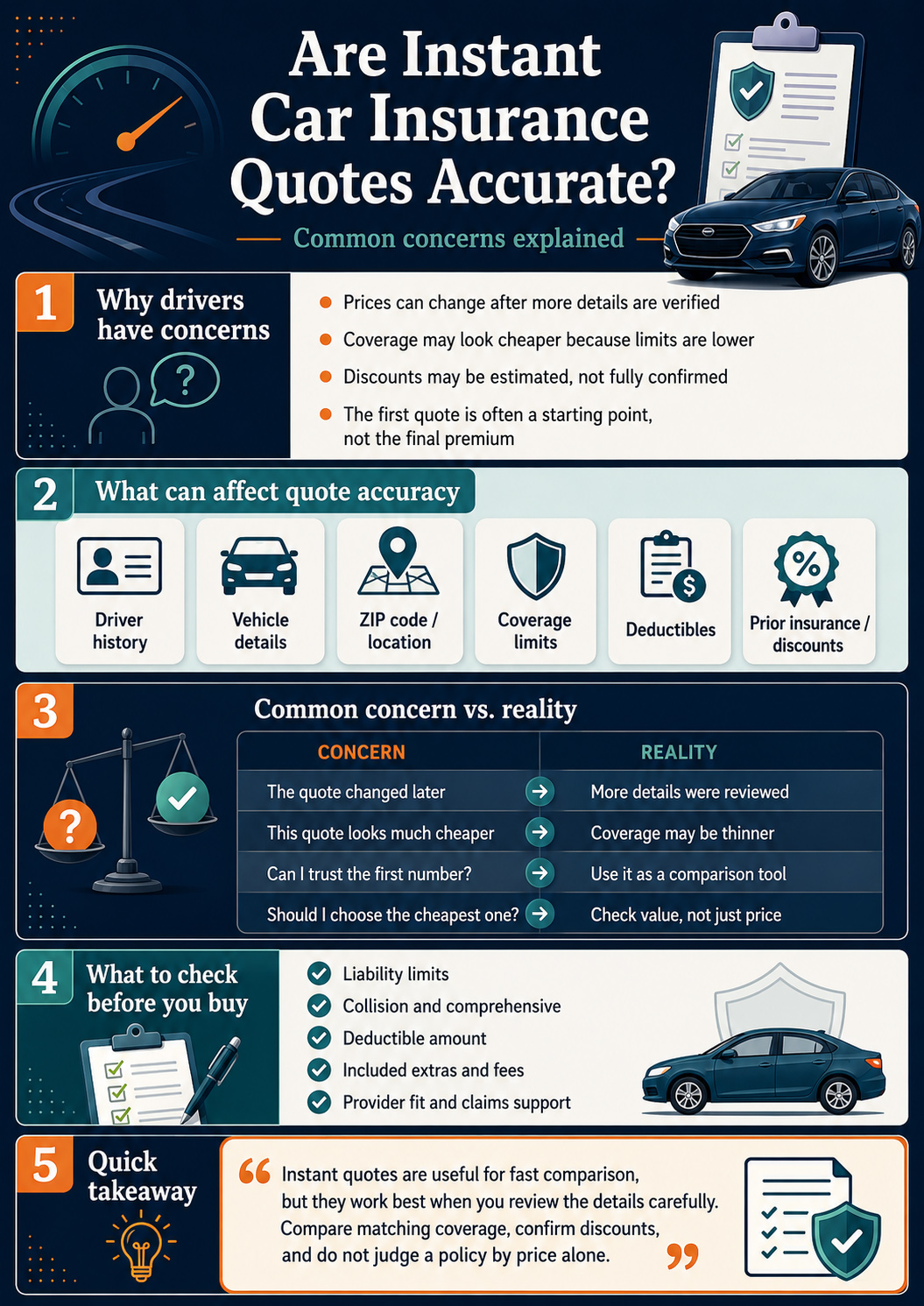
Quick Answer: Why Did the Quote Change?
The most common reason is that the insurer used more complete information during verification than it had during the first quote. The company may confirm driving and claims history, vehicle identification, household drivers, garaging address, annual mileage, prior coverage, eligible discounts, selected limits, deductibles, and payment terms before presenting a bindable offer.
- The first quote was preliminary: it was useful for shopping, but not yet a guaranteed policy price.
- A record differed from the application: a driving incident, claim, vehicle detail, or household driver may have been added or corrected.
- The policy structure changed: different limits, deductibles, optional coverages, or payment plans can materially change the premium.
- A discount was not confirmed: an estimated discount may disappear when eligibility cannot be verified.
- The effective date changed: rates and eligibility can differ depending on when coverage begins.
Preliminary Quote vs. Verified Offer vs. Bound Policy
| Stage | What the Price Represents | What May Still Change |
|---|---|---|
| Preliminary or instant quote | An early estimate based primarily on the information entered and the coverage choices shown during the quote flow. | Driver records, claims history, household information, VIN details, discounts, limits, deductibles, fees, and eligibility. |
| Verified offer | A more developed price after the insurer checks or confirms additional application and rating information. | Final coverage selections, payment plan, effective date, signatures, documents, and any last eligibility requirements. |
| Bound policy | The policy issued after the applicant accepts the terms, completes the required steps, and makes any required initial payment. | Future endorsements, added drivers or vehicles, address changes, payment changes, and renewal pricing. |
1. The Insurer Found a Different Driving Record
Insurers commonly consider driving history when rating auto insurance. During the verification process, the company may obtain information about accidents, violations, license status, or other driving-record details from a third-party source. The NAIC’s consumer shopping tool notes that insurers may obtain driving-record and accident-history information when calculating premiums.[1]
A quote can change when the verified record contains something that was omitted, entered with the wrong date, assigned to the wrong household driver, or treated differently than the shopper expected. Even when the incident was disclosed, the preliminary tool may not have calculated its effect until the insurer matched the record.
What to check
- Whether the incident belongs to you or another household driver.
- Whether the accident or violation date is correct.
- Whether the insurer classified the incident as chargeable.
- Whether an old incident should still be considered under the insurer’s rating rules.
- Whether your license status or years of driving experience were entered correctly.
2. Claims-History Information Changed the Result
Auto insurers may use consumer-report information about prior insurance claims when evaluating or pricing an application. The Consumer Financial Protection Bureau explains that claims exchanges can collect and report auto insurance claims information for use in insurance pricing and underwriting.[2]
A verified quote may therefore differ if a claim was not included in the initial application, was associated with a vehicle or driver in your household, or appeared differently in the reporting system. A claim record does not necessarily mean the final price is correct; it means you should verify whether the reported information is accurate and belongs to you.
What to check
- The date, type, and status of each reported claim.
- Whether you were the policyholder, driver, claimant, or only connected to the vehicle.
- Whether the claim was duplicated.
- Whether a claim belongs to another person with a similar name or prior address.
- Whether the insurer can explain how the record affected the quote.
3. A Household Driver Was Added or Reclassified
A preliminary quote may include only the person completing the form. During verification, the insurer may ask about other licensed people in the household, regular vehicle users, students living away from home, roommates, family members, or drivers who should be listed, excluded, or otherwise addressed under the company’s rules.
The price may rise when an additional driver has less experience, a different driving history, or regular access to the vehicle. It may also change when a person originally listed as an occasional driver is treated as a primary driver.
What to check
- Who is shown as the primary driver for each vehicle.
- Whether every listed driver actually lives in the household.
- Whether someone has moved out or no longer uses the vehicle.
- Whether a driver is duplicated or assigned to the wrong car.
- Whether the insurer requires documentation for an exclusion or separate coverage.
4. The VIN Revealed Different Vehicle Information
Early quote forms sometimes begin with only a vehicle year, make, and model. A VIN lookup can identify the exact trim, body style, engine, safety equipment, ownership status, or other vehicle characteristics. Those details can change repair costs, theft exposure, eligibility, physical-damage pricing, or the coverage the lender requires.
The quote can also change when the vehicle use is corrected. Commuting, business use, delivery activity, rideshare activity, pleasure use, and annual mileage do not necessarily produce the same result.
What to check
- The complete VIN and exact trim level.
- Whether the vehicle is owned, financed, or leased.
- The primary use of the vehicle.
- The estimated annual mileage and commute distance.
- Whether custom equipment or modifications were entered.
5. The Garaging Address or Location Details Changed
Where the vehicle is normally kept can affect the quote. A ZIP code entered for an initial estimate may not be enough to establish the final garaging location. During verification, the insurer may use the complete address and other permitted geographic rating information.
A difference can appear when the mailing address, residential address, and garaging address are not the same, or when the vehicle recently moved. Enter the address where the car is actually kept rather than selecting a different location simply because it produces a lower number.
What to check
- The street address and unit number.
- Where the vehicle is parked most nights.
- Whether the move date and policy effective date are correct.
- Whether the insurer used an old address.
- Whether every vehicle on the policy has the correct garaging location.
6. A Credit-Based Insurance Factor Was Applied Where Permitted
In many states, insurers may use a credit-based insurance score as one factor in underwriting or pricing, subject to state law and insurer practices. A credit-based insurance score is not the same as the consumer credit score commonly used for lending decisions.[3]
The effect is not uniform across the country. Some states restrict or prohibit certain uses, and companies do not all apply the same models. Review the disclosures shown during the quote process instead of assuming that every insurer or state handles credit information in the same way.
What to check
- Whether the insurer says it used consumer-report information.
- Whether you received an adverse-action or pricing notice.
- Which consumer reporting company supplied the information.
- How to obtain and dispute the underlying report if something is inaccurate.
- Whether your state provides special protections or exceptions.
7. An Estimated Discount Was Not Verified
Some preliminary quotes show potential savings before all eligibility conditions are confirmed. The price can increase when the shopper does not qualify for a listed discount or does not complete a required step.
Examples may include multi-policy, multi-car, prior-insurance, continuous-coverage, paid-in-full, automatic-payment, paperless, student, defensive-driving, low-mileage, vehicle-safety, or telematics discounts. Availability and requirements vary widely.
What to check
- Which discounts are included in the verified offer.
- Whether each discount is immediate or conditional.
- Whether documentation is required.
- Whether a telematics discount is only an initial participation discount.
- Whether changing the payment plan removes a discount.
8. The Coverage, Deductible, or Payment Plan Changed
Not every price change comes from a newly discovered record. Sometimes the verified offer simply does not match the structure of the first quote. A higher liability limit, lower collision deductible, lower comprehensive deductible, added uninsured motorist protection, rental reimbursement, roadside assistance, or other optional coverage can increase the premium.
Payment choices matter too. A six-month total, monthly installment, initial payment, installment fee, automatic-payment discount, and paid-in-full discount are different figures. Compare the same measurement before deciding that the price unexpectedly changed.
Use our guide to types of car insurance coverage when the verified offer contains protections or deductibles that are difficult to compare.
Quote Change Troubleshooting Table
| What Changed | Likely Explanation | Best Next Step |
|---|---|---|
| The premium increased after entering a driver’s license number. | The insurer may have matched additional driving-record information. | Review the incidents, dates, drivers, and classifications used. |
| The premium increased after entering the VIN. | The exact trim, vehicle characteristics, ownership status, or use may differ from the initial assumptions. | Confirm the VIN, trim, usage, mileage, financing, and garaging details. |
| A discount disappeared. | Eligibility or documentation may not have been confirmed. | Ask which requirement was not met and whether another discount applies. |
| The monthly amount increased, but the six-month total looks similar. | The payment plan, initial payment, or installment fees may have changed. | Compare total policy cost, down payment, installments, and fees separately. |
| The price increased after adding another household member. | The person may have been added as a rated driver or assigned to a vehicle. | Confirm residence, vehicle access, driver assignment, and available exclusion rules. |
| The insurer referenced a consumer report. | Claims, credit-based insurance information, or another permitted report may have influenced the result. | Read the notice, request the report from the named company, and dispute incorrect information. |
What to Do When the Verified Quote Is Higher
- Save both versions. Keep screenshots or PDFs showing the preliminary price, verified price, limits, deductibles, discounts, vehicles, drivers, effective date, and payment plan.
- Ask what specifically changed. Request a clear explanation instead of asking only why the price went up. Ask whether the difference came from a record, rating factor, discount, coverage, fee, or corrected application detail.
- Compare the same policy structure. Match liability limits, physical-damage deductibles, optional coverages, effective dates, and payment methods. Our car insurance rate comparison guide explains how to compare equivalent offers.
- Correct genuine errors. Do not remove accurate information merely to restore the lower price. Correct only information that is incomplete, outdated, duplicated, or assigned to the wrong person or vehicle.
- Review any consumer-report notice. If a report influenced the decision, the notice should identify the reporting company and explain how to obtain more information. LexisNexis provides a consumer disclosure process for information it maintains under the Fair Credit Reporting Act.[4]
- Request matched quotes elsewhere. Once your information is accurate, compare other insurers using the same coverage selections. Different insurers can evaluate the same profile differently.
How to Review the Quote Line by Line
The declarations or information page of an issued policy normally summarizes important details such as covered vehicles, policy dates, limits, deductibles, premium, discounts, and other policy information. The verified quote should be reviewed with the same level of attention before you buy.[5]
- Drivers: names, dates of birth, license information, status, and vehicle assignments.
- Vehicles: VIN, trim, ownership, annual mileage, use, and garaging address.
- Liability: bodily injury and property damage limits.
- Physical damage: collision and comprehensive deductibles.
- Optional protection: uninsured motorist, medical, rental, roadside, glass, gap, or other listed options.
- Discounts and surcharges: confirmed discounts, conditional discounts, and added charges.
- Payment details: policy term, total premium, initial payment, installment amount, and fees.
- Effective date: the exact date and time coverage begins.
When a Lower Verified Price Can Be Legitimate
Verification does not always make the quote more expensive. The price may decrease when the insurer confirms a clean driving record, continuous prior coverage, lower mileage, an eligible multi-policy discount, qualifying safety equipment, an accurate garaging address, or another favorable detail.
Still compare the coverage carefully. A lower price is useful only when it reflects the protection you intended to buy rather than a higher deductible, lower limit, removed option, or different payment presentation.
What Not to Do to Recover the Original Price
- Do not omit a regular household driver who should be disclosed.
- Do not use an address where the vehicle is not normally garaged.
- Do not reduce annual mileage below a reasonable estimate simply to lower the quote.
- Do not describe commuting, business, delivery, or rideshare use inaccurately.
- Do not compare a minimum-limit policy with a stronger policy and call the first one cheaper coverage.
- Do not purchase before confirming the effective date and whether the policy is actually bound.
Incorrect application information can create eligibility, pricing, cancellation, or claim problems. The safer approach is to correct genuine errors and then compare accurate offers from multiple insurers.
Frequently Asked Questions
Is an instant car insurance quote guaranteed?
No. It is generally a preliminary shopping result unless the insurer clearly states that the price is final and all required information has been verified. Coverage is not active merely because a quote appears on the screen.
Why did my quote increase after entering my driver’s license?
The insurer may have matched driving-record information that was not fully reflected in the preliminary quote. Review the incidents, dates, drivers, and classifications rather than assuming the new result is automatically correct.
Can I dispute information that changed my insurance quote?
You may be able to dispute inaccurate information with the consumer reporting company that supplied it. Read any notice from the insurer, request the underlying report, and follow the reporting company’s dispute procedure.
Does requesting a quote hurt my regular credit score?
Insurance-based credit practices are different from applying for a loan, and the rules vary by state. Review the insurer’s disclosures to understand whether credit-based insurance information is used and what consumer rights apply.
Should I accept a verified quote that is higher than the instant quote?
Accept it only after confirming why it changed, checking that the information is accurate, reviewing the coverage and payment details, and comparing equivalent offers. A higher price may still be competitive, but the explanation should make sense.
Can another company give me a different price using the same information?
Yes. Insurers use different rating plans, eligibility rules, discount structures, and underwriting approaches. Compare offers with the same limits, deductibles, drivers, vehicles, address, and effective date.
Final Review Before You Buy
A changed quote is a signal to review the application, not a reason to panic or immediately abandon the insurer. Identify the exact difference between the initial result and the verified offer, confirm that the records are accurate, and make sure the policy still fits your coverage needs and payment budget.
Once the information is correct, use the Car Insurance Calculator to establish a comparison baseline and review insurer fit through our provider comparison resources. Compare the complete policy rather than relying on the first monthly number shown.
References
- National Association of Insurance Commissioners, A Shopping Tool for Auto Insurance. Source ↩
- Consumer Financial Protection Bureau, LexisNexis C.L.U.E. and Telematics OnDemand. Source ↩
- National Association of Insurance Commissioners, Credit-Based Insurance Scores Aren’t the Same as a Credit Score. Source ↩
- LexisNexis Risk Solutions, Consumer Disclosure Report. Source ↩
- National Association of Insurance Commissioners, Does Your Vehicle Have the Right Protection? Source ↩
Check Quote Options Using Your Verified Details
Enter your ZIP code to continue comparing quote paths after reviewing your drivers, vehicles, coverage selections, and discount information.